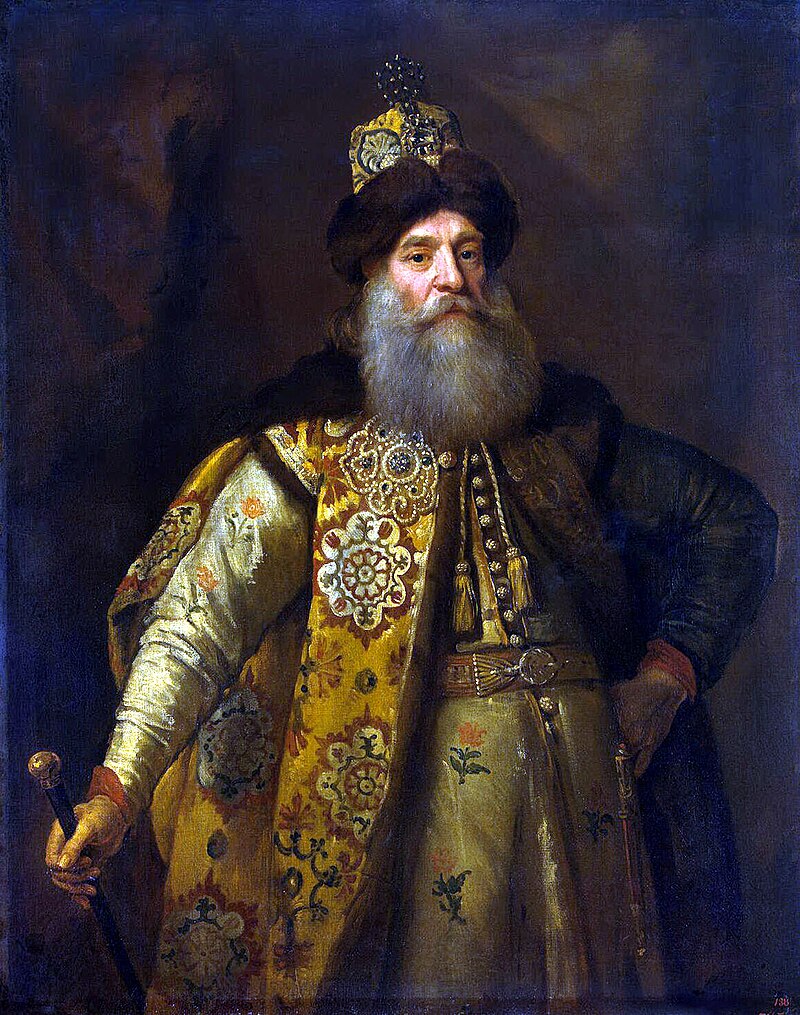
File:Godfrey_Kneller_-_Portrait_of_P.Potemkin_(1682,_Hermitage)_-_contrast.jpg · Wikimedia Commons · See Wikimedia Commons
boyar
Sign in to saveAlso known as boyars
thumb|Portrait of Russian boyar Pyotr Potemkin by [[Godfrey Kneller]] thumb|Russian boyars in the 16th–17th centuries
A boyar was a member of the highest rank of feudal Russian nobility, below the royal family, who held significant landholdings and political power from medieval times through the 17th century. They mattered because they formed the core aristocratic class that wielded influence over Russian territories and governance during this crucial period of the nation's development.
AI-generated from the Wikipedia summary — may contain errors.
Wikidata facts
- Instance of
- noble title
- Country of origin
- First Bulgarian Empire
Show 6 more facts
- Commons category
- Boyars
- described by source
- Granat Encyclopedic Dictionary
- topic's main category
- Category:Boyars
- female form of label
- bojarinja
- on focus list of Wikimedia project
- Wikipedia:Vital articles/Level/4
- start time
- 0901-00-00
Sources (1)
via Wikidata · CC0
~16 min read
Encyclopedic overview
16 sectionsContents
- Etymology
- Bolyars in Bulgaria
- Boyars in Serbia
- Boyars in Rus'
- Tsardom of Russia
- Galicia
- Boyars in Moldavia and Wallachia
- The boyar condition
- Origin
- Hierarchy
- The prince
- Cultural references
- See also
- Notes
- References
- External links
thumb|Portrait of Russian boyar Pyotr Potemkin by [[Godfrey Kneller]] thumb|Russian boyars in the 16th–17th centuries
A boyar or bolyar was a member of the highest rank of the feudal nobility in many Eastern European states, including Bulgaria, Kievan Rus' (and later Russia), Moldavia and Wallachia (and later Romania), Lithuania and among Baltic Germans. Comparable to Dukes/Grand Dukes, Boyars were second only to the ruling princes, grand princes or tsars from the 10th to the 17th centuries.
Excerpted from Wikipedia’s “boyar” article, available under the CC BY-SA 4.0 licence.
Gallery (17)
Available in 58 languages
- Español
- Français
- Deutsch
- 中文
- 日本語
- Русский
- Português
- Italiano
- العربية
- हिन्दी
- Afrikaans
- Asturian
- Azerbaijani
- Bahasa Indonesia
- Bashkir
- Basque
- be_x_old
- Belarusian
Show 39 more
- Breton
- Bulgarian
- Catalan
- Croatian
- Czech
- Danish
- Esperanto
- Estonian
- Finnish
- Galician
- Georgian
- Greek
- Hebrew
- Hungarian
- Latin
- Latvian
- Macedonian
- Nederlands
- Norwegian
- Norwegian Nynorsk
- Occitan
- Polski
- Romanian
- Scots
- Serbian
- Serbian (Latin)
- simple
- Slovak
- Slovenian
- Svenska
- Tiếng Việt
- Türkçe
- Ukrainian
- Uzbek
- Western Frisian
- Wu Chinese
- zh_yue
- فارسی
- 한국어
via Wikidata sitelinks · CC0