
Brassaï
Sign in to saveAlso known as Brassai, Gyula Halász Brassái, Gyula Halász Brassaí, Gyula Halász, Gyuala Halasz, Gyula Halasz Brassai, Gyula Halasz, Brassaï (Gyula Halász)
Brassaï (; pseudonym of Gyula Halász, ; 9 September 1899 – 8 July 1984) was a Hungarian–French photographer, sculptor, medalist, writer, and filmmaker who rose to international fame in France in the 20th century. He was one of the numerous Hungarian artists who flourished in Paris beginning between the world wars.
OverviewAI-generated
Brassaï, born Gyula Halász in 1899 in Brașov, was a Hungarian-French photographer, writer, sculptor, and illustrator. He was educated at the Hungarian University of Fine Arts and spoke Hungarian. His professional work included contributions to erotic art, and he participated in Documenta 6.
He received the Knight of the Legion of Honour and the Chevalier des Arts et des Lettres. His works are held in the collections of the Städel Museum, Museo Nacional Centro de Arte Reina Sofía, Minneapolis Institute of Art, and the Art Institute of Chicago. Archives of his work are located at the Musée Picasso.
Brassaï died in Nice in 1984 and is buried at Montparnasse Cemetery. Notable works include *Lewis Carroll*, *Paroles in l'air*, *Clotilde et Alexandre Sakharoff*, *Quiet days in Clichy*, and *Brassaï présente images de Camera*. A 1968 exhibition of his sculptures was held at Galerie Lucie Weill & Seligmann in Paris.
Synthesized by Vinony from 29 facts across 4 sources: Wikidata, Open Library, Firecrawl, Europeana Sparql. Generated from structured data (not the Wikipedia text) and checked against those facts — may still contain errors.
Person · Open Library
- Born
- 1899
- Died
- 1984
- Works
- 52
Top works
- Lewis Carroll
- Paroles in l'air
- Clotilde et Alexandre Sakharoff
- Quiet days in Clichy
- Brassaï présente images de Camera
via Open Library + Wikidata
Listeners · Last.fm
- Listeners
- 5
- Total plays
- 23
<a href="https://www.last.fm/music/Brassa%C3%AF">Read more on Last.fm</a>
Key facts
- Person.name
- Brassaï
- Person.image
- Brassai-123.jpg
- Person.caption
- Self-portrait
- Person.birth_name
- Gyula Halász
- Person.birth_place
- Brassó, Transylvania, Kingdom of Hungary, Austria-Hungary (today Brașov, Romania)
- Person.death_place
- Beaulieu-sur-Mer, France
- Person.alma_mater
- Hungarian Academy of Fine Arts
- Person.occupation
- Photographer, writer, sculptor and painter
- Person.spouse
- Gilberte-Mercédès Boyer (m. 1948)
via Wikipedia infobox
Described at
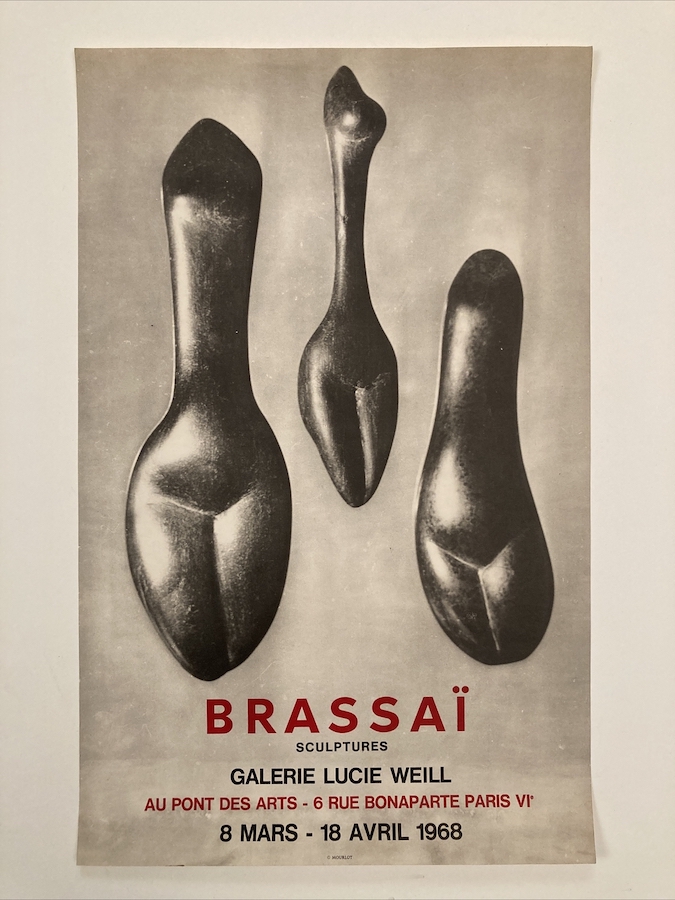
Sculptures — Gyula Halász (Brassaï) | galerie lws
Exposition · Gyula Halász (Brassaï) — 1968 · Galerie Lucie Weill & Seligmann, Paris.
galerielws.com →Link to a page describing this subject · 1,250 chars · not written by Vinony
Wikidata facts
- Instance of
- human
- Given name
- Gyula
- Gender
- male
- Citizenship
- Hungary
- Place of birth
- Brașov
- Place of death
- Nice
- Occupation
- painter
- Educated at
- Hungarian University of Fine Arts
- Languages spoken
- Hungarian
- Field of work
- erotic art
- Image
- Brassai-1681052842.JPG
Show 8 more facts
- place of burial
- Montparnasse Cemetery
- Commons category
- Brassaï
- date of birth
- 1899-09-09
- date of death
- 1984-07-07
- name in native language
- Brassaï
- has works in the collection
- J. Paul Getty Museum
- archives at
- Musée Picasso
- described at URL
- galerielws.com/expositions/sculptures
via Wikidata · CC0
Works in European collections
2 objects attributed to Brassaï, held across European museums, libraries & archives · via Europeana


~8 min read
Encyclopedic overview
9 sectionsContents
- Early life and education
- Career
- Marriage
- Death
- Publications by Brassaï
- Collections
- References
- Further reading
- External links
Brassaï (; pseudonym of Gyula Halász, ; 9 September 1899 – 8 July 1984) was a Hungarian–French photographer, sculptor, medalist, writer, and filmmaker who rose to international fame in France in the 20th century. He was one of the numerous Hungarian artists who flourished in Paris beginning between the world wars.
In the early 21st century, the discovery of more than 200 letters and hundreds of drawings and other items from the period 1940 to 1984 has provided scholars with material for understanding his later life and career.
Excerpted from Wikipedia’s “Brassaï” article, available under the CC BY-SA 4.0 licence.