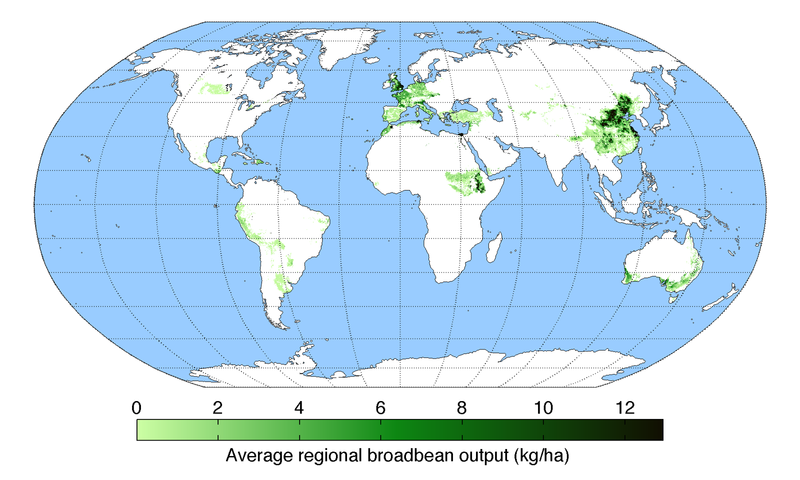
File:Broadbean_Yield.png · Wikimedia Commons · See Wikimedia Commons
broad bean
Sign in to saveAlso known as fava bean, faba bean, field bean, bell bean, tic bean, horse bean, Vicia faba
species of plant, vegetable
OverviewAI-generated
Vicia faba, commonly known as the broad bean, is a species within the genus Vicia of the family Fabaceae. It is classified as a useful and herbaceous plant. The organism serves as a medicinal plant, food, and fodder. It is also recognized as a major pulse crop and is eaten green.
The taxon’s range includes China, specifically the Shanghai, Fujian, and Tibet Autonomous Region regions. Additional descriptions note its presence in Chile Central. The species is referenced by 648 other encyclopedia articles. Scientific literature regarding the broad bean includes 4779 PubMed entries.
Synthesized by Vinony from 24 facts across 5 sources: Wikidata, PubMed, Encyclopedia of Life, Plants of the World, Vinony graph. Generated from structured data (not the Wikipedia text) and checked against those facts — may still contain errors.
Species
Chile Central
via · Kew POWO
Research
4,779 papers- The effect of broad bean diet on structure, flavor and taste of fresh grass carp: A comprehensive study using E-nose, E-tongue, TPA, HS-SPME-GC-MS and LC-MS.Food chemistry · 2024Fu B, Zheng M, Yang H et al.DOI: 10.1016/j.foodchem.2023.137690
- Hybrid RNA sequencing of broad bean wilt virus 2 from faba beans.Microbiology spectrum · 2023Maina S, Norton SL, Rodoni BCDOI: 10.1128/spectrum.02663-23
- Patterns of biogenic amine during broad bean paste fermentation: microbial diversity and functionality via Bacillus bioaugmentation.Journal of the science of food and agriculture · 2023Luo Y, Li D, Liao H et al.DOI: 10.1002/jsfa.12225
- Revealing the formation mechanisms of key flavors in fermented broad bean paste.Food research international (Ottawa, Ont.) · 2024Xiang Y, Zhou B, Jiang C et al.DOI: 10.1016/j.foodres.2023.113880
- Broad Bean-Induced Anaphylaxis: A Case Report.Journal of investigational allergology & clinical immunology · 2016Rodríguez-Mazariego ME, Fuentes Aparicio V, Bartolomé Zavala B et al.DOI: 10.18176/jiaci.0096
- Isolation, identification and characterization of taste peptides from fermented broad bean paste.Food & function · 2022Zhao J, Liao S, Bi X et al.DOI: 10.1039/d2fo01389d
- Vacuum impregnation as a sustainable technology to obtain iron-fortified broad bean (Vicia faba) flours.Food & function · 2023Arnal M, Gallego M, Mora L et al.DOI: 10.1039/d2fo03587a
- A Study and In Vitro Evaluation of the Bioactive Compounds of Broad Bean Sprouts for the Treatment of Parkinson's Syndrome.Molecules (Basel, Switzerland) · 2024Hu D, Qing G, Liu X et al.DOI: 10.3390/molecules29215160
via PubMed
Wikidata facts
- Instance of
- taxon
- Subclass of
- herbaceous plant
- Parent taxon
- Vicia
- Image
- Tuinboon bontbloeiend.jpg
- Has use
- fodder
Show 11 more facts
- taxon name
- Vicia faba
- taxon rank
- species
- Commons category
- Vicia faba
- Commons gallery
- Vicia faba
- taxon common name
- bob
- taxon range
- Guangdong
- on focus list of Wikimedia project
- Wikipedia:Vital articles/Level/4
- water footprint
- 2018
- short name
- V. faba
- taxon author citation
- L.
Sources (8)
via Wikidata · CC0
~28 min read
Encyclopedic overview
Vicia faba, commonly known as the broad bean, fava bean, or faba bean, is a species of vetch, a flowering plant in the pea and bean family Fabaceae. It is widely cultivated as a crop for human consumption, and also as a cover crop. Varieties with smaller, harder seeds that are fed to horses or other animals are called field bean, tic bean or tick bean. This legume is commonly consumed in many national and regional cuisines.
Some people have favism, a hemolytic response to the consumption of broad beans, a condition linked to a metabolic disorder known as G6PDD. Otherwise the beans, with the outer seed coat removed, can be eaten raw or cooked. With young seed pods, the outer seed coat can be eaten, and in very young pods, the entire seed pod can be eaten.
Excerpted from Wikipedia’s “broad bean” article, available under the CC BY-SA 4.0 licence.
Gallery (14)
Available in 96 languages
- Español
- Français
- Deutsch
- 中文
- 日本語
- Русский
- Português
- Italiano
- العربية
- हिन्दी
- Albanian
- Amharic
- Aragonese
- Armenian
- Asturian
- Aymara
- azb
- Azerbaijani
Show 77 more
- Bahasa Indonesia
- Basque
- bat_smg
- Belarusian
- Bosnian
- Bulgarian
- Catalan
- Cebuano
- Chuvash
- Corsican
- Croatian
- Czech
- Danish
- Egyptian Arabic
- Esperanto
- Estonian
- Finnish
- Galician
- Georgian
- Greek
- Hebrew
- Hungarian
- Icelandic
- Ido
- Irish
- Kashubian
- Kazakh
- Kurdish
- Latin
- Latvian
- lbe
- Ligurian
- Lithuanian
- lld
- Macedonian
- Malay
- Malayalam
- Mazanderani
- Mongolian
- nah
- nds_nl
- Nederlands
- Nepali
- Northern Frisian
- Norwegian
- Norwegian Nynorsk
- Occitan
- Ossetic
- Polski
- Quechua
- Romanian
- Sanskrit
- Sardinian
- Serbian
- Serbian (Latin)
- Sicilian
- Silesian
- simple
- Slovenian
- Svenska
- Swahili
- Tajik
- Tamil
- Tiếng Việt
- Türkçe
- Ukrainian
- Upper Sorbian
- Uzbek
- Walloon
- Waray
- Welsh
- Western Mari
- Wu Chinese
- zh_yue
- فارسی
- ไทย
- 한국어
via Wikidata sitelinks · CC0