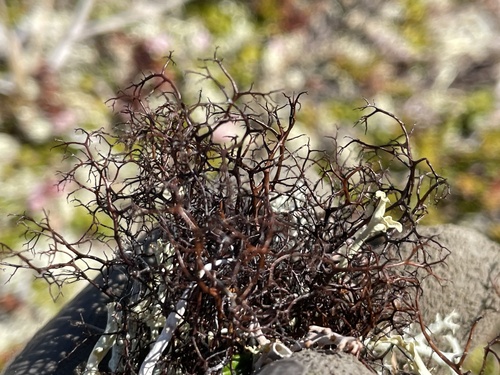
(c) tundra-leprechaun, some rights reserved (CC BY-NC) · cc-by-nc
Bryocaulon
Sign in to saveBryocaulon is a small genus of lichen-forming fungi in the family Parmeliaceae. The genus has a widespread distribution in north temperate regions, and contains four species. These lichens form shrub-like tufts with cylindrical branches that are covered in tiny white pores for gas exchange. They are found mainly in cold regions of the Northern Hemisphere, particularly in arctic and mountainous areas where they grow on acidic bark and rocks.
In the Vinony graph
Vinony's link graph records 5 inbound references to Bryocaulon, and connects out to fungi, Index Fungorum and International Standard Book Number.
It is catalogued under topics including Lecanorales genera, Lichen genera and Parmeliaceae.
Vinony links it to 7 Wikipedia language editions.
Species
Heath Foxhair Lichen
GENUS
- KingdomFungi
- PhylumAscomycota
- ClassLecanoromycetes
- OrderLecanorales
- FamilyParmeliaceae
via GBIF
Museum specimens
- Specimen records
- 19
- With media
- 10
- Family
- Parmeliaceae
- Collections
- NHMUK, PH, F, UPS, LD, MIL
- Recorded in
- Japan, Canada, United States, Chile, Russian Federation, Russia
Wikidata facts
- Instance of
- taxon
- Parent taxon
- Parmeliaceae
- Image
- Bryocaulon divergens-1.jpg
Show 5 more facts
- taxon name
- Bryocaulon
- taxon rank
- genus
- taxonomic type
- Bryocaulon divergens
- taxon common name
- シダレキノリ属
- Commons category
- Bryocaulon
Sources (1)
via Wikidata · CC0
~3 min read
Encyclopedic overview
5 sectionsContents
- Taxonomy
- Description
- Habitat and distribution
- Species
- References
Bryocaulon is a small genus of lichen-forming fungi in the family Parmeliaceae. The genus has a widespread distribution in north temperate regions, and contains four species. These lichens form shrub-like tufts with cylindrical branches that are covered in tiny white pores for gas exchange. They are found mainly in cold regions of the Northern Hemisphere, particularly in arctic and mountainous areas where they grow on acidic bark and rocks.
==Taxonomy==
Excerpted from Wikipedia’s “Bryocaulon” article, available under the CC BY-SA 4.0 licence.