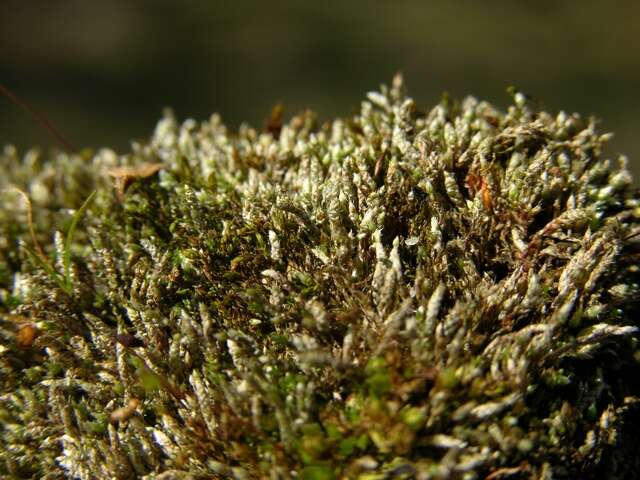
Encyclopedia of Life · EOL (see source)
Bryum
Sign in to saveBryum is a genus of mosses in the family Bryaceae. It was considered the largest genus of mosses, in terms of the number of species (over 1000), until it was split into three separate genera in a 2005 publication. As of 2013, the classification of both Bryum and the family Bryaceae to which it belongs underwent significant changes based on DNA studies.
Species
bryummossor
GENUS
- KingdomPlantae
- PhylumBryophyta
- ClassBryopsida
- OrderBryales
- FamilyBryaceae
Die Birnmoose (Bryum) sind mit ungefähr 1000 Arten eine der größten Gattungen der Laubmoose. Inhaltsverzeichnis 1 Beschreibung 2 Verbreitung und Standortansprüche 3 Systematik und europäische Arten 3.1 Verbreitete mitteleuropäische Arten 3.2 Liste europäischer Arten 4 Quellen und weiterführende Informationen 4.1 Literatur 4.2 Weblinks Beschreibung Es handelt sich um zumeist kleine, aufrecht bis aufsteigende wachsende Moose, die nur wenig verzweigt sind. Die Moose sind lebhaft grün, oft auch deutlich rötlich gefärbt, bei Bryum argenteum auch silbrig. Die Blätter sind bei allen Arten lanzettlich, bei einigen Arten allerdings vorne etwas verbreitert. Die Mittelrippe der Blätter ist kräftig und reicht bis in die Blattspitze. Bei vielen Arten tritt sie auch als kurze, grüne, rötliche oder auch farblose Stachelspitze aus. Die Zellen der Blattspreite sind rhombisch bis sechseckig, aber fast immer länger als breit. Lediglich am stets ganzrandigen Blattrand besitzen die meisten Arten einen Saum aus stark verlängerten Zellen. Die Kapsel steht hängend oder nickend auf der Seta und ist von der Form her meist birnförmig – daher der deutsche Name der Gattung – bis zylindrisch. Oft haben die Kaps
via GBIF
Museum specimens
- Specimen records
- 14,864
- With media
- 5,614
- Family
- Bryaceae
- Collections
- IBUNAM, SNM, FCN-UAQ, US, YPM, TENN
- Recorded in
- Mexico, United States, India, Canada
Wikidata facts
Show 5 more facts
- taxon rank
- genus
- taxon name
- Bryum
- Commons category
- Bryum
- topic's main category
- Category:Bryum
- taxon common name
- 真藓属
Sources (3)
via Wikidata · CC0
~1 min read
Encyclopedic overview
3 sectionsContents
- Description
- History
- References
Bryum is a genus of mosses in the family Bryaceae. It was considered the largest genus of mosses, in terms of the number of species (over 1000), until it was split into three separate genera in a 2005 publication. As of 2013, the classification of both Bryum and the family Bryaceae to which it belongs underwent significant changes based on DNA studies.
==Description== Bryum is a polyphyletic genus that has high morphological variation. Bryum species generally have shorter laminal cells with short, thick, and rounded stems. All Bryum species exhibit narrowed cells at the margins. Bryum species can be identified through patterns of asexual reproduction, coloration features of the stem and leaf base, and the strength of the leaf border.
Excerpted from Wikipedia’s “Bryum” article, available under the CC BY-SA 4.0 licence.
Gallery (2)
Available in 22 languages
- Français
- Deutsch
- 中文
- Italiano
- العربية
- Armenian
- Bahasa Indonesia
- Belarusian
- Catalan
- Cebuano
- Danish
- Egyptian Arabic
- Estonian
- Finnish
- Icelandic
- Lithuanian
- Nederlands
- Polski
Show 3 more
via Wikidata sitelinks · CC0