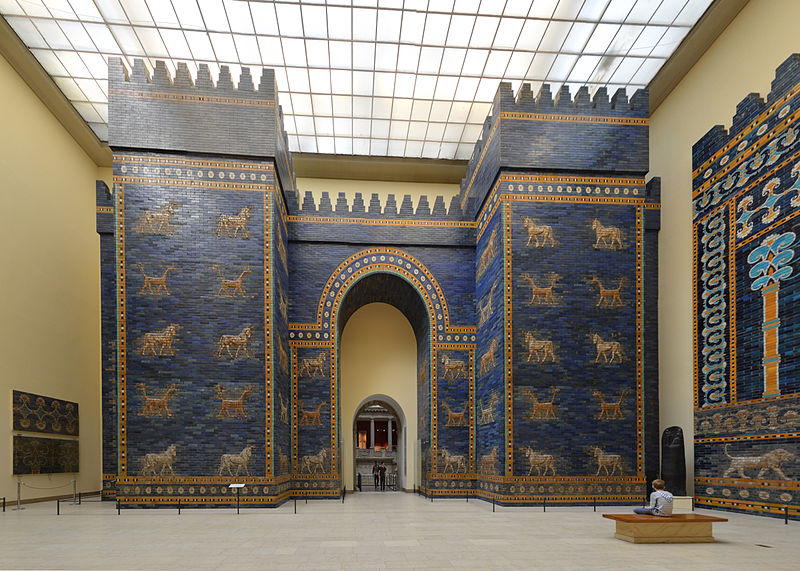
File:Ishtar_gate_in_Pergamon_museum_in_Berlin..jpg · Wikimedia Commons · See Wikimedia Commons
building
Sign in to saveAlso known as edifice, buildings
A building or edifice is an enclosed structure with a roof, walls and often windows, usually standing permanently in one place, such as a house or factory. Buildings come in a variety of sizes, shapes, and functions, and have been adapted throughout history for numerous factors, from building materials available, to weather conditions, land prices, ground conditions, specific uses, prestige, and aesthetic reasons. To better understand the concept, see Nonbuilding structure for contrast. thumb|right| A historical building in Tabriz, [[Iran]] Buildings serve several societal needs – occupancy,
A building is a permanent enclosed structure with a roof and walls that serves various purposes, from homes to factories, and its design is shaped by factors like available materials, climate, land costs, and intended use. Buildings are important because they serve fundamental societal needs, including providing spaces for people to live and work.
AI-generated from the Wikipedia summary — may contain errors.
Described at
Link to a page describing this subject · 13,670 chars · not written by Vinony
Wikidata facts
- Image
- Lutheran Cathedral Helsinki.jpg
Show 8 more facts
- OpenStreetMap tag
- building=yes
- Commons category
- Buildings
- equivalent class
- dbpedia.org/ontology/Building
- described at URL
- www.whosonfirst.org/docs/placetypes/#building
- NCI Thesaurus ID
- C80231
- exact match
- purl.obolibrary.org/obo/ENVO_00000073
- name in kana
- けんちくぶつ
- sRGB color hex triplet
- 708090
via Wikidata · CC0
~10 min read
Article
19 sectionsContents
- Definition
- History
- Types
- Residential
- Commercial
- Industrial
- Agricultural
- Mixed use
- Complex
- Creation
- Ownership and funding
- Environmental impacts
- Building services
- Physical plant
- Conveying systems
- Building damage
- See also
- References
- External links
A building or edifice is an enclosed structure with a roof, walls and often windows, usually standing permanently in one place, such as a house or factory. Buildings come in a variety of sizes, shapes, and functions, and have been adapted throughout history for numerous factors, from building materials available, to weather conditions, land prices, ground conditions, specific uses, prestige, and aesthetic reasons. To better understand the concept, see Nonbuilding structure for contrast. thumb|right| A historical building in Tabriz, [[Iran]] Buildings serve several societal needs – occupancy, primarily as shelter from weather, security, living space, privacy, to store belongings, and to comfortably live and work. A building as a shelter represents a physical separation of the human habitat (a place of comfort and safety) from the outside (a place that may be harsh and harmful at times).
Buildings have been objects or canvasses of much artistic expression. In recent years, interest in sustainable planning and building practices has become an intentional part of the design process of many new buildings and other structures, usually green buildings.
Gallery (32)
Available in 116 languages
- Español
- Français
- Deutsch
- 中文
- 日本語
- Русский
- Português
- Italiano
- العربية
- हिन्दी
- Afrikaans
- Akan
- Albanian
- Albanian
- Aragonese
- Aramaic
- Asturian
- azb
Show 97 more
- Azerbaijani
- Bahasa Indonesia
- Bangla
- Basque
- be_x_old
- Belarusian
- Bikol
- Bosnian
- Breton
- Bulgarian
- Catalan
- Central Kurdish
- Chuvash
- Croatian
- Czech
- Danish
- Esperanto
- Estonian
- Extremaduran
- Fijian
- Filipino
- Finnish
- Galician
- Georgian
- Greek
- Guarani
- Hebrew
- Hungarian
- Iban
- Icelandic
- Ido
- Interlingua
- Irish
- Javanese
- Kannada
- Kurdish
- Latgalian
- Latin
- Latvian
- Limburgish
- Lithuanian
- Lojban
- Luxembourgish
- Macedonian
- Malay
- Manipuri
- Marathi
- Minangkabau
- Mongolian
- nah
- nds_nl
- Nederlands
- Nepali
- Newari
- Norwegian
- Norwegian Nynorsk
- Pashto
- Polski
- Punjabi
- Quechua
- roa_rup
- Romanian
- Rusyn
- Santali
- Scots
- Serbian
- Serbian (Latin)
- simple
- Sindhi
- Slovak
- Slovenian
- Somali
- Svenska
- Swahili
- Tajik
- Tamil
- Telugu
- Tiếng Việt
- Toki Pona
- Tumbuka
- Türkçe
- Ukrainian
- Urdu
- Uzbek
- Volapük
- Waray
- Welsh
- Western Frisian
- Western Panjabi
- Wu Chinese
- Yakut
- zh_min_nan
- zh_yue
- Zulu
- فارسی
- ไทย
- 한국어
via Wikidata sitelinks · CC0