File:Burebista_cropped.png · Wikimedia Commons · See Wikimedia Commons
Burebista
Sign in to saveBurebista () was the king of the Getae and Dacian tribes from 82/61BC to 45/44BC. He was the first king who successfully unified the tribes of the Dacian kingdom, which comprised the area located between the Danube, Tisza, and Dniester rivers, and modern day Romania and Moldova. In the 7th and 6thcenturies BC it became home to the Thracian peoples, including the Getae and the Dacians. From the 4thcentury to the middle of the 2ndcentury BC the Dacian peoples were influenced by La Tène Celts who brought new technologies with them into Dacia. Sometime in the 2ndcentury BC, the Dacians expelled th
Listeners · Last.fm
- Listeners
- 6
- Total plays
- 9
<a href="https://www.last.fm/music/Burebista">Read more on Last.fm</a>
Key facts
- Royalty.name
- Burebista
- Royalty.image
- File:Burebista cropped.png
- Royalty.caption
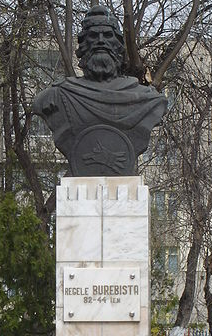
- Statue of Burebista located in Călărași
- Royalty.succession
- Dacian king
- Royalty.reign
- 82/61–45/44 BC
- Royalty.successor
- Deceneu
- Royalty.death_date
- 45/44 BC
via Wikipedia infobox
~17 min read
Encyclopedic overview
16 sectionsContents
- Early references
- Dacian kingdom
- Reign of Burebista
- Date of ascension
- Development of Burebista's polity
- Conquests and external policy
- Neighbouring tribes
- Capture of Greek cities
- Caesar's civil war
- Death
- Dacia after Burebista
- Legacy
- See also
- Notes
- References
- External links
Burebista () was the king of the Getae and Dacian tribes from 82/61BC to 45/44BC. He was the first king who successfully unified the tribes of the Dacian kingdom, which comprised the area located between the Danube, Tisza, and Dniester rivers, and modern day Romania and Moldova. In the 7th and 6thcenturies BC it became home to the Thracian peoples, including the Getae and the Dacians. From the 4thcentury to the middle of the 2ndcentury BC the Dacian peoples were influenced by La Tène Celts who brought new technologies with them into Dacia. Sometime in the 2ndcentury BC, the Dacians expelled the Celts from their lands. Dacians often warred with neighbouring tribes, but the relative isolation of the Dacian peoples in the Carpathian Mountains allowed them to survive and even to thrive. By the 1stcentury BC the Dacians had become the dominant power.
From 61 BC onwards Burebista pursued a series of conquests that expanded the Dacian kingdom. The tribes of the Boii and Taurisci were destroyed early in his campaigns, followed by the conquest of the Bastarnae and probably the Scordisci peoples. He led raids throughout Thrace, Macedonia, and Illyria. From 55BC the Greek cities on the west coast of the Black Sea were conquered one after another. These campaigns inevitably culminated in conflict with Rome in 48BC, at which point Burebista gave his support to Pompey. This in turn made him an enemy to Julius Caesar, who decided to start a campaign against Dacia. This plan fell through in 44BC when Caesar was assassinated. Burebista himself was assassinated in a plot by the Dacian aristocracy at around the same time.
Excerpted from Wikipedia’s “Burebista” article, available under the CC BY-SA 4.0 licence.