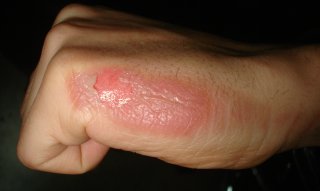
File:Hand2ndburn.jpg · Wikimedia Commons · See Wikimedia Commons
I don't see any context provided in your message. Could you please share the context about "burn" that you'd like me to base the overview on? Once you provide it, I'll write the 2-sentence overview for a general reader.
AI-generated from the Wikipedia summary — may contain errors.
Key facts
- Medical condition.name
- Burn
- Medical condition.image
- Hand2ndburn.jpg
- Medical condition.caption
- Second-degree burn of the hand
- Medical condition.field
- Dermatology, critical care medicine, plastic surgery
- Medical condition.symptoms
- First degree: Red without blistersSecond degree: Blisters and painThird degree: Area stiff and not painful Fourth degree: Bone and tendon loss
- Medical condition.complications
- Infection
- Medical condition.duration
- Days to weeks
- Medical condition.types
- First degree, second degree, third degree, fourth degree
- Medical condition.causes
- Heat, cold, electricity, chemicals, friction, radiation
- Medical condition.risks
- Open cooking fires, unsafe cooking stoves, smoking, alcoholism, dangerous work environment
- Medical condition.treatment
- Depends on the severity
- Medical condition.medication
- Pain medication, intravenous fluids, tetanus toxoid
- Medical condition.frequency
- 67 million (2015)
- Medical condition.deaths
- 176,000 (2015)
via Wikipedia infobox
Research
156,666 papers- Assessment and Management of Acute Burn Injuries.Physical medicine and rehabilitation clinics of North America · 2023
- The Immune and Regenerative Response to Burn Injury.Cells · 2022
- The biology of burn injury.Experimental dermatology · 2010
- Acute Burn Care.Plastic and reconstructive surgery · 2024
- Sedation and Pain Management in Burn Patients.Clinics in plastic surgery · 2017
via PubMed
Wikidata facts
- Instance of
- symptom or sign
- Subclass of
- clinical sign
- Image
- Brandwond-graad2.JPG
Show 8 more facts
- health specialty
- emergency medicine
- Commons category
- Burns
- drug or therapy used for treatment
- silver nitrate
- NCI Thesaurus ID
- C34441
- described by source
- Encyclopædia Britannica 11th edition
- topic's main category
- Category:Burns
- ICPC 2 ID
- S14
- on focus list of Wikimedia project
- Wikipedia:Vital articles/Level/4
via Wikidata · CC0
~33 min read
Encyclopedic overview
28 sectionsContents
- Signs and symptoms
- Cause
- Thermal
- Chemical
- Electrical
- Radiation
- Non-accidental
- Pathophysiology
- Diagnosis
- Size
- Severity
- Prevention
- Management
- Intravenous fluids
- Wound care
- Medications
- Surgery
- Alternative medicine
- Patient support
- Prognosis
- Complications
- Epidemiology
- Developed countries
- Developing countries
- History
- References
- General and cited references
- External links
A burn is an injury to skin, or other tissues, caused by heat, electricity, chemicals, friction, or ionizing radiation (such as sunburn, caused by ultraviolet radiation). Most burns are thermal burns caused by contact with heat from hot fluids (called scalding), solids, or fire. Burns occur mainly in the home or the workplace. In the home, risks are associated with domestic kitchens, including stoves, flames, and hot liquids. In the workplace, risks are associated with fire and chemical and electric burns. Alcoholism and smoking are other risk factors. Burns can also occur as a result of self-harm or violence between people (assault).
Burns that affect only the superficial skin layers are known as superficial or first-degree burns. They appear red without blisters, and pain typically lasts around three days. When the injury extends into some of the underlying skin layer, it is a partial-thickness or second-degree burn. Blisters are frequently present and they are often very painful. Healing can require up to eight weeks and scarring may occur. In a full-thickness or third-degree burn, the injury extends to all layers of the skin. Often there is no pain and the burnt area is stiff. Healing typically does not occur on its own. A fourth-degree burn additionally involves injury to deeper tissues, such as muscle, tendons, or bone. The burn is often black and frequently leads to loss of the burned part.
Excerpted from Wikipedia’s “burn” article, available under the CC BY-SA 4.0 licence.
Gallery (33)
Available in 77 languages
- Español
- Français
- Deutsch
- 中文
- 日本語
- Русский
- Português
- Italiano
- العربية
- हिन्दी
- Albanian
- Armenian
- Asturian
- Azerbaijani
- Bahasa Indonesia
- Bangla
- Basque
- be_x_old
Show 58 more
- Belarusian
- Bulgarian
- Catalan
- Croatian
- Czech
- Danish
- Divehi
- Estonian
- Filipino
- Finnish
- Galician
- Georgian
- Greek
- Guarani
- Gujarati
- Hausa
- Hebrew
- Hungarian
- hyw
- Irish
- Jamaican Creole English
- Kazakh
- Kyrgyz
- Latvian
- Lithuanian
- Macedonian
- Malay
- Malayalam
- Nederlands
- Nepali
- Norwegian
- Occitan
- Odia
- Polski
- Punjabi
- Romanian
- Serbian
- Serbian (Latin)
- simple
- Sinhala
- Slovak
- Slovenian
- Svenska
- Swahili
- Tamil
- Tatar
- Tiếng Việt
- Türkçe
- Ukrainian
- Urdu
- Uzbek
- Wu Chinese
- Yakut
- zh_yue
- Zhuang
- فارسی
- ไทย
- 한국어
via Wikidata sitelinks · CC0