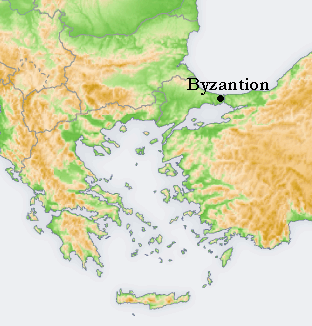
File:Locator_map_Byzantion.PNG · Wikimedia Commons · See Wikimedia Commons
Byzantium
Sign in to saveAlso known as Constantinople, Byzantion
Byzantium () or Byzantion () was an ancient Greek city in classical antiquity that became known as Constantinople in late antiquity and Istanbul in modern times. The Greek name Byzantion and its Latinization Byzantium continued to be used as a name of Constantinople sporadically and to varying degrees during the thousand-year existence of the Eastern Roman Empire, which also became known by the former name of the city as the Byzantine Empire. Byzantium was colonized by Greeks from Megara in the 7th century BCE and remained primarily Greek-speaking until its conquest by the Ottoman Empire in 14
Byzantium was an ancient Greek city founded in the 7th century BCE that later became Constantinople and then Istanbul, serving as the capital of the Eastern Roman Empire for over a thousand years. The city's historical importance is reflected in how it lent its name to the entire Byzantine Empire, one of history's most significant civilizations that shaped Eastern European, Mediterranean, and Middle Eastern culture and politics.
AI-generated from the Wikipedia summary — may contain errors.
Key facts
- Ancient site.name
- Byzantium667 BCE – 330 CE
- Ancient site.native_name
- Βυζάντιον
- Ancient site.alternate_name
- Byzantion (earlier Greek name), Nova Roma ("New Rome")
- Ancient site.image
- Locator map Byzantion.PNG
- Ancient site.caption
- Location of Byzantion, corresponding to the modern-day Fatih district of Istanbul
- Ancient site.map_size
- 275
- Ancient site.location
- Fatih, Istanbul, Turkey
- Ancient site.region
- Marmara Region
- Ancient site.type
- Ancient city
- Ancient site.area
- enclosed within Constantinian Walls enclosed within Theodosian Walls
- Ancient site.built
- 667 BCE
- Ancient site.notes
- Replaced by Constantinople in the 330s.
via Wikipedia infobox
Research
372 papers- Byzantium.Nature · 2021Dawson RDOI: 10.1038/d41586-021-02769-z
- Reading Galen in Byzantium: The fate of Therapeutics to Glaucon.Review2018Bouras-Vallianatos P, Xenophontos S, Bouras-Vallianatos P
- Sailing to Byzantium.Annual review of biochemistry · 1992Kennedy EPDOI: 10.1146/annurev.bi.61.070192.000245
- Thinking about Chemistry in Byzantium and the Islamic World.Journal of the history of ideas · 2023Roberts AMDOI: 10.1353/jhi.2023.a909532
- Mobility and migration in Byzantium: who gets to tell the story?Early medieval Europe · 2023Rapp CDOI: 10.1111/emed.12641
- Surgical confrontation of urolithiasis in Byzantium.Urology · 2004Lascaratos J, Lascaratos G, Kostakopoulos ADOI: 10.1016/S0090-4295(03)00340-6
- [Eunuchism in Byzantium].Progres en urologie : journal de l'Association francaise d'urologie et de la Societe francaise d'urologie · 2001Androutsos G, Geroulanos S
- Uroscopy in Byzantium.American journal of nephrology · 1997Diamandopoulos AADOI: 10.1159/000169105
via PubMed
Wikidata facts
- Instance of
- polis
- Named after
- Byzas
- Country
- Roman Empire
- Founded by
- Dorians
- Followed by
- Constantinople
- Image
- 1784 Bocage Map of The Bosphorus and the City of Byzantium - Istanbul - Constantinople - Geographicus - Bosphorus-white-1793.jpg
- Significant event
- Siege of Byzantium
Show 10 more facts
- Commons category
- Byzantium
- topic's main category
- Category:Ancient Byzantium
- described by source
- Oxford Classical Dictionary
- category of associated people
- Category:Ancient Byzantines
- replaced by
- Constantinople
- native label
- Βυζάντιον
- different from
- Byzantine Empire
- dissolved, abolished or demolished date
- 0330-00-00
- culture
- Ancient Greece
- inception
- 0667-00-00
Sources (8)
via Wikidata · CC0
~11 min read
Encyclopedic overview
9 sectionsContents
- Etymology
- History
- Emblem
- People
- See also
- Notes
- References
- Sources
- External links
Byzantium () or Byzantion () was an ancient Greek city in classical antiquity that became known as Constantinople in late antiquity and Istanbul in modern times. The Greek name Byzantion and its Latinization Byzantium continued to be used as a name of Constantinople sporadically and to varying degrees during the thousand-year existence of the Eastern Roman Empire, which also became known by the former name of the city as the Byzantine Empire. Byzantium was colonized by Greeks from Megara in the 7th century BCE and remained primarily Greek-speaking until its conquest by the Ottoman Empire in 1453 CE.
==Etymology==
Excerpted from Wikipedia’s “Byzantium” article, available under the CC BY-SA 4.0 licence.
Gallery (2)
On the map
31 mapped locations
Available in 77 languages
- Español
- Français
- Deutsch
- 中文
- 日本語
- Русский
- Português
- Italiano
- العربية
- Albanian
- Albanian
- Armenian
- Asturian
- Azerbaijani
- Bahasa Indonesia
- Bangla
- Basque
- be_x_old
Show 58 more
- Belarusian
- Bosnian
- Breton
- Bulgarian
- Catalan
- Czech
- Egyptian Arabic
- Esperanto
- Estonian
- Filipino
- Finnish
- Galician
- Georgian
- Gorontalo
- Greek
- Guarani
- Hebrew
- hyw
- Ido
- Ladino
- Latin
- Latvian
- Ligurian
- Low German
- Macedonian
- Malagasy
- Malay
- Mongolian
- Neapolitan
- Nederlands
- Norwegian
- Norwegian Nynorsk
- Picard
- Piedmontese
- Polski
- Quechua
- Romanian
- Rusyn
- Serbian
- Serbian (Latin)
- simple
- Slovenian
- Svenska
- Swahili
- Tamil
- Tiếng Việt
- Türkçe
- Ukrainian
- Urdu
- Uzbek
- Waray
- Western Panjabi
- Wu Chinese
- Yiddish
- zh_min_nan
- فارسی
- ไทย
- 한국어
via Wikidata sitelinks · CC0