
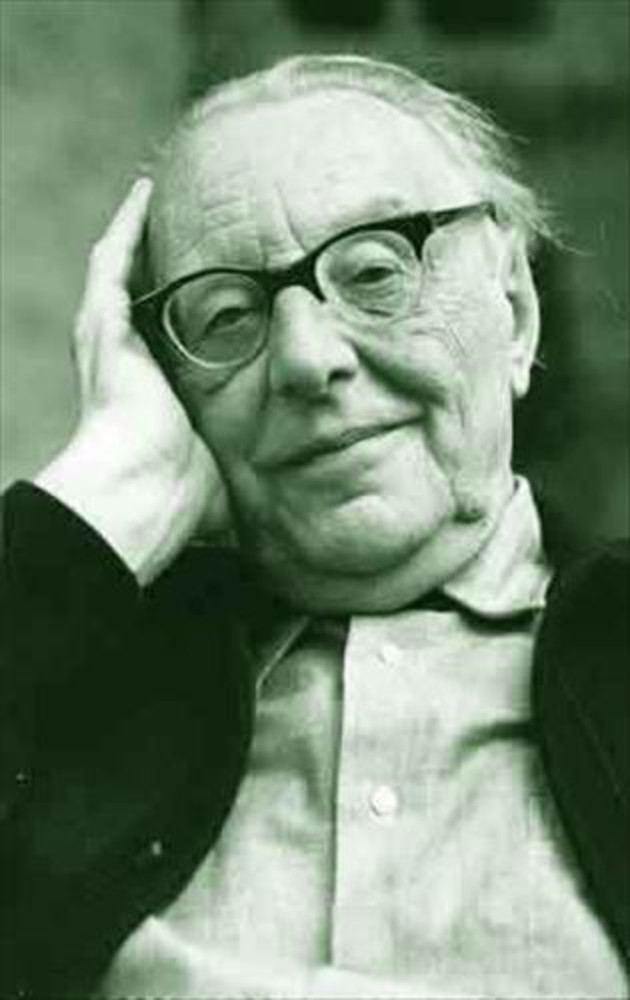
File:Carl_Orff_um_1970.jpg · Wikimedia Commons · See Wikimedia Commons
OverviewAI-generated
Carl Orff (1895–1982) was a German composer, musicologist, music educator, and university teacher. His notable works include *Carmina Burana*, *Die Kluge*, *Der Mond*, and *Catulli Carmina*. Orff was a member of the Bavarian Academy of Fine Arts and received several honors, including the Bavarian Order of Merit, the National Prize of East Germany, the Goethe Plaque of the City of Frankfurt, and the Bavarian Maximilian Order for Science and Art.
He studied at the University of Music and Theatre Munich and Mozarteum University Salzburg, where he was a student of Hermann Zilcher. Orff taught students such as Edwin Carr and Thrasybulos Georgiades. He played the organ, piano, cello, and percussion instruments. His wife was Luise Rinser. Orff died of pancreatic cancer in Munich and was buried at Andechs Abbey.
Synthesized by Vinony from 45 facts across 10 sources: Wikidata, Open Library, MusicBrainz, Last.fm, Firecrawl, Europeana Sparql, Crossref, TMDb, Wikiquote, Vinony graph. Generated from structured data (not the Wikipedia text) and checked against those facts — may still contain errors.
Film & TV
Known for
- O, Fortuna! A portrait of the composer of Carmina Burana, Carl Orff — Self2011
via TMDB
Music · MusicBrainz
- Type
- Person
- Gender
- Male
- Country
- Germany
- Active from
- 1895
- Active to
- 1982
Discography
- Carmina Burana1953
- Catulli Carmina1954
- Carmina Burana1957
- Carmina Burana1959
- Carmina Burana1960
- Carmina Burana1960
- Carmina Burana1961
- Catulli Carmina1965
- Умница / Симфониетта1965
- Carmina Burana1966
via MusicBrainz · CC0
Listeners · Last.fm
- Listeners
- 633,306
- Total plays
- 5,806,382
Tags
Carl Orff (10th July 1895–29th March 1982) was a German composer, most famous for his Carmina Burana (1937), and an important and influential music educator. Orff was born in Munich and came from a Bavarian family that was very active in the German military. His father's regimental band supposedly often played the compositions of the young Orff. He studied at the Munich Academy of Music until 1914, then served in the military during World War I. <a href="https://www.last.fm/music/Carl+Orff">Re
Described at
Carl Orff Museum - Carl Orff
co-mu.de →Carl Orff wurde am 10. Juli 1895 in München geboren und wuchs in einer musikalischen Familie auf. Seine Leidenschaft für Musik durfte er schließlich zum Beruf machen. Als Lehrer experimentierte er mit Sprache, Musik und Bewegung. Er entdeckte alte Musik und außereuropäische Musikinstrumente für sich. Mit Carmina Burana feierte er seinen Durchbruch. Den dort gefundenen Stil entwickelte er in seinem weiteren Schaffen fort. Nach langen Jahren in Dießen am Ammersee verstarb er 1982 in seiner Geburtsstadt. Carl Orff führte ein faszinierendes und vielseitiges Leben. Neben seiner musikalischen Karriere als Komponist war er als Pädagoge, Wortschöpfer und Theatermacher aktiv. Carl Orffs Carmina Burana zählen zu den erfolgreichsten Chorwerken des 20. Jahrhunderts. Das Orff-Schulwerk hat sich zu einer international anerkannten und weit verbreiteten Methode der musikalischen Bildung und Erziehung entwickelt.
Excerpt from a page describing this subject · 10,262 chars · not written by Vinony
Wikidata facts
- Instance of
- human
- Given name
- Carl
- Gender
- male
- Citizenship
- Germany
- Place of birth
- Munich
- Place of death
- Munich
- Occupation
- librettist
- Educated at
- Mozarteum University Salzburg
- Languages spoken
- Ancient Greek
- Notable work
- Catulli Carmina
- Student of
- Hermann Zilcher
- Genre
- opera
- Instrument
- xylophone
- Conflict
- World War I
- Image
- Carl Orff um 1970.jpg
- Work location
- Frankfurt (Oder)
- Residence
- Gräfelfing
Show 12 more facts
- Commons category
- Carl Orff
- date of birth
- 1895-07-10
- date of death
- 1982-03-29
- topic's main category
- Category:Carl Orff
- cause of death
- pancreatic cancer
- manner of death
- natural causes
- member of
- Bavarian Academy of Fine Arts
- place of burial
- Andechs Abbey
- name in native language
- Carl Orff
- writing language
- Ancient Greek
- P12674
- Ilma Rakusa
- described at URL
- co-mu.de/carl-orff
via Wikidata · CC0
Works in European collections
1 object attributed to Carl Orff, held across European museums, libraries & archives · via Europeana

~40 min read
Encyclopedic overview
Carl Heinrich Maria Orff ( German: [kaʁl ˈʔɔʁf] ; 10 July 1895 – 29 March 1982) was a German composer and music educator, who composed the cantata Carmina Burana (1937). The concepts of his Schulwerk were influential for children's music education.
Life
Excerpted from Wikipedia’s “Carl Orff” article, available under the CC BY-SA 4.0 licence.
Gallery (5)
Available in 59 languages
- Español
- Français
- Deutsch
- 中文
- 日本語
- Русский
- Português
- Italiano
- العربية
- हिन्दी
- Afrikaans
- Albanian
- Aragonese
- Armenian
- Azerbaijani
- Bahasa Indonesia
- Basque
- Bavarian
Show 40 more
- be_x_old
- Belarusian
- Bosnian
- Bulgarian
- Catalan
- Croatian
- Czech
- Danish
- Egyptian Arabic
- Esperanto
- Estonian
- Finnish
- Galician
- Greek
- Hebrew
- Hungarian
- Icelandic
- Ido
- Interlingue
- Kyrgyz
- Latin
- Latvian
- Lithuanian
- Nederlands
- Norwegian
- Polski
- Romanian
- Serbian
- Serbian (Latin)
- simple
- Slovenian
- Svenska
- Tiếng Việt
- Türkçe
- Ukrainian
- Uzbek
- Wu Chinese
- فارسی
- ไทย
- 한국어
via Wikidata sitelinks · CC0