File:Portuguese_Carracks_off_a_Rocky_Coast.jpg · Wikimedia Commons · See Wikimedia Commons
carrack
Sign in to saveAlso known as carracks
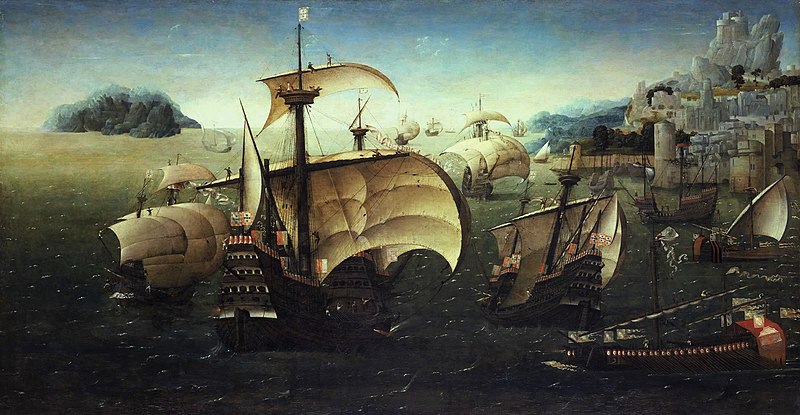
thumb|right|300px|The Portuguese carrack Santa Catarina do Monte Sinai and other ships, painting by [[Joachim Patinir. The voyage of Infanta Beatriz, second daughter of King Manuel of Portugal, to Villefranche for her marriage to Charles III, Duke of Savoy, in 1521.]] thumb| painting of a large carrack attributed to Pieter Bruegel the Elder
Wikidata facts
- Subclass of
- sailing ship
- Operator
- Swedish Navy
- Country of origin
- Portugal
- Image
- SantaMaria.jpg
- Said to be same as
- nau
Show 4 more facts
- end time
- 1600-00-00
- start time
- 1500-00-00
- Commons category
- Carracks
- topic's main category
- Category:Carracks
Sources (1)
via Wikidata · CC0
~14 min read
Encyclopedic overview
10 sectionsContents
- Name
- Origins
- In Asia
- Famous carracks
- Gallery
- Popular culture
- See also
- References
- Further reading
- External links
thumb|right|300px|The Portuguese carrack Santa Catarina do Monte Sinai and other ships, painting by [[Joachim Patinir. The voyage of Infanta Beatriz, second daughter of King Manuel of Portugal, to Villefranche for her marriage to Charles III, Duke of Savoy, in 1521.]] thumb| painting of a large carrack attributed to Pieter Bruegel the Elder
A carrack (; ; ) is a three- or four-masted ocean-going sailing ship that was developed in the 14th to 15th centuries in Europe, most notably in Portugal and Spain. Evolving from the single-masted cog, the carrack was first used for European trade from the Mediterranean to the Baltic and quickly found use with the newly found wealth of the trade between Europe and Africa and then the trans-Atlantic trade with the Americas. In their most advanced forms, they were used by the Portuguese and Spaniards for trade between Europe, Africa and Asia starting in the late 15th century, before being gradually superseded in the late 16th and early 17th centuries by the galleon.
Excerpted from Wikipedia’s “carrack” article, available under the CC BY-SA 4.0 licence.