
Portugal
Sign in to saveAlso known as Portuguese Republic, PRT, POR
Portugal, officially the Portuguese Republic, is a country located on the Iberian Peninsula in Southwestern Europe. It is a unitary republic made up by mainland Portugal and two autonomous regions, with Lisbon as both its capital and largest city. It has a total population of over 10.7 million. The mainland borders Spain to the north and east, with Madeira and the Azores in the Atlantic Ocean. It features the westernmost point in continental Europe.
OverviewAI-generated
Portugal, officially the Portuguese Republic, is a country in Southern Europe. Its capital is Lisbon, and it contains the administrative territorial entities of Leiria, Santarém, and Setúbal. The nation operates as a republic and a constitutional monarchy, with the Assembly of the Republic serving as its legislative body. It is a member of the European Union, the United Nations, NATO, and the Organization for Economic Cooperation and Development.
The population is reported as 10,600,000, 10,749,635, and 10,694,681 in various datasets. The country has an area of 92,090 square kilometers. Its highest point is Mount Pico, and its lowest point is the Atlantic Ocean. The patron saint is Saint George, and the public holiday is Portugal Day. The demonym is Portuguese.
Portugal maintains diplomatic relations with Italy, Brazil, Germany, and Australia. It is part of the timezones UTC-01:00 and UTC. The top-level domain is .pt. The country has a forest area percentage of 36.154994891142 and a renewable energy percentage of 32.3. The life expectancy is 82.3829268292683 years, and the unemployment rate is 6.164 percent.
Synthesized by Vinony from 67 facts across 9 sources: Wikidata, Open Meteo, Openweathermap, REST Countries, World Bank, OpenStreetMap, PubMed, Vinony graph, Geo. Generated from structured data (not the Wikipedia text) and checked against those facts — may still contain errors.
Weather now
cached 146h ago7-day forecast
via Open-Meteo
Country

- Capital
- Lisbon
- Population
- 10,749,635
- Region
- Europe · Southern Europe
- Demonym
- Portuguese
- Currencies
- EUR (€)
- Languages
- Portuguese
- Calling code
- +351
- Drives on
- Right
- Gini
- 33.5 (2018)
- FIFA code
- POR
- TLD
- .pt
- Timezones
- UTC-01:00 · +1 more
- Borders
- ESP
via REST Countries
Indicators · World Bank
- GDP
- $313.3B(2024)
- Population
- 10,694,681(2024)
- Life expectancy
- 82.4 yrs(2024)
- Unemployment
- 6.2 %(2025)
- Urban population
- 61.3 %(2024)
- Internet users
- 88.5 %(2024)
- Forest area
- 36.2 %(2023)
- Renewable energy
- 32.3 %(2021)
via World Bank Open Data · CC BY 4.0
Wikipedia views (30d)
237,176 totalvia Wikimedia Pageviews API
Key facts
- Country.area_rank
- 92nd
- Country.conventional_long_name
- Portuguese Republic
- Country.common_name
- Portugal
- Country.image_flag
- Flag of Portugal (official).svg
- Country.flag_type_article
- Flag of Portugal
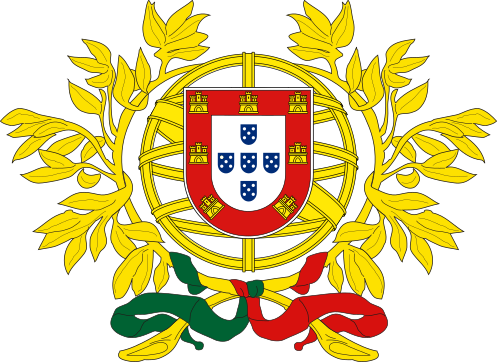
- Country.image_coat
- Coat of arms of Portugal.svg
- Country.symbol_type_article
- Coat of arms of Portugal
- Country.coa_size
- 115
- Country.national_anthem
- "The Portuguese"File:Hino Nacional da Republica Portuguesa.ogg
- Country.map_width
- 220px
- Country.capital
- Lisbon
- Country.largest_city
- capital
- Country.official_languages
- Portuguese
- Country.recognised_national_languages
- Portuguese Sign Language
- Country.recognised_regional_languages
- Mirandese
- Country.demonym
- Portuguese
- Country.government_type
- Unitary semi-presidential republic
- Country.leader_title1
- President
via Wikipedia infobox
Research
206,623 papers- Portugal's primary care crisis as GPs depart.BMJ (Clinical research ed.) · 2024Howard SDOI: 10.1136/bmj.q1349
- Portugal's voluntary food reformulation agreement and the WHO reformulation targets.ReviewJournal of global health · 2019Goiana-da-Silva F, Cruz-E-Silva D, Allen L et al.DOI: 10.7189/jogh.09.020315
- Portugal's airport plans threaten wetlands.Science (New York, N.Y.) · 2020Alves JA, Dias MPDOI: 10.1126/science.abe4325
- Portugal.Department of State publication. Background notes series · 1985United States. Department of State. Bureau of Public Affairs
- Forecasted Dementia Prevalence in Portugal (2020-2080).Journal of geriatric psychiatry and neurology · 2024Alves S, Duarte N, Gomes BDOI: 10.1177/08919887241237220
- [Rickettsia infections in Portugal].ReviewActa medica portuguesa · 1999Oliveira J, Côrte-Real R
- Inhalant Allergens in Portugal.ReviewInternational archives of allergy and immunology · 2017Gomes Câmara Camacho IDOI: 10.1159/000458150
- Portugal's farmland bird crisis requires action.Science (New York, N.Y.) · 2024Silva JP, Gameiro J, Valerio F et al.DOI: 10.1126/science.adn1390
via PubMed
Travel guide
Understand
Portugal sits on the western edge of the Iberian peninsula, with two archipelagos in the Atlantic Ocean. Despite its small land area, it has many landforms and climates between the Atlantic coast and the mountains.
Get in
In addition, citizens of Andorra may enter and reside in Portugal indefinitely without a visa.
See
thumb|Pena National Palace, in [[Sintra: it's one of the major expressions of 19th-century Romanticism in the world.]] thumb|The luxurious [[Cascais village in the Portuguese Riviera (Estoril Coast).]] thumb|[[Fátima|Sanctuary of Our Lady of Fátima: this is one of the largest pilgrimage sites (Marian shrine) in the world.]]
Eat
Portuguese cuisine evolved from hearty peasant food drawn from the land and abundant seafood found in the country's lengthy coast with the cows, pigs and goats raised on the limited grazing land of its interior. From these humble origins, spices and condiments brought back to the country during the exploration and colonisation of South America, Africa, the East Indies and the Far East, contributed to the development of what become regarded as 'typical' Portuguese cuisine which inherently, also helped shape the cuisine in the regions under Portuguese influence, from Brazil and Cape Verde to Thailand and Japan. Today, traditional Portuguese cuisine is served alongside the latest trendy and fusion cuisine styles. Several establishments have been awarded Michelin stars.
thumb|Caldo verde: the green broth is a very popular soup in Portuguese cuisine. Soup is an essential first course of a Portuguese meal. The most popular is the Minho speciality, caldo verde, made from kale, potatoes and spiced smoked sausage.
thumb|Bacalhau à Brás: salt cod with onions, scrambled eggs and fried potatoes. You will see another Portuguese staple bacalhau (salt cod) everywhere. Locals will tell you that there are as many ways to cook this revered dish as there are days in the year, or even more.
thumb|Sardinhas assadas: grilled sardines with potatoes and salad. The most common of Portugal's delicious fish (peixe) dishes revolve around sole (linguado) and sardines (sardinha) although salmon (salmão…
Drink
thumb|Portuguese drinks: Brandy from [[Douro, and Porto and Madeira wines.]] When travelling in Portugal, the drink of choice is wine. Red wine is the favourite amongst the locals, but white wine is also popular. Northern Portugal has a white wine cultivar variation with a greenish tint known as vinho verde. This wine has a very crisp acidic-sweet flavour and is better served cold, it goes best with seafood or fish dishes and Alvarinho is one of the more famous brands. Drinking wine during a meal or socially is very common in Portugal, after a meal is finished, people will tend to talk and sip wine while the food digests. Port wine (vinho do Porto) can be an apéritif or a dessert. Alentejo wine may not be yet known worldwide like Port, but within Portugal just as famous, Esporão is one of the best brands from the Alentejo region. Portugal has other official demarcated wine regions (regiões vinhateiras) which produce some of the best wines such as, Madeira, Dão, Sado and Douro. The Bairrada region produces some delightful sparkling wines, Raposeira being a well known brand.
Beer (cerveja) is also an option and the production of beer in Portugal can be traced back to Lusitanian times. Apart from some imports, the best known national brands are the lager type Super Bock, Sagres and Coral. On a smaller scale, Tagus is sold in the Greater Lisbon area and Cristal, a Pilsner type beer is available mostly in the Porto region. The only drawbacks are the small bottles and caneca(jug) …
Sleep
thumb|Night in Lisbon The youth hostel network has a great number of hostels around the country. There are also many camping places. 'Wild camping' (camping outside camping parks) is not allowed, unless you have the land owner's agreement. Holiday Villas and apartments are another option to investigate.
There's a wide and abundant hotel offering all through Portugal.
If budget is a concern and you want a 'typically Portuguese' experience, don't be shy and try a residencial or pensão, the home-like inn's ubiquitous in cities and most towns. In many places you can get a double or triple room with private bathroom for €25-35 off season or €35-40 in season (2017). Be sure, however, of the quality of the rooms. In smaller cities, "pensões" tend to be near transportation hubs like railway stations and bus terminals. If travelling with friends, haggling in a nice way can yield discounts even during high season.
On the luxury side, you may want to try the Pousadas de Portugal, a network of hotels remarkable for using very beautiful ancient buildings like palaces and castles and also for having consistent excellent service all over the country. Formerly run by the Portuguese State, they are now run by the Pestana Group. You will do well eating out, as the cuisine of Pousadas can be both expensive and boring, although it appears the trend is changing for the better (mid-2008).
The "Casas de Campo" (Turismo de Habitação, Turismo Rural, Agro-Turismo), when travelling through the coun…
Stay safe
The emergency telephone number for police, fire, and medical assistance is 112. This is the national call centre dial in number for any emergency or to report an accident, fire etc etc. Ensure you have this number registered in your means of communication or noted down somewhere in case it becomes necessary to notify authorities or emergency response entities.
Portugal is a relatively safe country to visit, but some basic common sense will go a long way. There are no internal conflicts, no terrorism-related danger and violent crime is not a serious problem, as it is generally confined to particular neighbourhoods and is rarely a random crime.
There are three main police branches. In major urban areas the PSP or Policía de Segurança Pública (Public Security Police) are in charge of law enforcement. Outside major urban centres and in rural areas, the GNR or Guarda Nacional Republicana (National Republican Guards) take over the law enforcement.
Both the PSP and GNR are also responsible for road policing within their territorial jurisdictions. The third branch is the PJ or Policía Judiciária (Judicial Police). These are a crime investigation branch composed of plain clothes detectives. In general, the Portuguese police officers are well trained, educated and polite. Many that are posted in tourist popular areas, have basic communication skills in foreign languages and some are fluent speakers of French, German, English and Spanish, therefore, easy to approach if the need arise…
Stay healthy
Portugal adheres to all international protocols and guidelines concerning consumer products and health care.
Major cities are well served with medical and emergency facilities and public hospitals are at European standards. The national emergency number is 112. The Serviço Nacional de Saúde (National Health Service) 24-hour hotline is 808 24 24 24.
Many municipalities have pharmacies that take turns being open late or even 24 hours. These can be found online.
Portugal's water sources are perfectly safe, but some people may prefer bottled/spring water (água mineral). In so far as restaurants and other food and drink establishments or outlets are concerned, Portugal has a vigorously enforced system of national high standards to ensure a healthy chain of supply from producers to consumers, therefore the risk of food or drink poisoning is negligible. Star ratings are ascribed for levels of establishment luxury (5* to 1*) and not the quality of food or beverage, since those are strictly governed anyway.
Citizens of the European Union are covered by Portugal's National Healthcare System as long as they carry the free European Health Insurance Card (EHIC), obtainable from their own national health care authority. Non European Union travellers are advised to purchase traveller's basic medical insurance to cover serious physical injury treatment costs, in case of an accident.
Connect
To call Portugal from abroad, dial country code 351 before the city code. To call abroad from Portugal, dial 00 before the country code. The city dialling code for Lisbon is 21 and for Porto is 22. All other city codes are three digits starting with 2. Telephone numbers are nine digits long, including the city code. Mobile numbers begin with 9.
The Portuguese postal service is CTT (CTT Correios de Portugal, S.A., formerly Correios, Telégrafos e Telefones). Mailboxes are red. They can be pillar boxes on a street corner or small boxes attached to buildings.
Travel guide from Wikivoyage (CC BY-SA 4.0)
~40 min read
Encyclopedic overview
48 sectionsContents
- Etymology
- History
- Prehistory
- Historical overview of Portugal
- ''Reconquista''
- Independence
- Age of Discovery
- Iberian Union and Restoration
- Constitutional monarchy
- First Republic and {{lang|pt-PT|Estado Novo}}
- Return to democracy
- Geography
- Climate
- Biodiversity
- Government and politics
- Foreign relations
- Territorial disputes
- Military
- Law and justice
- Human rights
- Law enforcement
- Subdivisions
- Provinces
- Districts, regions and municipalities
- Economy
- Science and Technology
- Tourism
- Transport
- Energy
- Demographics
- Immigration
- Urbanisation
- Religion
- Languages
- Education
- Health
- Culture
- Architecture
- Cuisine
- Visual arts
- Literature
- Music
- Sport
- See also
- Notes
- References
- Sources
- External links
Portugal, officially the Portuguese Republic, is a country in Southwestern Europe. It is a unitary republic made up by mainland Portugal and two autonomous regions, with Lisbon as its capital and largest city. It has a population of over 10.7 million. The mainland is located on the southwestern of the Iberian Peninsula and is bordered by Spain to the north and east; Madeira and the Azores are in the Atlantic Ocean.
The western Iberian Peninsula has been inhabited since prehistoric times, with the earliest signs of settlement dating to 5400 BC. Portugal was established as a county of the Kingdom of León in 868, and formally as a kingdom in the 12th century as a result of the Reconquista against the Muslims, who had occupied the Iberian Peninsula since 711. A major participant in the Age of Discovery, the kingdom made several advancements in nautical science and maritime exploration to discover new territories and sea routes, which led to the establishment of the Portuguese Empire. The kingdom became a republic in 1910 and was a dictatorship from 1926 until the dictatorship's overthrow in 1974 enabled the full establishment of democracy in 1976.
Excerpted from Wikipedia’s “Portugal” article, available under the CC BY-SA 4.0 licence.
Gallery (59)
On the map
6 mapped locations
Available in 301 languages
- Español
- Français
- Deutsch
- 中文
- 日本語
- Русский
- Português
- Italiano
- العربية
- हिन्दी
- Abkhazian
- abstract
- Acehnese
- Adyghe
- Afrikaans
- Akan
- Albanian
- Albanian
Show 282 more
- Amharic
- ami
- Angika
- Aragonese
- Aramaic
- Armenian
- Arpitan
- Assamese
- Asturian
- Atikamekw
- Avaric
- Awadhi
- Aymara
- azb
- Azerbaijani
- Bahasa Indonesia
- Balinese
- Bambara
- Bangla
- Bashkir
- Basque
- bat_smg
- Batak Toba
- Bavarian
- be_x_old
- Belarusian
- Betawi
- Bhojpuri
- Bikol
- Bishnupriya
- Bislama
- Bosnian
- Breton
- btm
- Buginese
- Bulgarian
- Buriat
- Burmese
- Catalan
- cbk_zam
- cdo
- Cebuano
- Central Dusun
- Central Kurdish
- Chamorro
- Chechen
- Cherokee
- Church Slavic
- Chuvash
- Cornish
- Corsican
- Crimean Tatar
- Croatian
- Czech
- dag
- Danish
- Divehi
- dty
- Dzongkha
- Egyptian Arabic
- eml
- Erzya
- Esperanto
- Estonian
- Ewe
- Extremaduran
- Faroese
- Fiji Hindi
- Fijian
- Filipino
- Finnish
- fiu_vro
- Friulian
- Fula
- Gagauz
- Galician
- Ganda
- gcr
- Georgian
- Gilaki
- Gothic
- gpe
- Greek
- Guarani
- Gujarati
- Haitian Creole
- Hakka Chinese
- Hausa
- Hawaiian
- Hebrew
- Hungarian
- hyw
- Iban
- Icelandic
- Ido
- Igbo
- Iloko
- Inari Sami
- Ingush
- Interlingua
- Interlingue
- Inupiaq
- Irish
- Jamaican Creole English
- Javanese
- Kabardian
- Kabyle
- Kannada
- Kanuri
- Kara-Kalpak
- Karachay-Balkar
- Kashmiri
- Kashubian
- Kazakh
- kbp
- kge
- Khmer
- Kinyarwanda
- Komi
- Komi-Permyak
- Kongo
- Konkani
- Kotava
- Kurdish
- Kyrgyz
- Ladino
- Lao
- Latgalian
- Latin
- Latvian
- lbe
- Lezghian
- Ligurian
- Limburgish
- Lingala
- Lingua Franca Nova
- Lithuanian
- lld
- Lojban
- Lombard
- Low German
- Lower Sorbian
- Luxembourgish
- Macedonian
- Madurese
- Maithili
- Malagasy
- Malay
- Malayalam
- Maltese
- Manipuri
- Manx
- Māori
- map_bms
- Marathi
- Mari
- Mazanderani
- Minangkabau
- Mingrelian
- Mirandese
- Moksha
- Mongolian
- Moroccan Arabic
- Navajo
- nds_nl
- Neapolitan
- Nederlands
- Nepali
- Newari
- Nias
- Northern Frisian
- Northern Sami
- Northern Sotho
- Norwegian
- Norwegian Nynorsk
- Novial
- nrm
- nup
- Obolo
- Occitan
- Odia
- Old English
- olo
- Oromo
- Ossetic
- Pampanga
- Pangasinan
- Papiamento
- Pashto
- Pennsylvania German
- Picard
- Piedmontese
- Polski
- Pontic
- Punjabi
- Quechua
- roa_tara
- Romanian
- Romansh
- Romany
- Rundi
- Rusyn
- Samoan
- Sanskrit
- Santali
- Sardinian
- Saterland Frisian
- Scots
- Scottish Gaelic
- Serbian
- Serbian (Latin)
- Shan
- Shona
- Sicilian
- Silesian
- simple
- Sindhi
- Sinhala
- skr
- Slovak
- Slovenian
- Somali
- Southern Sotho
- Sranan Tongo
- Standard Moroccan Tamazight
- Sundanese
- Svenska
- Swahili
- Swati
- syl
- szy
- Tachelhit
- Tahitian
- Tajik
- Talysh
- Tamil
- Taroko
- Tatar
- tay
- Telugu
- Tetum
- Tibetan
- Tiếng Việt
- Tok Pisin
- Toki Pona
- Tongan
- Tumbuka
- Türkçe
- Turkmen
- Tyap
- Udmurt
- Ukrainian
- Upper Sorbian
- Urdu
- Uyghur
- Uzbek
- Venda
- Venetian
- Veps
- Volapük
- Walloon
- Waray
- Welsh
- West Flemish
- Western Frisian
- Western Panjabi
- Wolof
- Wu Chinese
- Xhosa
- Yakut
- Yiddish
- Yoruba
- Zaza
- Zeelandic
- zh_classical
- zh_min_nan
- zh_yue
- Zhuang
- Zulu
- فارسی
- ไทย
- 한국어
via Wikidata sitelinks · CC0