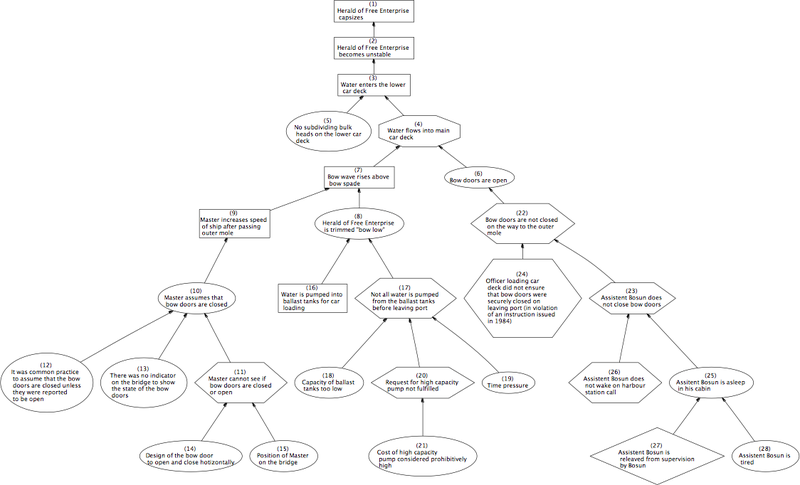
File:Herald_of_Free_Enterprise_WBG.png · Wikimedia Commons · See Wikimedia Commons
causality
Sign in to saveAlso known as causation, cause and effect, causal mechanism
Causality is an influence by which one event, process, state, or subject (i.e., a cause) contributes to the production of another event, process, state, or object (i.e., an effect) where the cause is at least partly responsible for the effect, and the effect is at least partly dependent on the cause. The cause of something may also be described as the reason behind the event or process.
Causality is the relationship where one thing directly influences and helps bring about another thing—for example, how a cause produces an effect and bears at least some responsibility for it. Understanding causality matters because it helps us identify the reasons behind events and processes, allowing us to make sense of how things happen in the world.
AI-generated from the Wikipedia summary — may contain errors.
Research
11,693,199 papers- Mendelian Randomization as an Approach to Assess Causality Using Observational Data.ReviewJournal of the American Society of Nephrology : JASN · 2016Sekula P, Del Greco M F, Pattaro C et al.DOI: 10.1681/ASN.2016010098
- Focus on Causality in ESC/iPSC-Based Modeling of Psychiatric Disorders.ReviewCells · 2020Hoffmann A, Ziller M, Spengler DDOI: 10.3390/cells9020366
- [Causality: risk factors and interventions].ReviewNederlands tijdschrift voor geneeskunde · 2013Dekkers OM, Vandenbroucke JP
- Prediction or causality? A scoping review of their conflation within current observational research.European journal of epidemiology · 2021Ramspek CL, Steyerberg EW, Riley RD et al.DOI: 10.1007/s10654-021-00794-w
- Causal relationship between gut microbiota and cancers: a two-sample Mendelian randomisation study.BMC medicine · 2023Long Y, Tang L, Zhou Y et al.DOI: 10.1186/s12916-023-02761-6
- The ASCOD phenotyping of ischemic stroke (Updated ASCO Phenotyping).Cerebrovascular diseases (Basel, Switzerland) · 2013Amarenco P, Bogousslavsky J, Caplan LR et al.DOI: 10.1159/000352050
- How and why to focus on causality in teaching human physiology.Advances in physiology education · 2025Silldorff EP, Robinson GDDOI: 10.1152/advan.00186.2025
- How to establish causality in epilepsy surgery.ReviewBrain & development · 2013Asano E, Brown EC, Juhász CDOI: 10.1016/j.braindev.2013.04.004
via PubMed
Wikidata facts
Show 7 more facts
- opposite of
- prevention
- studied by
- Buddhist logico-epistemology
- Commons category
- Causality
- topic's main category
- Category:Causality
- described by source
- Encyclopædia Britannica 11th edition
- on focus list of Wikimedia project
- Wikipedia:Vital articles/Level/4
- Stack Exchange tag
- stats.stackexchange.com/tags/causality
Sources (2)
via Wikidata · CC0
~61 min read
Encyclopedic overview
38 sectionsContents
- Concept
- Metaphysics
- Ontology
- Epistemology
- Geometrical significance
- Volition
- Contrasted with conditionals
- Questionable cause
- Theories
- Counterfactual theories
- Probabilistic causation
- Causal calculus
- Structure learning
- Derivation theories
- Manipulation theories
- Process theories
- Fields
- Science
- Physics
- Engineering
- Biology, medicine and epidemiology
- Psychology
- Statistics and economics
- Management
- Humanities
- History
- Law
- History
- Hindu philosophy
- Buddhist philosophy
- Western philosophy
- Aristotelian
- Pyrrhonism
- Middle Ages
- After the Middle Ages
- See also
- References
- Further reading
Causality is an influence by which one event, process, state, or subject (i.e., a cause) contributes to the production of another event, process, state, or object (i.e., an effect) where the cause is at least partly responsible for the effect, and the effect is at least partly dependent on the cause. The cause of something may also be described as the reason behind the event or process.
In general, a process can have multiple causes, which are also said to be causal factors for it, and all lie in its past. An effect can in turn be a cause of, or causal factor for, many other effects, which all lie in its future. Thus, the distinction between cause and effect either follows from or else provides the distinction between past and future. While the former viewpoint is more prevalent in physics, some writers have held that causality is metaphysically prior to notions of time and space. Causality is an abstraction that indicates how the world progresses. As such, it is a basic concept, and one might expect it to be more apt as an explanation of other concepts of progression than as something to be explained by yet more fundamental ideas. The concept is like those of agency and efficacy. For this reason, a leap of intuition may be needed to grasp it. Accordingly, causality is implicit in the structure of ordinary language, as well as explicit in the language of scientific causal notation.
Excerpted from Wikipedia’s “causality” article, available under the CC BY-SA 4.0 licence.
Gallery (9)
Available in 63 languages
- Español
- Français
- Deutsch
- 中文
- 日本語
- Русский
- Português
- Italiano
- العربية
- हिन्दी
- Afrikaans
- Albanian
- Armenian
- Azerbaijani
- Bahasa Indonesia
- Bangla
- Basque
- Bosnian
Show 44 more
- Bulgarian
- Catalan
- Central Kurdish
- Chuvash
- Croatian
- Czech
- Danish
- Esperanto
- Estonian
- Finnish
- Galician
- Greek
- Hebrew
- Hungarian
- Ido
- Latin
- Latvian
- Lithuanian
- Macedonian
- Malay
- Mazanderani
- Nederlands
- Norwegian
- Norwegian Nynorsk
- Piedmontese
- Polski
- Punjabi
- Romanian
- Serbian
- Serbian (Latin)
- simple
- Slovak
- Svenska
- Tamil
- Tiếng Việt
- Türkçe
- Ukrainian
- Urdu
- Welsh
- Wu Chinese
- zh_yue
- فارسی
- ไทย
- 한국어
via Wikidata sitelinks · CC0