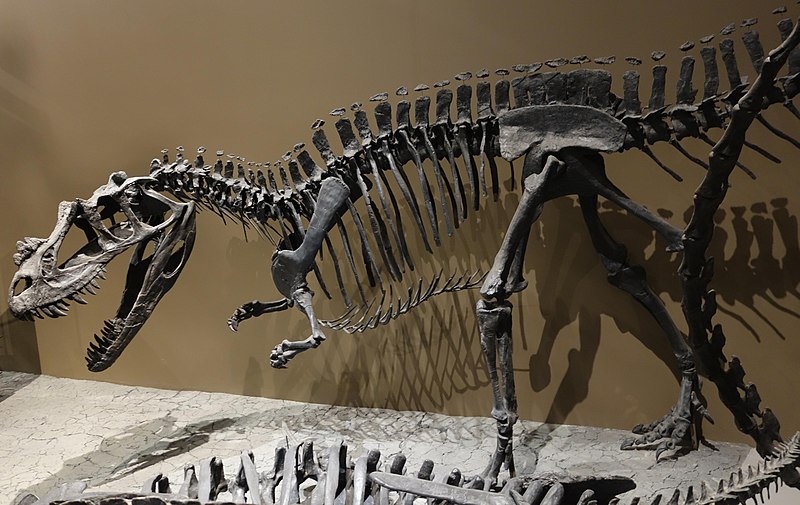
File:Ceratosaurus_mount_utah_museum_1.jpg · Wikimedia Commons · See Wikimedia Commons
Ceratosaurus
Sign in to saveCeratosaurus (from Greek 'horn' and 'lizard') is a genus of carnivorous theropod dinosaur that lived during the Late Jurassic period in North America and Europe. The genus was first described in 1884 by American paleontologist Othniel Charles Marsh based on a nearly complete skeleton discovered in Garden Park, Colorado, in rocks belonging to the Morrison Formation. The type species is Ceratosaurus nasicornis.
Ceratosaurus was a large carnivorous dinosaur that lived during the Late Jurassic period in North America and Europe, distinguished by a horn on its head. The species was first identified in 1884 when paleontologist Othniel Charles Marsh described a nearly complete skeleton found in Colorado, making it an important early example of a theropod dinosaur.
AI-generated from the Wikipedia summary — may contain errors.
Wikidata facts
- Parent taxon
- Ceratosauridae
- Mass
- 600
- Image
- Ceratosaurus nasicornis walking.jpg
- Height
- 2.5
- Length
- 6
Show 9 more facts
- main food source
- carnivore
- taxon name
- Ceratosaurus
- Commons category
- Ceratosaurus
- taxon rank
- genus
- taxon common name
- Ceratosaurus ("horned lizard")
- start time
- 153000000-
- end time
- 148000000-
- location of discovery
- Portugal
- time period
- Late Jurassic
Sources (2)
via Wikidata · CC0
~53 min read
Encyclopedic overview
23 sectionsContents
- History of discovery
- Holotype specimen of ''C. nasicornis''
- Additional finds in North America
- Finds outside North America
- Description
- Skull
- Postcranial skeleton
- Classification
- Paleobiology
- Feeding
- Function of the nasal horn and osteoderms
- Forelimb function
- Brain and senses
- Fusion of metatarsals and paleopathology
- Growth
- Supposed semiaquatic lifestyle
- Paleoecology
- Distribution and paleoenvironment
- Niche partitioning
- In popular culture
- Notes
- References
- External links
Ceratosaurus (from Greek 'horn' and 'lizard') is a genus of carnivorous theropod dinosaur that lived during the Late Jurassic period in North America and Europe. The genus was first described in 1884 by American paleontologist Othniel Charles Marsh based on a nearly complete skeleton discovered in Garden Park, Colorado, in rocks belonging to the Morrison Formation. The type species is Ceratosaurus nasicornis.
The Garden Park specimen remains the most complete skeleton known from the genus and only a handful of additional specimens have been described since. Two additional species, Ceratosaurus dentisulcatus and Ceratosaurus magnicornis, were described in 2000 from two fragmentary skeletons from the Cleveland-Lloyd Quarry of Utah and from the vicinity of Fruita, Colorado. These species are no longer accepted by most paleontologists, and all three skeletons possibly represent different growth stages of the same species. In 1999, the discovery of the first juvenile specimen was reported. In 2000, a partial specimen was excavated and described from the Lourinhã Formation of Portugal, providing evidence for the presence of the genus outside of North America. Fragmentary remains have also been reported from Tanzania, Uruguay, and Switzerland, although their assignment to Ceratosaurus is currently not accepted by most paleontologists.
Excerpted from Wikipedia’s “Ceratosaurus” article, available under the CC BY-SA 4.0 licence.