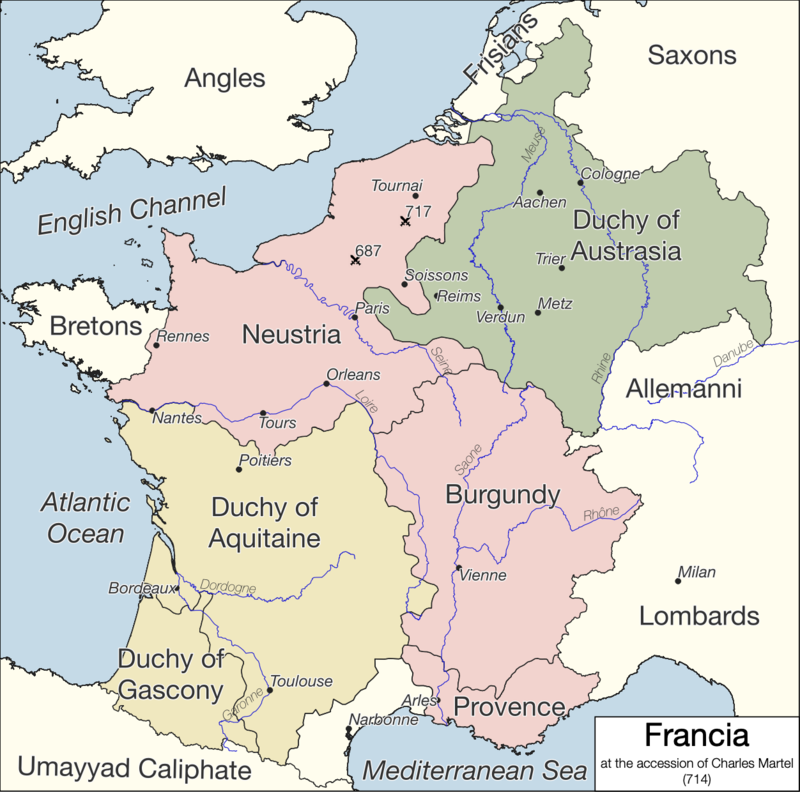
File:Francia_714.png · Wikimedia Commons · See Wikimedia Commons
Charlemagne
Sign in to saveAlso known as Karolus Magnus, Charles the Great, Emperor Charlemagne, Karl the Great, Carolus Magnus, Charlemagne the Franc, Charles I, Carlus Magnus
Charlemagne ( ; 2 April 748 – 28 January 814) was King of the Franks from 768, King of the Lombards from 774, and Emperor of what is now known as the Carolingian Empire from 800. He united most of Western and Central Europe and was the first recognised emperor to rule from the west after the fall of the Western Roman Empire approximately three centuries earlier. Charlemagne's reign was marked by political and social changes that had lasting influence on Europe throughout the Middle Ages.
Charlemagne was a medieval king who ruled the Franks starting in 768 and expanded his power to become the first recognized emperor of Western Europe after the Roman Empire's collapse around three centuries earlier. His reign brought lasting political and social changes that shaped Europe throughout the Middle Ages.
AI-generated from the Wikipedia summary — may contain errors.
Key facts
- Royalty.name
- Charlemagne
- Royalty.more
- Carolus Magnus
- Royalty.image
- Charlemagne denier Mayence 812 814.jpg
- Royalty.caption
- A denarius of Charlemagne dated with the inscription (Karolus Imperator Augustus)
- Royalty.succession2
- Emperor of the Carolingian Empire
- Royalty.reign2
- 25 December 800 – 28 January 814
- Royalty.coronation2
- 25 December 800Old St. Peter's Basilica, Rome
- Royalty.successor2
- Louis the Pious
- Royalty.birth_place
- Francia
- Royalty.death_place
- Aachen, Germany
- Royalty.issue link
- Wives,_concubines,_and_children
- Royalty.issue pipe
- Among others
- Royalty.house
- Carolingian
- Royalty.house type
- Dynasty
- Royalty.father
- Pepin the Short
- Royalty.mother
- Bertrada of Laon
- Royalty.signature_type
- Signum manus
- Royalty.religion
- Chalcedonian Christianity
via Wikipedia infobox
Wikidata facts
- Instance of
- human
- Gender
- male
- Citizenship
- Francia
- Place of birth
- Liège
- Place of death
- Aachen
- Spouse
- Liutperga
- Father
- Pepin the Short
- Mother
- Bertrada of Laon
- Occupation
- sovereign
- Position held
- Holy Roman Emperor
- Languages spoken
- Frankish
- Religion
- Christianity
- Family
- Carolingian dynasty
- Noble title
- Holy Roman Emperor
- Image
- Charlemagne Agostino Cornacchini Vatican 2.jpg
- Height
- 1.84
Show 22 more facts
- date of birth
- 0742-04-10
- date of death
- 0814-02-01
- place of burial
- Palatine Chapel in Aachen
- topic's main category
- Category:Charlemagne
- Commons category
- Carolus Magnus
- described by source
- New International Encyclopedia
- Commons gallery
- Carolus Magnus
- time period
- Early Middle Ages
- canonization status
- blessed
- on focus list of Wikimedia project
- Wikipedia:Vital articles/Level/4
- cause of death
- disease
- ethnic group
- Franks
- feast day
- January 18
- present in work
- Orlando Furioso
- different from
- Charlemagne, le prince à cheval
- P8168
- Mneme
- name
- Charles Ier
- appointed by
- Leo III
- birth name
- Karlus
- subject has role
- Confessor of the Faith
- manner of death
- natural causes
Sources (9)
via Wikidata · CC0
~66 min read
Encyclopedic overview
34 sectionsContents
- Name
- Early life and rise to power
- Political background and ancestry
- Birth
- Language and education
- <span class="anchor" id="Accession and joint reign with Carloman"></span>Accession and reign with Carloman
- King of the Franks and the Lombards
- Annexation of the Lombard Kingdom
- Frontier wars in Saxony and Spain
- Building the dynasty
- Saxon resistance and reprisal
- Benevento, Bavaria, and Pepin's revolt
- Continued wars with the Saxons and Avars
- Reign as emperor
- Coronation
- Governing the empire
- Conflict and diplomacy with the east
- Wars with the Danes
- Final years and death
- Legacy
- Political legacy
- Carolingian Renaissance
- Memory and historiography
- Religious influence and veneration
- Wives, concubines, and children
- Appearance and iconography
- Notes
- References
- Citations
- Works cited
- Further reading
- Primary sources in English translation
- Secondary works
- External links
Charlemagne ( ; 2 April 748 – 28 January 814) was King of the Franks from 768, King of the Lombards from 774, and Emperor of what is now known as the Carolingian Empire from 800. He united most of Western and Central Europe and was the first recognised emperor to rule from the west after the fall of the Western Roman Empire approximately three centuries earlier. Charlemagne's reign was marked by political and social changes that had lasting influence on Europe throughout the Middle Ages.
A member of the Frankish Carolingian dynasty, Charlemagne was the eldest son of Pepin the Short and Bertrada of Laon. With his brother Carloman I, he became king of the Franks in 768 following Pepin's death and became the sole ruler three years later. Charlemagne continued his father's policy of protecting the papacy and became its chief defender, removing the Lombards from power in northern Italy in 774. His reign saw a period of expansion that led to the conquests of Bavaria, Saxony, and northern Spain, as well as other campaigns that led Charlemagne to extend his rule over a large part of Europe. Charlemagne spread Christianity to his new conquests, as seen at the Massacre of Verden against the Saxons. He also sent envoys and initiated diplomatic contact with Harun al-Rashid, the Abbasid caliph in the 790s, due to their mutual interest in Iberian affairs.
Excerpted from Wikipedia’s “Charlemagne” article, available under the CC BY-SA 4.0 licence.
Gallery (539)
Available in 167 languages
- Español
- Français
- Deutsch
- 中文
- 日本語
- Русский
- Português
- Italiano
- العربية
- हिन्दी
- abstract
- Afrikaans
- Albanian
- Albanian
- Amharic
- Angika
- Aragonese
- Armenian
Show 148 more
- Arpitan
- Assamese
- Asturian
- Awadhi
- azb
- Azerbaijani
- Bahasa Indonesia
- Bangla
- Bashkir
- Basque
- bat_smg
- be_x_old
- Belarusian
- Betawi
- Bikol
- Bosnian
- Breton
- btm
- Bulgarian
- Buriat
- Burmese
- Catalan
- Cebuano
- Central Kurdish
- Chechen
- Chuvash
- Cornish
- Corsican
- Croatian
- Czech
- Danish
- Egyptian Arabic
- Esperanto
- Estonian
- Extremaduran
- Faroese
- Fiji Hindi
- Filipino
- Finnish
- fiu_vro
- Friulian
- Galician
- Gan Chinese
- gcr
- Georgian
- Gothic
- Greek
- Guarani
- Haitian Creole
- Hausa
- Hebrew
- Hungarian
- Icelandic
- Ido
- Iloko
- Interlingua
- Interlingue
- Irish
- Jamaican Creole English
- Javanese
- Kara-Kalpak
- Kazakh
- kbp
- Kotava
- Kurdish
- Kyrgyz
- Latin
- Latvian
- Ligurian
- Limburgish
- Lingua Franca Nova
- Lithuanian
- lld
- Lombard
- Low German
- Luxembourgish
- Macedonian
- Madurese
- Malagasy
- Malay
- Malayalam
- Manx
- Marathi
- Mingrelian
- Mirandese
- Mongolian
- nds_nl
- Nederlands
- Newari
- Northern Frisian
- Norwegian
- Norwegian Nynorsk
- nrm
- Occitan
- Old English
- olo
- Pampanga
- Pashto
- Picard
- Piedmontese
- Polski
- Punjabi
- Quechua
- Romanian
- Romansh
- Rusyn
- Sanskrit
- Scots
- Scottish Gaelic
- Serbian
- Serbian (Latin)
- Sicilian
- simple
- Sindhi
- Slovak
- Slovenian
- Svenska
- Swahili
- szy
- Tachelhit
- Tamil
- Tatar
- Tiếng Việt
- Toki Pona
- Türkçe
- Tuvinian
- Ukrainian
- Urdu
- Uzbek
- Venetian
- Veps
- Walloon
- Waray
- Welsh
- West Flemish
- Western Frisian
- Western Panjabi
- Wu Chinese
- Yakut
- Yiddish
- Yoruba
- Zaza
- zh_classical
- zh_min_nan
- zh_yue
- فارسی
- ไทย
- 한국어
via Wikidata sitelinks · CC0