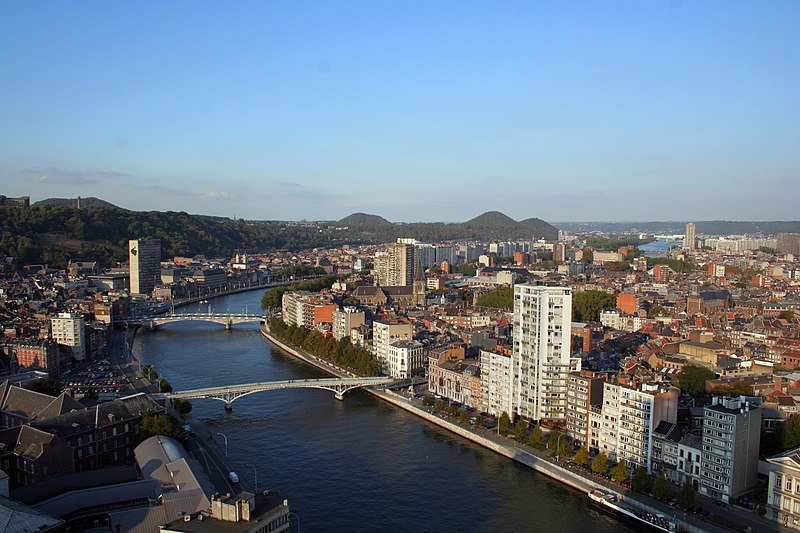
File:Liege_View_03.jpg · Wikimedia Commons · See Wikimedia Commons
Liège
Sign in to saveAlso known as Lîdje, Luik, Luuk, Lüttich
Liège ( ; ; ; ; ) is a city and municipality in the Belgian region of Wallonia, and the capital of the eponymous province. The city is situated in the valley of the Meuse, in the east of Belgium, not far from borders with the Netherlands (Maastricht is about to the north) and with Germany (Aachen is about north-east). In Liège, the Meuse meets the river Ourthe. The city is part of the sillon industriel, the former industrial backbone of Wallonia. It is still the principal economic and cultural centre of the region.
Liège is a city in eastern Belgium, located in the Wallonia region where the Meuse and Ourthe rivers meet, near the borders with the Netherlands and Germany. It serves as the capital of its province and remains the main economic and cultural center of Wallonia, though it was historically built on industrial manufacturing.
AI-generated from the Wikipedia summary — may contain errors.
Weather now
cached 71h ago7-day forecast
via Open-Meteo
Key facts
- Belgium municipality.name
- Liège
- Belgium municipality.namenl
- Luik
- Belgium municipality.namede
- Lüttich
- Belgium municipality.type
- city
- Belgium municipality.imagesize
- 250px
- Belgium municipality.map
- Liège Liège Belgium Map.svg
- Belgium municipality.map legend
- The municipality of Liège in the province of Liège
- Belgium municipality.arms
- Luik stadswapen.svg
- Belgium municipality.flag
- LuikVlag.svg
- Belgium municipality.province
- Liège
- Belgium municipality.arrondissement
- Liège
- Belgium municipality.nis
- 62063
- Belgium municipality.mayor
- Willy Demeyer (PS)
- Belgium municipality.majority
- PS – MR
- Belgium municipality.postal codes
- 4000–4032
- Belgium municipality.telephone area
- 04
- Belgium municipality.footnotes
- 70px|center
via Wikipedia infobox
Wikidata facts
- Official name
- Luuk
- Demonym
- liegesi
- Population
- 195278
- Area
- 68.65
- Elevation
- 66
- Official website
- www.liege.be
- Image
- Liege View 01.jpg
- Dialing code
- 04
Show 12 more facts
- Commons category
- Liège
- postal code
- 4032
- Commons gallery
- Liège
- annual number of weddings
- 558
- inception
- 0800-00-00
- native label
- Lîdje
- P8168
- Rorbach-lès-Dieuze
- phone number
- +32-4-221-81-11
- social media followers
- 9136
- P12749
- Huffman coding
- P13200
- Poissy
- number of viewers/listeners
- 1564134
Sources (13)
via Wikidata · CC0
Travel guide
Understand
thumb|right|View from Saint Martin At the foot of Ardennes on the river Meuse, it has been a prominent urban centre since the Middle Ages, but really blossomed during the industrial revolution, when it grew to become Belgium's third-largest metropolis, after Brussels and Antwerp. Thanks to its strategic position, Liège still enjoys relative affluence and economic importance, in contrast to its fellow Wallon cities farther south.
Despite its size and location in-between some of the most-visited cities in Europe, Liège sees very little tourist traffic. It is the largest city of Wallonia, the French-speaking part of Belgium, and the capital city of the namesake province.
Liège has been an important city since the early Middle Ages. It was the capital of the Principality (prince-bishopric) of Liège, which remained an independent state until the French Revolution (around 1789). In the 19th century it became an early centre of industrialism. Today it is a large city of 200,000 inhabitants, with a total 750,000 in its metropolitan area. A city heavily shaped by waves of immigrants, Liège has important Italian (making up at least 5% of the population), Spanish, German, Moroccan, Turkish, and Sub-Saharan African communities (the latter being one of the largest in Belgium).
The central area of Liège presents itself as a rather interesting mix of a historic town centre (dotted with a few extremely brutalist buildings from the 1960s and 70s), a rather elegant new town with wide boulev…
Do
Visit the Carré District, where you can celebrate or party on any day, at any time. It's the preferred district of students, alternating shops and cafés, many of which allow dancing (sometimes on the tables!). The Philharmonic Orchestra, Royal Opera, and Theater de la Place head up the cultural life in Liège. Liège is the European city with the most theaters per person. Liège has an international reputation especially for its marionnette theaters, whose performances often involve the traditional folklore character Tchantchès in an unbelievably wide range of situations. The most-known marionnette theaters can be found at: Museum of Wallonian Life (Wednesdays and school holidays at 14:30 and Sundays at 10:30, Cour des Mineurs, +32 4 237 9040, open even when the museum is closed.) Museum of Tchantchès (Oct to end Apr, Sundays at 10:30 and Wednesdays at 1430, rue Surlet 56, +32 4 342 7575) Movie theaters include Le Parc and Le Churchill for European films; Le Palace and Kinepolis for big-name blockbusters; and soon UGC Longdoz in the future "media city". Football: Standard Liège play soccer in Pro League, Belgium's top tier. Their home ground is Stade Maurice Dufrasne (capacity 27,000) on the river bank 2 km south of city centre. RFC Seraing were relegated in 2023 so they now play in Challenger Pro League, the second tier, at Stade de Pairay (capacity 8200) in Seraing city. There are numerous other sports clubs including no less than three rowing clubs. RCAE, a university club …
Buy
Sunday morning market at la rive gauche The Marché de la Batte is where most locals visit on Sundays. The one of the longest markets in Europe stretches along the Meuse River by the Université de Liège and attracts many visitors to Liège. The market typically runs from early morning to 2 o'clock in the afternoon every weekend year long. Produce, clothing, and snack vendors are the main concentration of the market. Flea Markets at Saint Gilles (every Saturday morning on Boulevard Louis Hillier) and Saint Pholien (every Friday morning on Boulevard de la Constitution) also attract many visitors.
Eat
thumbnail|right|La tarte au riz, or rice tart, a provincial specialty In addition to the local foods mentioned above, regional specialities include: boulets sauce-lapin, meatballs in a sauce made from Sirop de Liège, onions, vinegar and prunes, accompanied of course by frites - french fries. The boulet even has its own critics and reviews. la potée liégeoise, a country dish made from beans, potatoes, and bacon bits cooked together and drenched in vinegar. les boûkètes, dark crêpes served at New Year's Eve or other festive occasions le matoufèt, a cross between a crêpe and an omelette, made from flour, eggs, milk and bacon bits, and served either salty or sweet. la tarte au riz, originally from the neighboring city of Verviers or the area of Tancrémont thumbnail|right|It is hard to resist freshly baked Liège waffles, or gaufres de Liège
Prices are fairly high, as in most other Belgian cities. Budget restaurants will cost about €12-15 per person, drinks included, mid-range restaurants between €25 and €50, and splurge restaurants well over that!
For budget solutions, snack shops like any of the sandwicheries or kebab shops offer cheap yet tasty food. A Döner kebab typically costs €3-5, and a sandwich is around €2-4. In Liège all snack shops charge 50 cents for sauce, and usually another 50 cents for vegetables. For example you can see a meatball sandwich for €2 on the price list; however, after the sauce and the vegetables it will be €3 in total. It is recommended to look for …
Drink
thumbnail|right|Rue du Mouton Blanc, a street in "Le Carré" The area known as "Le Carré" offers numerous options to drink and party 365 days per year, with a young, vibrant, student atmosphere. Also worth a visit: the trendier Place du Marché, and the area around Place Cathédrale, to see and be seen. In addition, many of the cafés in the Le Carré area are a good alternative, with plenty of dancing and typically no entrance fee.
Sleep
thumbnail|Stairs of Montagne de Bueren For a city of its size, Liège has surprisingly few accommodation facilities. This is both due to the city's relatively low popularity as a tourist destination and the fact that it is between 1 and 3 hours from many major cities where business traffic to it originates. You may want to take advantage of the latter yourself and stay anywhere closer or farther and come to the city for the day.
Stay safe
Liège is generally a safe city during daytime. However, be cautious at night, especially if you are a woman. It is not recommended for women to walk alone in the evenings, as many foreign female students have been followed late at night. Robbery is rare, but harassment of single females occurs often. It is mostly verbal, but some travelers have been assaulted in off-downtown areas. If where you're staying is more than a 5-min walk from the centre, it is safest to take a cab after 22:00.
Connect
Liège has 4G from all Belgian carriers. As of July 2022, 5G has not reached the city.
Go next
Neupré World War II Ardennes American Cemetery and Memorial commemorates the American soldiers who died in Northern Europe during WWII. Henri-Chapelle World War II Henri-Chapelle American Cemetery and Memorial is the final resting place for 7,992 American military lost during the drive into Germany. Spa is the pleasant town that gave its name to mineral spring resorts. Tongeren dates from Roman times, but its sights are mostly medieval. Maastricht in the Netherlands has an attractive old centre. Aachen (Aix-la-Chapelle) in Germany is ranged around its cathedral, begun in 796 AD.
Travel guide from Wikivoyage (CC BY-SA 4.0)
~31 min read
Article
28 sectionsContents
- Etymology
- History
- Early Middle Ages
- Late medieval and early modern periods
- 18th century to World War I
- World War II to the present
- Climate
- Demographics
- Main sights
- Folklore
- Culture
- Sports
- Economy
- 1812 mine accident
- Transport
- Air
- Maritime
- Rail
- Road
- Notable people
- International relations
- Twin towns - Sister cities - Partner cities
- Sister Cities
- Partner cities
- See also
- Citations
- Bibliography
- External links
Liège ( ; ; ; ; ) is a city and municipality in the Belgian region of Wallonia, and the capital of the eponymous province. The city is situated in the valley of the Meuse, in the east of Belgium, not far from borders with the Netherlands (Maastricht is about to the north) and with Germany (Aachen is about north-east). In Liège, the Meuse meets the river Ourthe. The city is part of the sillon industriel, the former industrial backbone of Wallonia. It is still the principal economic and cultural centre of the region.
The municipality consists of the following sections (sub-municipalities): Liège proper, Angleur, Bressoux, Chênée, Glain, Grivegnée, Jupille-sur-Meuse, Rocourt, and Wandre. In January 2022, Liège had 195,278 inhabitants. The metropolitan area, including the outer commuter zone, covers an area of 1,879 km2 (725 sq mi) and had a total population of 749,110 on 1 January 2008. This includes a total of 52 municipalities, among others, Herstal and Seraing. Liège ranks as the third most populous urban area in Belgium, after Brussels and Antwerp, and the fourth municipality after Antwerp, Ghent and Charleroi. The city is part of the Meuse-Rhine Euroregion.
Gallery (27)
On the map
2 mapped locations
Available in 106 languages
- Español
- Français
- Deutsch
- 中文
- 日本語
- Русский
- Português
- Italiano
- العربية
- Afrikaans
- Albanian
- Albanian
- Aragonese
- Armenian
- Asturian
- Azerbaijani
- Bahasa Indonesia
- Balinese
Show 87 more
- Bashkir
- Basque
- be_x_old
- Belarusian
- Breton
- Bulgarian
- Burmese
- Catalan
- cbk_zam
- Cebuano
- Chechen
- Chuvash
- Colognian
- Corsican
- Croatian
- Czech
- Danish
- Egyptian Arabic
- Esperanto
- Estonian
- Finnish
- Galician
- Georgian
- Greek
- Hebrew
- Hungarian
- hyw
- Icelandic
- Ido
- Interlingue
- Irish
- kai
- Kazakh
- Kyrgyz
- Latin
- Latvian
- Limburgish
- Lithuanian
- Lombard
- Low German
- Luxembourgish
- Malagasy
- Malay
- Maltese
- Marathi
- Nederlands
- Northern Frisian
- Norwegian
- Norwegian Nynorsk
- Occitan
- Old English
- Ossetic
- Picard
- Piedmontese
- Polski
- Romanian
- Scots
- Serbian
- Serbian (Latin)
- Silesian
- simple
- Sinhala
- Slovak
- Slovenian
- Svenska
- Swahili
- Tatar
- Tiếng Việt
- Türkçe
- Ukrainian
- Urdu
- Uzbek
- Veps
- Volapük
- Walloon
- Waray
- Welsh
- West Flemish
- Western Frisian
- Western Panjabi
- Wu Chinese
- Yiddish
- Zeelandic
- zh_yue
- فارسی
- ไทย
- 한국어
via Wikidata sitelinks · CC0