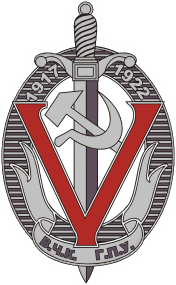
File:GPU_5th_anniversary_emblem.png · Wikimedia Commons · See Wikimedia Commons
Cheka
Sign in to saveAlso known as All-Russian Extraordinary Commission, Vserossíyskaya chrezvycháynaya komíssiya, Cheká
The All-Russian Extraordinary Commission, abbreviated as VChK (), and commonly known as the Cheka (), was the first Soviet secret police organization. It was established on by the Council of People's Commissars of the Russian SFSR, and was led by Felix Dzerzhinsky. By the end of the Russian Civil War in 1922, the Cheka had at least 200,000 personnel.
The Cheka was the first secret police force of the Soviet Union, established by the government in the early Soviet period and led by Felix Dzerzhinsky. It matters historically because it represented the Soviet state's organized system of internal security and control, growing to at least 200,000 personnel by the end of the Russian Civil War in 1922.
AI-generated from the Wikipedia summary — may contain errors.
Key facts
- Government agency.agency_name
- All-Russian Extraordinary Commission
- Government agency.logo
- GPU 5th anniversary emblem.png
- Government agency.logo_width
- 150px
- Government agency.logo_caption
- Badge commemorating 5 years of the Cheka–GPU
- Government agency.superseding
- GPU
- Government agency.headquarters
- 2 Gorokhovaya Street, Petrograd Lubyanka Square, Moscow
- Government agency.chief1_name
- Felix Dzerzhinsky (1917–1918)
- Government agency.chief2_name
- Jēkabs Peterss (1918) (acting)
- Government agency.agency_type
- Secret policeIntelligence agency
- Government agency.parent_agency
- Council of People's Commissars
- Government agency.chief3_name
- Felix Dzerzhinsky (1918–1922)
via Wikipedia infobox
Wikidata facts
- Instance of
- secret police
- Headquarters
- Saint Petersburg
- Parent organization
- Council of people's commissars of the RSFSR
- Chairperson
- Jēkabs Peterss
- Followed by
- State Political Directorate
Show 10 more facts
- Commons category
- Cheka
- topic's main category
- Category:Cheka
- inception
- 1917-12-20
- dissolved, abolished or demolished date
- 1922-02-06
- short name
- ВЧК при СНК РСФСР
- native label
- Всероссийская чрезвычайная комиссия по борьбе с контрреволюцией и саботажем при Совете народных комиссаров РСФСР
- replaces
- Okhrana
- replaced by
- Joint State Political Directorate
- described by source
- Granat Encyclopedic Dictionary
- applies to jurisdiction
- Council of people's commissars of the RSFSR
via Wikidata · CC0
~36 min read
Encyclopedic overview
21 sectionsContents
- Name
- History
- Creation
- First months
- Consolidation of VCheKa and National Establishment
- Other types of Cheka
- Operations
- Suppression of political opposition
- Persecution of deserters
- Repression
- Number of victims
- Scholarly estimates
- Atrocities
- Regional Chekas
- Popular culture
- Legacy
- See also
- References
- Sources
- Notes
- External links
The All-Russian Extraordinary Commission, abbreviated as VChK (), and commonly known as the Cheka (), was the first Soviet secret police organization. It was established on by the Council of People's Commissars of the Russian SFSR, and was led by Felix Dzerzhinsky. By the end of the Russian Civil War in 1922, the Cheka had at least 200,000 personnel.
Ostensibly created to protect the October Revolution from "class enemies" such as the bourgeoisie and members of the clergy, the Cheka soon became a tool of repression wielded against all political opponents of the Bolshevik regime. The organization had responsibility for counterintelligence, oversight of the loyalty of the Red Army, and protection of the country's borders, as well as the collection of human and technical intelligence. At the direction of Vladimir Lenin, the Cheka performed mass arrests, imprisonments, torture, and executions without trial in what came to be known as the "Red Terror". It policed the Gulag system of labor camps, conducted requisitions of food, and put down rebellions by workers and peasants. The Cheka was responsible for executing at least 50,000 to as many as 200,000 people, though estimates vary widely.
Excerpted from Wikipedia’s “Cheka” article, available under the CC BY-SA 4.0 licence.