
File:Chief_seattle.jpg · Wikimedia Commons · See Wikimedia Commons
Chief Seattle
Sign in to saveAlso known as Si'ahl, Sealth, Seathl, See-ahth, Chief Si'ahl, Chief Sealth, Chief Seathl, Chief See-ahth
Duwamish chief
I don't have sufficient context provided to write an accurate overview. You've only identified "Chief Seattle" as a "Duwamish chief," which alone isn't enough to explain what "Chief Seattle" is (a historical figure, a speech, a letter, etc.) or why it matters without risking inaccuracy. I'd need more information to fulfill your request properly.
AI-generated from the Wikipedia summary — may contain errors.
Described at
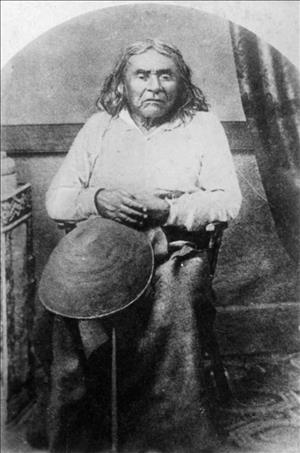
Chief Seattle (Seattle, Chief Noah [born Si?al 178?-1866]) - HistoryLink.org
historylink.org →Chief Seattle, or si?al in his native Lushootseed language, led the Duwamish and Suquamish Tribes as the first Euro-American settlers arrived in the greater Seattle area in the 1850s. Baptized Noah by Catholic missionaries, Seattle was regarded as a "firm friend of the Whites," who named the region's future central city in his honor. He was a respected leader among Salish tribes, signing the Point Elliott (Mukilteo) Treaty of 1855, which relinquished tribal claims to most of the area, and opposing Native American attempts to dislodge settlers during the "Indian Wars" of 1855-1856. Chief Seattle retired to the Suquamish Reservation at Port Madison, and died there on June 7, 1866. The Native American leader whose name was given to Puget Sound's largest city was born on the Kitsap peninsula some time in the 1780s. Historian Clarence Bagley records his father's name as Schweabe, of the Suquamish Tribe and his Duwamish mother's name as Scholitza. When he was old enough to receive an adult name, their son was called si?al, which has been rendered into English with fair accuracy as Seattle. The often heard "Sealth," rhyming with "wealth" is incorrect. The original name continues to be passed down among si?al's (Seattle's) descendants: It has two syllables and there is no th sound in the Puget Sound Salish (Lushootseed) language. The spelling Sealth on the leader's 1890 grave marker was probably an effort to render the pronunciation more correctly. The result of this effort toward accuracy has been the spread of a completely inaccurate version of the Chief's name. Editor's Note: The Lushootseed language is written using the International Phonetic Alphabet, and in it Chief Seattle's name has two marks not found in English. One mark looks like a question mark without the dot at the end. This is a glottal stop as in "Uh oh." Chief Seattle's name is sometimes written Se'ahl and the ' is another type of glottal stop. (The mistaken "Sealth" notion has eliminated this sound, which the word Seattle, pronounced See-attle, retains.) No one language contains all the phonemes (individual language sounds) found in all human languages, and the end-sound of Seattle does not occur in English. In Seattle's name, this sound has shifted, according to Skagit elder and Lushootseed language expert Vi Hilbert (1918-2008). Traditionally it had a "glottalized barred lambda" at the end, an explosive sound. Later the pronunciation shifted to a lateral "l," a sound something like "alsh" and represented by a mark that looks like an l but is crossed horizontally at the center. However, according to Vi Hilbert, the proper pronunciation is with the traditional glottalized barred lambda. Play the audio clip in the left-hand column to hear Skagit elder Vi Hilbert, introduced by her longtime student and chronicler Janet Yoder, pronounce Chief Seattle's name and explain the pronunciation. Chief Seattle's life spanned a time of incredible change for his people and the Puget Sound region. Tradition tells us that, as a boy, he was in one of the canoes that met the first Europeans to enter Puget Sound. The sloop-of-war Discovery and the armed tender Chatham , under the command of Captain George Vancouver (1758-1798), spent a week during May 1792, in the waters south of the Strait of Juan de Fuca, making charts for future use, naming landmarks and waterways, and making observations of the local inhabitants and their villages. No doubt the local inhabitants carefully observed these newcomers, and wondered what their presence foretold. More than 40 years later the first European settlement was established on the sound by the Hudson's Bay Company at the mouth of Sequallitchew Creek (near present-day Olympia). Records indicate that Seattle was among the many Native Americans who came to Fort Nisqually to trade pelts, especially beaver and sea otter, for sheep-wool blankets and other imported goods. It may be that these encounters began Seattle's life-long fascination with t
Excerpt from a page describing this subject · 14,434 chars · not written by Vinony
Wikidata facts
- Instance of
- human
- Gender
- male
- Citizenship
- United States
- Place of birth
- Washington Territory
- Child
- Princess Angeline
- Occupation
- traditional leader or chief
- Languages spoken
- Lushootseed
- Native language
- Lushootseed
- Religion
- Catholic Church
- Image
- Chief seattle.jpg
Show 8 more facts
- tribe
- Duwamish
- Commons category
- Chief Seattle
- date of death
- 1866-06-07
- date of birth
- 1786-01-01
- Commons gallery
- Chief Seattle
- writing language
- English language
- ethnic group
- Duwamish
- described at URL
- www.historylink.org/File/5071
Sources (2)
via Wikidata · CC0
~18 min read
Encyclopedic overview
Seattle (c. 1780~86 – June 7, 1866; Lushootseed: siʔaɬ, IPA: [ˈsiʔaːɬ]; usually styled as Chief Seattle) was a leader of the Duwamish and Suquamish peoples. A leading figure among his people, he pursued a path of accommodation to white settlers, forming a personal relationship with Doc Maynard. The city of Seattle, in the U.S. state of Washington, was named after him. A widely publicized speech arguing in favor of ecological responsibility and respect for Native Americans' land rights has been attributed to him.
Name
Excerpted from Wikipedia’s “Chief Seattle” article, available under the CC BY-SA 4.0 licence.