File:Clade-grade_II.svg · Wikimedia Commons · See Wikimedia Commons
clade
Sign in to saveAlso known as monophyletic group, monophyletic taxon, evolutionary clade
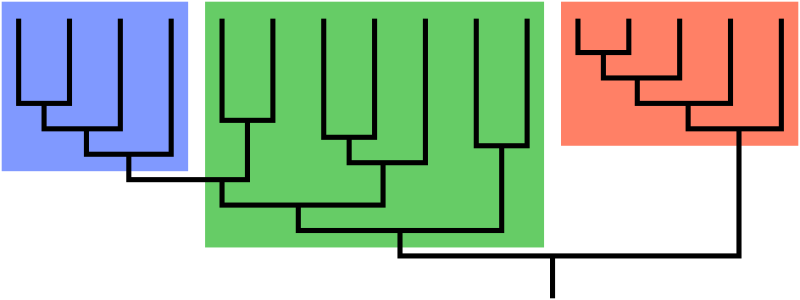
thumb|400px| Cladogram (a branching tree diagram) illustrating the relationships of organisms within groups of taxa known as clades. The vertical line (stem) at the base (bottom) represents the [[last common ancestor. The blue and red subgroups are clades, each defined by a common ancestor stem at the base of its respective subgroup (branch). The green subgroup alone, however, is not a clade; it is a paraphyletic group relative to the blue subgroup because it excludes the blue branch, which shares the same common ancestor. Together, the green and blue subgroups form a clade.]]
A clade is a group of organisms that includes a common ancestor and all of its descendants, shown as branches on a tree diagram. Scientists use clades to understand evolutionary relationships because they reveal which species are most closely related by shared ancestry.
AI-generated from the Wikipedia summary — may contain errors.
Wikidata facts
- Instance of
- taxonomic rank
- Subclass of
- taxon
- Part of
- cladistics
- Image
- Cladogram Crocodilia NL.PNG
Show 3 more facts
- topic has template
- Template:Clade
- manifestation of
- monophyly
- has characteristic
- monophyly
Sources (2)
via Wikidata · CC0
~9 min read
Encyclopedic overview
12 sectionsContents
- Naming and etymology
- History of nomenclature and taxonomy
- Definition
- Clades and phylogenetic trees
- Terminology
- Age
- Viruses
- See also
- Notes
- References
- Bibliography
- External links
thumb|400px| Cladogram (a branching tree diagram) illustrating the relationships of organisms within groups of taxa known as clades. The vertical line (stem) at the base (bottom) represents the [[last common ancestor. The blue and red subgroups are clades, each defined by a common ancestor stem at the base of its respective subgroup (branch). The green subgroup alone, however, is not a clade; it is a paraphyletic group relative to the blue subgroup because it excludes the blue branch, which shares the same common ancestor. Together, the green and blue subgroups form a clade.]]
In biology, a clade () (), also known as a monophyletic group or natural group, is a group of organisms that is composed of a common ancestor and all of its descendants. Clades are the fundamental unit of cladistics, a modern approach to taxonomy adopted by most biological fields.
Excerpted from Wikipedia’s “clade” article, available under the CC BY-SA 4.0 licence.
Gallery (15)
Available in 72 languages
- Español
- Français
- Deutsch
- 中文
- 日本語
- Русский
- Português
- Italiano
- العربية
- हिन्दी
- Afrikaans
- Aragonese
- Armenian
- Asturian
- Azerbaijani
- Bahasa Indonesia
- Basque
- Belarusian
Show 53 more
- Bosnian
- Bulgarian
- Catalan
- Chuvash
- Czech
- Esperanto
- Estonian
- Finnish
- Galician
- Georgian
- Greek
- Hebrew
- Hungarian
- Icelandic
- Iloko
- Interlingua
- Irish
- Javanese
- Kabyle
- Kashmiri
- Latin
- Latvian
- Limburgish
- Low German
- Macedonian
- Malay
- Malayalam
- Maltese
- Manx
- Marathi
- Moroccan Arabic
- Nederlands
- Norwegian
- Polski
- Romanian
- Serbian
- Serbian (Latin)
- Sindhi
- Slovak
- Slovenian
- Svenska
- Tamil
- Tiếng Việt
- Türkçe
- Ukrainian
- Venetian
- West Flemish
- Western Frisian
- Wu Chinese
- zh_yue
- فارسی
- ไทย
- 한국어
via Wikidata sitelinks · CC0