File:Clade-grade_II.svg · Wikimedia Commons · See Wikimedia Commons
Also known as monophyletic group, monophyletic taxon, evolutionary clade
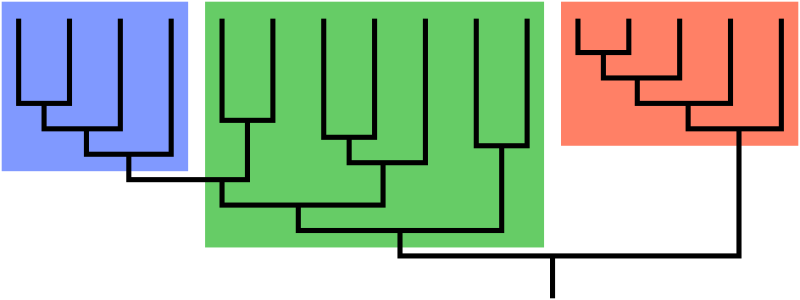
thumb|400px| Cladogram (a branching tree diagram) illustrating the relationships of organisms within groups of taxa known as clades. The vertical line (stem) at the base (bottom) represents the [[last common ancestor. The blue and red subgroups are clades, each defined by a common ancestor stem at the base of its respective subgroup (branch). The green subgroup alone, however, is not a clade; it is a paraphyletic group relative to the blue subgroup because it excludes the blue branch, which shares the same common ancestor. Together, the green and blue subgroups form a clade.]]
A clade is a group of organisms that includes a common ancestor and all of its descendants, shown as branches on a tree diagram. Scientists use clades to understand evolutionary relationships because they reveal which species are most closely related by shared ancestry.
AI-generated from the Wikipedia summary — may contain errors.
Wikidata facts
- Instance of
- taxonomic rank
- Subclass of
- taxon
- Part of
- cladistics
- Image
- Cladogram Crocodilia NL.PNG
Show 3 more facts
- topic has template
- Template:Clade
- manifestation of
- monophyly
- has characteristic
- monophyly
Sources (2)
via Wikidata · CC0
Article · 日本語
分岐群(ぶんきぐん、クレード、英: clade)とは、ある共通の祖先から進化した生物すべてを含む生物群のこと。分岐分類学における単系統群(monophyletic group)、進化分類学における(holophyletic group)と同じ。 対義語は(だんかいぐん、グレード、英: grade)であり、ボディプランが類似する生物群を示す。例として段階群による脊椎動物の分類体系では爬虫類という祖先群(ancestral grade)の中に鳥類や哺乳類という子孫群(descendant grade)が位置し、同様に爬虫類は両生類と魚類という祖先群を持つ。分岐分類学ではこのような祖先群は側系統群とされ、分岐群(単系統群)以外は分類群として認めないとする意見もあり、この観点では爬虫類は鳥類を含めて哺乳類(単弓類)を含まない分岐群として再定義される。
Abstract from DBpedia / Wikipedia · CC BY-SA
Gallery (15)
Available in 72 languages
- Español
- Français
- Deutsch
- 中文
- 日本語
- Русский
- Português
- Italiano
- العربية
- हिन्दी
- Afrikaans
- Aragonese
- Armenian
- Asturian
- Azerbaijani
- Bahasa Indonesia
- Basque
- Belarusian
Show 53 more
- Bosnian
- Bulgarian
- Catalan
- Chuvash
- Czech
- Esperanto
- Estonian
- Finnish
- Galician
- Georgian
- Greek
- Hebrew
- Hungarian
- Icelandic
- Iloko
- Interlingua
- Irish
- Javanese
- Kabyle
- Kashmiri
- Latin
- Latvian
- Limburgish
- Low German
- Macedonian
- Malay
- Malayalam
- Maltese
- Manx
- Marathi
- Moroccan Arabic
- Nederlands
- Norwegian
- Polski
- Romanian
- Serbian
- Serbian (Latin)
- Sindhi
- Slovak
- Slovenian
- Svenska
- Tamil
- Tiếng Việt
- Türkçe
- Ukrainian
- Venetian
- West Flemish
- Western Frisian
- Wu Chinese
- zh_yue
- فارسی
- ไทย
- 한국어
via Wikidata sitelinks · CC0