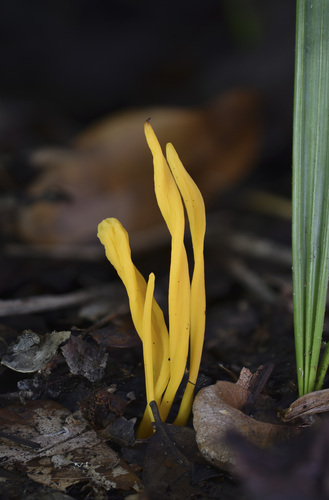
(c) Scott Ostuni, some rights reserved (CC BY-NC), uploaded by Scott Ostuni · cc-by-nc
Clavariaceae
Sign in to saveThe Clavariaceae are a family of fungi in the order Agaricales. Originally the family contained most of the clavarioid fungi (club and coral fungi), but in its current sense is more restricted, albeit with a greater diversity of basidiocarp (fruit body) forms. Basidiocarps are variously clavarioid or agaricoid (mushroom-shaped), less commonly corticioid (effused, crust-like) or hydnoid (with pendant spines).
Species
Ember Spindle
FAMILY
- KingdomFungi
- PhylumBasidiomycota
- ClassAgaricomycetes
- OrderAgaricales
- FamilyClavariaceae
Рогатиковые (также рогатики, булавастики, булавницы, коралловые грибы; лат. Clavariaceae) — одно из трёх семейств крупных грибов, к которым относят род рамария. Насчитывает 7 родов и 120 видов. В других классификациях рассматривалось как род в семействе гименомицетовые (группа базидиомицеты). Одни из булавниц имеют вид булавочных пестов (откуда их русское название), длиною с палец и толщиною до 4 мм, другие растут кустиками, третьи образуют комки и наросты, величиною от кулака до тыквы и похожие на кораллы, головку цветной капусты и т. п. Употребляются в пищу, как и другие грибы.
via GBIF
Museum specimens
- Specimen records
- 227
- With media
- 47
- Family
- Clavariaceae
- Collections
- US, LSUM, UFPB, FH, MEL
- Recorded in
- Guyana, United States, Brasil, Australia
Wikidata facts
- Instance of
- taxon
- Parent taxon
- Agaricales
- Image
- Clavulinopsis corallinorosacea.jpg
Show 6 more facts
- taxon name
- Clavariaceae
- taxon rank
- family
- topic's main category
- Category:Clavariaceae
- Commons category
- Clavariaceae
- described by source
- Granat Encyclopedic Dictionary
- taxon author citation
- Chevall. (1826)
via Wikidata · CC0
~3 min read
Encyclopedic overview
7 sectionsContents
- Taxonomy
- History
- Current status
- Habitat and distribution
- Ecology
- See also
- References
The Clavariaceae are a family of fungi in the order Agaricales. Originally the family contained most of the clavarioid fungi (club and coral fungi), but in its current sense is more restricted, albeit with a greater diversity of basidiocarp (fruit body) forms. Basidiocarps are variously clavarioid or agaricoid (mushroom-shaped), less commonly corticioid (effused, crust-like) or hydnoid (with pendant spines).
==Taxonomy== ===History=== Clavariaceae was originally circumscribed (as "Clavariae") by French botanist and mycologist François Fulgis Chevallier in 1826. It was one of five families (along with the Agaricaceae, Hydnaceae, Polyporaceae, and Thelephoraceae) that Elias Fries used to divide the Agaricales and Aphyllophorales in his influential work Systema Mycologicum. The family served as a convenient placement for all genera containing species with superficially similar club or coral-like fruitbodies. It was first M.A. Donk and later E.J.H. Corner who realized that, in this broad sense, the family was not a natural phylogenetic assemblage of related species. Corner published his world monograph in 1950 (revised in 1967 and updated in 1970), introducing modern concepts of many genera of clavarioid fungi. Corner included three genera in his concept of the Clavariaceae: Clavaria, Clavulinopsis, and Ramariopsis.
Excerpted from Wikipedia’s “Clavariaceae” article, available under the CC BY-SA 4.0 licence.