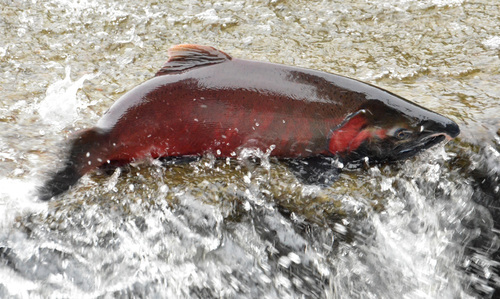
(c) Mike Patterson, some rights reserved (CC BY-NC), uploaded by Mike Patterson · cc-by-nc
coho salmon
Sign in to saveAlso known as Oncorhynchus kisutch, silver salmon
species of Pacific salmon
OverviewAI-generated
Coho salmon (*Oncorhynchus kisutch*) is a species of fish belonging to the family Salmonidae and the order Salmoniformes. The taxon was described by Walbaum in 1792 and is classified within the class Teleostei and phylum Chordata. It is an accepted species name that falls under the parent taxon *Oncorhynchus*. Common names for this organism include coho salmon, Coho Salmon, and cohozalm.
The species inhabits marine, brackish, and freshwater environments. It is categorized as a food product and a subclass of fish as food. The coho salmon has a sequenced genome available through Ensembl. Information regarding its description, life history, range, and habitat is provided by the Alaska Department of Fish and Game. The species has been the subject of 1,229 PubMed records and 5,700 iNaturalist observations.
Synthesized by Vinony from 32 facts across 6 sources: Wikidata, Firecrawl, iNaturalist, PubMed, WoRMS, Vinony graph. Generated from structured data (not the Wikipedia text) and checked against those facts — may still contain errors.
Species
Coho salmon
Species
- PhylumChordata
- ClassTeleostei
- OrderSalmoniformes
- FamilySalmonidae
Maximum longevity: 5 years (wild) Observations: The salmon ages and dies shortly after spawning. It is not considered ageing but rather sudden death.
via
Research
1,229 papers- A ubiquitous tire rubber-derived chemical induces acute mortality in coho salmon.Science (New York, N.Y.) · 2021
- Population-size history inferences from the coho salmon (Oncorhynchus kisutch) genome.G3 (Bethesda, Md.) · 2023
- Continuous light (relative to a 12:12 photoperiod) has no effect on anxiety-like behaviour, boldness, and locomotion in coho salmon (Oncorhynchus kisutch) post-smolts in recirculating aquaculture systems at a salinity of either 2.5 or 10 ppt.Comparative biochemistry and physiology. Part A, Molecular & integrative physiology · 2022
- Acute Toxicity of 6PPD-Quinone to Early Life Stage Juvenile Chinook (Oncorhynchus tshawytscha) and Coho (Oncorhynchus kisutch) Salmon.Environmental toxicology and chemistry · 2023
- Blood-Brain and Blood-Gill Barrier Disruption in Coho Salmon Exposed to Roadway Runoff and 6PPD-Quinone.Environmental science & technology · 2025
via PubMed
Described at

Coho Salmon Species Profile, Alaska Department of Fish and Game
General information about Coho Salmon in Alaska such as description, life history, range, habitat and more.
adfg.alaska.gov →Adults usually weigh 8 to 12 pounds and are 24 to 30 inches long, but individuals weighing 31 pounds have been landed. Adults in salt water or newly returning to fresh water are bright silver with small black spots on the back and on the upper lobe of the tail fin. They can be distinguished from Chinook salmon by the lack of black spots on the lower lobe of the tail and by their white gums; Chinook have small black spots on both tail fin lobes and they have black gums. Spawning adults of both sexes have dark backs and heads with maroon to reddish sides. Adults usually weigh 8 to 12 pounds and are 24 to 30 inches long, but individuals weighing 31 pounds have been landed. Adults in salt water or newly returning to fresh water are bright silver with small black spots on the back and on the upper lobe of the tail fin. They can be distinguished from Chinook salmon by the lack of black spots on the lower lobe of the tail and by their white gums; Chinook have small black spots on both tail fin lobes and they have black gums. Spawning adults of both sexes have dark backs and heads with maroon to reddish sides. Coho salmon enter spawning streams from July to November, usually during periods of high runoff. The female digs a nest, called a redd, and deposits 2,400 to 4,500 eggs. As the eggs are deposited, they are fertilized with sperm, known as milt, from the male. The eggs develop during the winter, hatch in early spring, and the embryos remain in the gravel utilizing their egg yolk until they emerge in May or June. During the fall, juvenile coho may travel miles before locating off-channel habitat where they pass the winter free of floods. Some fish leave fresh water in the spring and rear in brackish estuarine ponds and then migrate back into fresh water in the fall. They spend one to three winters in streams and may spend up to five winters in lakes before migrating to the sea as smolt. Time spent at sea varies. Some males (called jacks) mature and return after only 6 months at sea at a length of about 12 inches, while most fish stay 18 months before returning as full size adults. In freshwater, coho fry feed voraciously on a wide range of aquatic insects and plankton. They also consume eggs deposited by adult spawning salmon. Their diet at sea consists mainly of fish and squid. Little is known about the ocean migrations of coho salmon. High seas tagging shows that maturing Southeast Alaska coho move northward throughout the spring and appear to concentrate in the central Gulf of Alaska in June. They later disperse towards shore and migrate along the shoreline until they reach their stream of origin. The emergent fry occupy shallow stream margins, and, as they grow, establish territories which they defend from other salmonids. Coho fry live in ponds, lakes, and pools within streams and rivers, usually among submerged, woody debris- in quiet areas free of current. Coho are found in coastal waters of Alaska from Southeast to Point Hope on the Chukchi Sea and in the Yukon River to the Alaska-Yukon border. Coho are extremely adaptable and occur in nearly all accessible bodies of fresh water, from large trans-boundary watersheds to small tributaries. The status of coho populations in the California and the Pacific Northwest varies; some are healthy and robust while one is listed as endangered and three are considered threatened under the Endangered Species Act. Coho salmon populations in Alaska are healthy. Over the longer term, the natural production of this species, particularly in the southern portions of its range, will continue to be challenged by freshwater environmental change brought about by increasing human development and climate change. Populations at lower latitudes will likely continue to experience greater variability in both smolt production and marine survival compared with Alaska's populations. Recent declines in hatchery production combined with environmental and management changes make it unlikely that the Pa
Excerpt from a page describing this subject · 12,391 chars · not written by Vinony
Wikidata facts
- Instance of
- food product
- Subclass of
- fish as food
- Parent taxon
- Oncorhynchus
- Image
- Coho.jpg
Show 7 more facts
- Commons category
- Oncorhynchus kisutch
- taxon rank
- species
- taxon name
- Oncorhynchus kisutch
- described at URL
- spsseg.org/meet-the-7-species-of-pacific-salmon
- sequenced genome URL
- www.ensembl.org/Oncorhynchus_kisutch
- taxon common name
- hopealohi
- short name
- O. kisutch
Sources (3)
via Wikidata · CC0
~12 min read
Encyclopedic overview
The coho salmon (Oncorhynchus kisutch) is a species of anadromous fish in the salmon family and one of the six Pacific salmon species. Coho salmon are also known as silver salmon (or "silvers") and is often sold as medium red salmon. "Coho" was borrowed into English from the word k̓ʷə́xʷəθ, the species' name in the downriver dialect of the Halkomelem language spoken in Vancouver. The scientific species name is based on the Russian common name kizhuch (кижуч).
Description
Excerpted from Wikipedia’s “coho salmon” article, available under the CC BY-SA 4.0 licence.