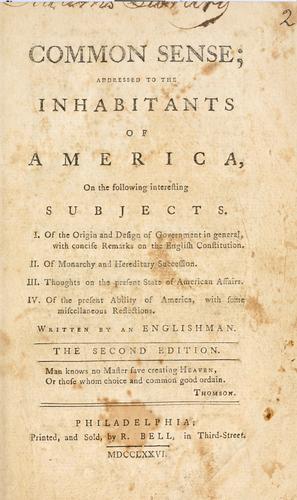
Cover via Open Library · Open Library
In the Vinony graph
Vinony's link graph records 552 inbound references to Common Sense, and connects out to John Adams, constitutional monarchy and George III.
The entry is geolocated on the map in PA.
It sits within the topics 1776 non-fiction books, American pamphlets and American political philosophy literature.
Vinony links it to 31 Wikipedia language editions.
Key facts
- Author
- Thomas Paine
- Language
- English
- Published
- January 10, 1776 ; 250 years ago ( 1776-01-10 )
- Publication place
- British America
- Text
- Common Sense at Wikisource
via Wikipedia infobox
Wikidata facts
- Read free · Project Gutenberg
- #3755
- Instance of
- literary work
- Author
- Thomas Paine
- Genre
- essay
- Country of origin
- United States
- Main subject
- politics
- Image
- Commonsense.jpg
Show 5 more facts
- publication date
- 1776-00-00
- language of work or name
- English language
- title
- Common Sense
- copyright status
- public domain
- Commons category
- Common Sense (pamphlet)
Sources (1)
via Wikidata · CC0
~22 min read
Encyclopedic overview
Common Sense is a 47-page pamphlet written by Thomas Paine in 1775–1776 advocating independence from Great Britain to people in the Thirteen Colonies. Writing in clear and persuasive prose, Paine collected moral and political arguments to encourage common people in the Colonies to fight for egalitarian government. It was published anonymously on January 10, 1776, at the beginning of the American Revolution and became an immediate sensation.
Published in Philadelphia, Common Sense was sold and distributed widely and read aloud at taverns and meeting places. In proportion to the population of the colonies at that time, 2.5 million, it had the largest sale and circulation of any book published in American history. As of 2006, it remains the all-time best-selling American title and is still in print today.
Excerpted from Wikipedia’s “Common Sense” article, available under the CC BY-SA 4.0 licence.