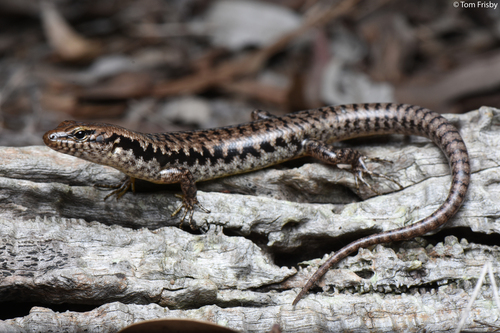
(c) Tom Frisby, all rights reserved, uploaded by Tom Frisby
Concinnia
Sign in to saveConcinnia is a genus of skinks in the subfamily Sphenomorphinae.
Species
Southern Bar-sided Skink
GENUS
- KingdomAnimalia
- PhylumChordata
- ClassSquamata
- FamilyScincidae
via GBIF
Museum specimens
- Specimen records
- 294
- With media
- 4
- Family
- Scincidae
- Collections
- QM, AM
- Recorded in
- Australia
Wikidata facts
- Instance of
- taxon
- Parent taxon
- Sphenomorphinae
- Image
- Bar-sided Forest-skink (Eulamprus tenuis) (9899640984).jpg
Show 5 more facts
Sources (2)
via Wikidata · CC0
~3 min read
Encyclopedic overview
4 sectionsContents
- Taxonomy and systematics
- Species
- References
- Further reading
Concinnia is a genus of skinks in the subfamily Sphenomorphinae.
==Taxonomy and systematics== The genus Concinnia belongs to the Australian Sphenomorphid clade that contains other genera such as Ctenotus, Anomalopus and the Eulamprus water skinks. This genus was raised by Skinner et al.(2013) based on molecular phylogenetic analysis of mitochondrial and nuclear DNA sequences, which showed that five sampled species from the Eulamprus tenuis group formed a well supported clade with the then monotypic genera Gnypetoscincus and Nangura. Wells and Wellington (1983) coined the name Concinnia and applied it to the Eulamprus tenuis group delimited by Greer (1989). Although this tenuis group may form a clade it did not receive strong support in molecular phylogenetic analyses, with C. amplus and C. frerei forming deep lineages of uncertain position relative to C. queenslandiae and C. spinosus. Consequently, Skinner et al. (2013) united the well supported broader clade, including Gnypetoscincus and Nangura in Concinnia, including C. frerei and C. sokosoma based on the work of O'Connor and Moritz (2003). Skinner et al. (2013) further restricted the genus Eulamprus to the water skinks assigned by Greer (1989) to the Eulamprus quoyii group and created two new genera, Silvascincus for species in Greer's (1989) Eulamprus murrayi group (including E. murrayi and E. tryoni), and Tumbunascincus for Eulamprus luteilateralis.
Excerpted from Wikipedia’s “Concinnia” article, available under the CC BY-SA 4.0 licence.
Gallery (2)
Available in 10 languages
via Wikidata sitelinks · CC0