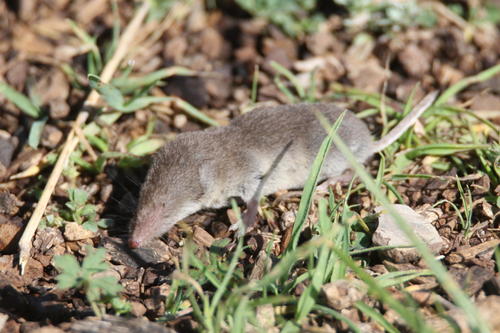
(c) Galen Stewart, all rights reserved, uploaded by Galen Stewart
Cryptotis
Sign in to saveAlso known as Small-eared shrew
The genus Cryptotis is a group of relatively small shrews with short ears, which are usually not visible, and short tails, commonly called small-eared shrews. They have 30 teeth and are members of the red-toothed shrew subfamily. Since 1992, Neal Woodman (in cooperation with Robert Timm) at the United States National Museum has been in the process of revising the genus. To date, this has resulted in an increase in the number of species from 12 to 30.
Species
North American Least Shrew
PHYLUM
- KingdomAnimalia
- PhylumChordata
Die Kleinohrspitzmäuse (Cryptotis) sind eine artenreiche, in Amerika verbreitete Spitzmausgattung. Inhaltsverzeichnis 1 Merkmale 2 Verbreitung und Lebensraum 3 Lebensweise 4 Gefährdung 5 Systematik 6 Literatur 7 Weblinks Merkmale Kleinohrspitzmäuse sind vergleichsweise kleine Spitzmäuse, sie erreichen Kopfrumpflängen von 5 bis 10 Zentimetern, wozu noch ein 1 bis 4 Zentimeter langer Schwanz kommt, und ein Gewicht von 4 bis 7 Gramm. Das Fell ist an der Oberseite braun oder schwarz gefärbt, die Unterseite oft nur wenig heller. Namensgebendes Merkmal sind die kleinen Ohren, die kaum aus dem Fell ragen, auch die Augen sind klein. Verbreitung und Lebensraum Das Verbreitungsgebiet der Kleinohrspitzmäuse reicht vom Südosten Kanadas und den östlichen USA über Mittelamerika bis in das nördliche Südamerika (Kolumbien, Ecuador, Nordperu und Venezuela). Sie sind damit die einzige Spitzmausgattung, ja die einzige Gattung der Insektenfresser überhaupt, die südlich von Guatemala lebt und auch in Südamerika vorkommt. Ihr Verbreitungsschwerpunkt liegt in Mittelamerika, in Kanada und den USA lebt mit Cryptotis parva nur eine einzige Art. Ihr bevorzugter Lebensraum sind Wälder, manche Arten (wie C. pa
via GBIF
Museum specimens
- Specimen records
- 1,803
- With media
- 120
- Family
- Soricidae
- Collections
- UAMI, CIBYC-UAEM, CM, SEMAHN, MZFC-FC-UNAM
- Recorded in
- Mexico, United States
Wikidata facts
- Instance of
- taxon
- Parent taxon
- Blarinini
- Image
- Exhibit Museum of Natural History, Ann Arbor - IMG 9033.JPG
Show 5 more facts
- taxon name
- Cryptotis
- Commons category
- Cryptotis
- taxon rank
- genus
- topic's main category
- Category:Cryptotis
- temporal range start
- Early Miocene
Sources (1)
via Wikidata · CC0
~3 min read
Encyclopedic overview
3 sectionsContents
- List of species
- References
- External links
The genus Cryptotis is a group of relatively small shrews with short ears, which are usually not visible, and short tails, commonly called small-eared shrews. They have 30 teeth and are members of the red-toothed shrew subfamily. Since 1992, Neal Woodman (in cooperation with Robert Timm) at the United States National Museum has been in the process of revising the genus. To date, this has resulted in an increase in the number of species from 12 to 30.
Members of the genus are found mainly in Central America; the North American least shrew, C. parva, is the only species found north of Mexico. The genus occurs as far south as northern Peru and as far east as western Venezuela in South America. It is the only soricomorph genus found south of Guatemala. The limited diversity and restricted northern distribution of shrews in South America implies that the group entered the continent relatively recently from Central America, where they are more diverse, presumably as part of the Great American Interchange. However, shrews have no fossil record in South America that would allow their arrival to be dated.
Excerpted from Wikipedia’s “Cryptotis” article, available under the CC BY-SA 4.0 licence.