File:Bcrablmet.jpg · Wikimedia Commons · See Wikimedia Commons
cytogenetics
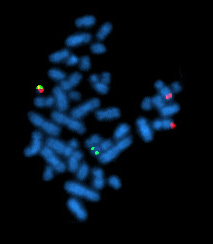
Sign in to saveright|thumb|A metaphase cell positive for the BCR/ABL rearrangement using FISH Cytogenetics is essentially a branch of genetics, but is also a part of cell biology/cytology (a subdivision of human anatomy), that is concerned with how the chromosomes relate to cell behaviour, particularly to their behaviour during mitosis and meiosis. Techniques used include karyotyping, analysis of G-banded chromosomes, other cytogenetic banding techniques, as well as molecular cytogenetics such as fluorescence in situ hybridization (FISH) and comparative genomic hybridization (CGH).
Wikidata facts
- Instance of
- medical specialty
- Subclass of
- genetics
Show 2 more facts
- topic's main category
- Category:Cytogenetics
- Commons category
- Cytogenetics
via Wikidata · CC0
~17 min read
Encyclopedic overview
20 sectionsContents
- History
- Beginnings
- Applications of cytogenetics
- McClintock's work on maize
- Natural populations of ''Drosophila''
- Lily and mouse
- Human abnormalities and medical applications
- Advent of banding techniques
- Beginnings of molecular cytogenetics
- Techniques
- Karyotyping
- Slide preparation
- Analysis
- Fluorescence in situ hybridization
- Slide preparation
- Analysis
- Future of cytogenetics
- See also
- References
- External links
right|thumb|A metaphase cell positive for the BCR/ABL rearrangement using FISH Cytogenetics is essentially a branch of genetics, but is also a part of cell biology/cytology (a subdivision of human anatomy), that is concerned with how the chromosomes relate to cell behaviour, particularly to their behaviour during mitosis and meiosis. Techniques used include karyotyping, analysis of G-banded chromosomes, other cytogenetic banding techniques, as well as molecular cytogenetics such as fluorescence in situ hybridization (FISH) and comparative genomic hybridization (CGH).
==History==
Excerpted from Wikipedia’s “cytogenetics” article, available under the CC BY-SA 4.0 licence.