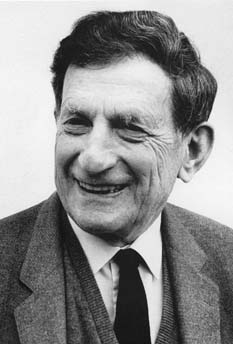
File:David_Bohm.jpg · Wikimedia Commons · See Wikimedia Commons
OverviewAI-generated
David Joseph Bohm was an American, Brazilian, and British physicist, philosopher, and university teacher. Born in Wilkes-Barre in 1917, he worked in physics, quantum physics, and quantum theory. He participated in the Manhattan Project and was nominated for the Nobel Prize in Physics. His notable works include *The Ending of Time: Where Philosophy and Physics Meet*, *Der Dialog*, *Die verborgene Ordnung des Lebens*, *Fragmentation and wholeness*, and *Thought as a system*.
Bohm was educated at the University of Bristol, California Institute of Technology, and University of California, Berkeley. His doctoral advisor was J. Robert Oppenheimer. He taught at the University of São Paulo, Birkbeck, University of London, University of California, Berkeley, and Princeton University. He was a doctoral student of Oppenheimer and supervised David Pines, Yakir Aharonov, Jeffrey Bub, and Harry J. Lipkin. He was a member of the Royal Society and received the Elliott Cresson Medal. He died of myocardial infarction in London in 1992.
Synthesized by Vinony from 28 facts across 3 sources: Wikidata, Open Library, Vinony collections. Generated from structured data (not the Wikipedia text) and checked against those facts — may still contain errors.
Person · Open Library
- Born
- 1917
- Died
- 1992
- Works
- 47
Top works
- The Ending of Time: Where Philosophy and Physics Meet
- Der Dialog
- Die verborgene Ordnung des Lebens
- Fragmentation and wholeness
- Thought as a system
via Open Library + Wikidata
Key facts
- Born
- David Joseph Bohm , ( 1917-12-20 ) 20 December 1917, Wilkes-Barre, Pennsylvania , US
- Died
- 27 October 1992 (1992-10-27) (aged 74), London , England, UK
- Citizenship
- American Brazilian British
- Alma mater
- Pennsylvania State College ( BS ), University of California, Berkeley ( PhD )
- Awards
- 1991 Elliott Cresson Medal 1990 Royal Society fellowship
- Fields
- Theoretical physics
- Institutions
- Princeton University University of São Paulo Technion University of Bristol Birkbeck College, London
- Doctoral advisor
- Robert Oppenheimer
- Doctoral students
- Y. Aharonov D. Pines J. Bub H. Bortoft Eugene P. Gross
via Wikipedia infobox
Wikidata facts
- Instance of
- human
- Given name
- Joseph
- Gender
- male
- Citizenship
- United Kingdom
- Place of birth
- Wilkes-Barre
- Place of death
- London
- Occupation
- physicist
- Employer
- University of Bristol
- Languages spoken
- English language
- Participant in
- Manhattan Project
- Doctoral advisor
- J. Robert Oppenheimer
- Doctoral student
- Eugene P. Gross
- Field of work
- quantum theory
- Image
- David Bohm.jpg
Show 11 more facts
- cause of death
- myocardial infarction
- date of birth
- 1917-12-20
- date of death
- 1992-10-27
- manner of death
- natural causes
- nominated for
- Nobel Prize in Physics
- Commons category
- David Bohm (physicist)
- name in native language
- Böhm Dávid József
- member of
- Royal Society
- influenced by
- Albert Einstein
- ethnic group
- Hungary
- maintained by WikiProject
- WikiProject Mathematics
via Wikidata · CC0
~28 min read
Encyclopedic overview
David Joseph Bohm (/boʊm/; 20 December 1917 – 27 October 1992) was an American physicist who has been described as one of the most significant theoretical physicists of the 20th century and who contributed unorthodox ideas to quantum theory, neuropsychology and the philosophy of mind. Among his many contributions to physics is his causal and deterministic interpretation of quantum theory known as De Broglie–Bohm theory.
Bohm advanced the view that quantum physics meant that the old Cartesian model of reality—that there are two kinds of substance, the mental and the physical, that somehow interact—was too limited. To complement it, he developed a mathematical and physical theory of "implicate" and "explicate" order. He also believed that the brain, at the cellular level, works according to the mathematics of some quantum effects, and postulated that thought is distributed and non-localised just as quantum entities are. Bohm's main concern was with understanding the nature of reality in general and of consciousness in particular as a coherent whole, which according to Bohm is never static or complete.
Excerpted from Wikipedia’s “David Bohm” article, available under the CC BY-SA 4.0 licence.