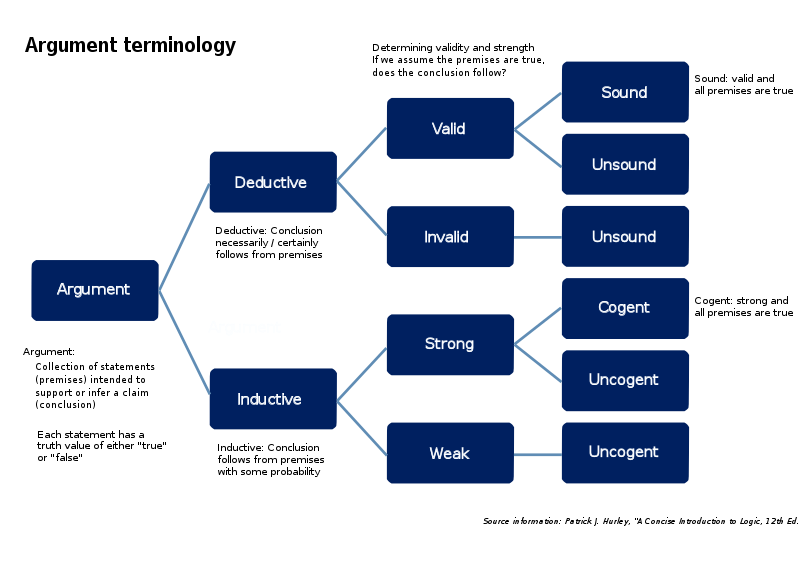
File:Argument_terminology_used_in_logic_(en).svg · Wikimedia Commons · See Wikimedia Commons
Also known as deductive logic, deduction, deductive methods, deductive inference
一般的・普遍的な前提から、より個別的・特殊的な結論を得る論理的推論の方法
Deductive reasoning is a method where you start with statements you accept as true and follow the logical rules of how ideas connect to reach conclusions that must be true. It matters because it allows you to arrive at reliable, certain conclusions rather than just making educated guesses.
AI-generated from the Wikipedia summary — may contain errors.
Wikidata facts
Show 5 more facts
- has characteristic
- working hypothesis
- topic's main category
- Category:Deductive reasoning
- Commons category
- Deductive reasoning
- discoverer or inventor
- Thales
- maintained by WikiProject
- WikiProject Mathematics
via Wikidata · CC0
Article · 日本語
演繹(えんえき、英: deduction)は、一般的・普遍的な前提から、より個別的・特殊的な結論を得る論理的推論の方法である。 帰納に於ける前提と結論の導出関係が「蓋然的」に正しいとされるのみであるのに対し、演繹の導出関係は、その前提を認めるなら、「絶対的」「必然的」に正しい。したがって理論上は、前提が間違っていたり適切でない前提が用いられたりした場合には、誤った結論が導き出されることになる。近代では、演繹法とは記号論理学によって記述できる論法の事を指す。
Abstract from DBpedia / Wikipedia · CC BY-SA
Gallery (2)
Available in 65 languages
- Español
- Français
- Deutsch
- 中文
- 日本語
- Русский
- Português
- Italiano
- العربية
- हिन्दी
- Albanian
- Armenian
- Azerbaijani
- Bahasa Indonesia
- Basque
- Bosnian
- Bulgarian
- Catalan
Show 46 more
- Central Kurdish
- Croatian
- Czech
- Danish
- Esperanto
- Estonian
- Finnish
- Galician
- Greek
- Hebrew
- Hungarian
- Icelandic
- Ido
- Javanese
- Kazakh
- Kikuyu
- Kyrgyz
- Latvian
- Lojban
- Macedonian
- Malay
- Nederlands
- Norwegian
- Norwegian Nynorsk
- Pashto
- Polski
- Romanian
- Serbian
- Serbian (Latin)
- simple
- Slovak
- Slovenian
- Svenska
- Tamil
- Tatar
- Tiếng Việt
- Türkçe
- Ukrainian
- Urdu
- Uzbek
- Western Panjabi
- Wu Chinese
- zh_yue
- فارسی
- ไทย
- 한국어
via Wikidata sitelinks · CC0