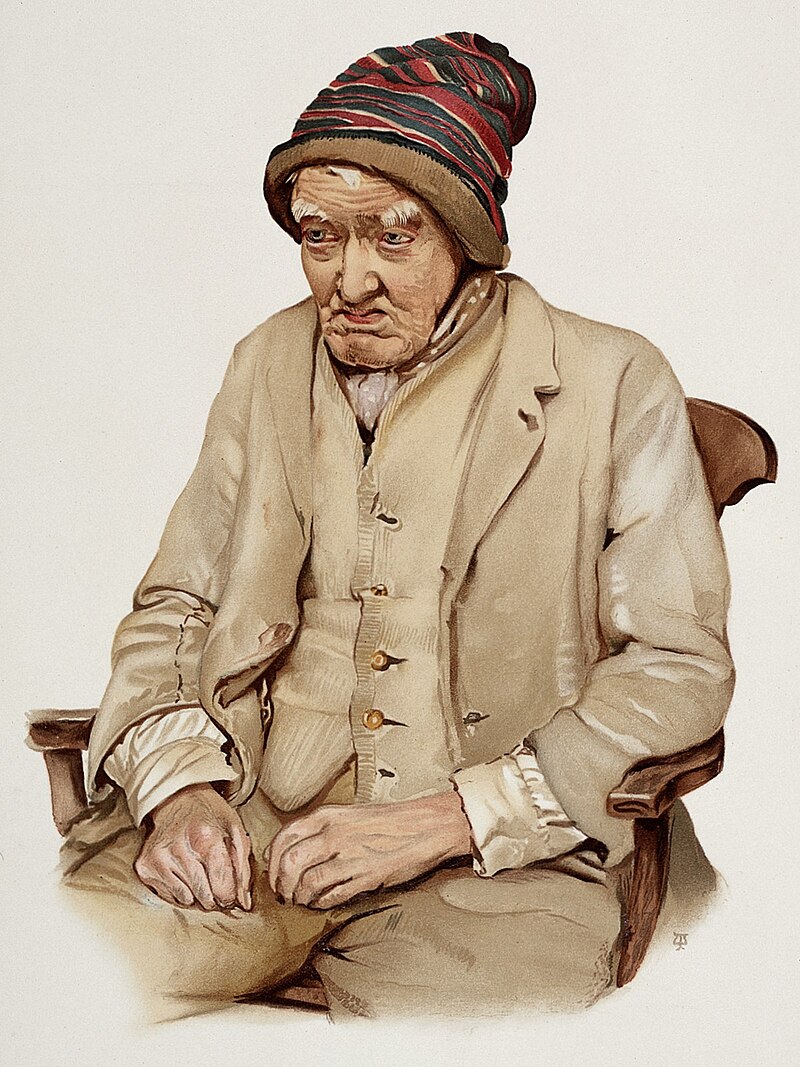
File:An_old_man_diagnosed_as_suffering_from_senile_dementia._Colo_Wellcome_L0026689.jpg · Wikimedia Commons · See Wikimedia Commons
dementia
Sign in to saveAlso known as senility, rare dementia
Dementia is a syndrome, often associated with neurodegenerative diseases such as Alzheimer's, and characterized by a general decline in cognitive abilities that affects a person's ability to perform everyday activities. This typically involves problems with memory, thinking, behavior, and motor control. Aside from memory impairment and a disruption in thought patterns, the most common symptoms of dementia include emotional problems, difficulties with language, and decreased motivation. The symptoms may be described as occurring in a continuum over several stages. Dementia is an incurable, prog
OverviewAI-generated
Dementia is a medical condition categorized under the International Classification of Primary Care version 2 with the identifier P70. It is associated with specific codes in the ICD-9-CM system, including 290.8, 294.8, and 294.1. The condition is also identified by the NCI Thesaurus ID C4786.
The prevalence of dementia is recorded as 0.065. It is linked to several external database identifiers, such as DOID:1307 and Orphanet_89043. In academic literature, the term "dementia" appears in 325,630 PubMed records. Additionally, the subject is referenced by 3,476 other encyclopedia articles.
Synthesized by Vinony from 9 facts across 3 sources: Wikidata, PubMed, Vinony graph. Generated from structured data (not the Wikipedia text) and checked against those facts — may still contain errors.
Key facts
- Medical condition.risks
- Several across the life course (e.g. less education, hearing loss, vision loss, physical inactivity, obesity, high cholesterol, hypertension, diabetes, smoking, excessive alcohol consumption, social isolation, air pollution, traumatic brain injury, depression)
- Medical condition.diagnosis
- Clinical assessment, cognitive testing (mini–mental state examination), and imaging
- Medical condition.differential
- Delirium, depression, hypothyroidism
- Medical condition.prevention
- Addressing risk factors throughout the life course, e.g. preventing, reducing or treating hearing and vision loss, depression, head injury and vascular risk factors (e.g. cholesterol, diabetes), decreasing smoking, and maintaining physical activity and cognitive stimulation
- Medical condition.treatment
- Varies but supportive care is given
- Medical condition.medication
- Varies depending on the type and stage, most medications have a small benefit
- Medical condition.prognosis
- Varies, dementia is a life limiting condition and life expectancy is usually shortened
- Medical condition.frequency
- 57 million (2021)
- Medical condition.deaths
- 1.62 million dementia-related deaths (2019) estimated to increase to 4.91 million by 2050
- Medical condition.name
- Dementia
- Medical condition.image
- File:An old man diagnosed as suffering from senile dementia. Colo Wellcome L0026689.jpg
- Medical condition.caption
- 1896 lithograph of a man with dementia
- Medical condition.field
- Neurology, psychiatry, Neuropsychiatry
- Medical condition.symptoms
- Decreased ability to think and remember, emotional problems, problems with language, decreased motivation, general decline in cognitive abilities
- Medical condition.complications
- Malnutrition, pneumonia, inability to perform self-care tasks, personal safety challenges, fractures from falls.
- Medical condition.onset
- Varies, usually gradual
- Medical condition.duration
- Varies, usually long term
- Medical condition.causes
- Neurodegeneration, vascular disease, stroke, traumatic brain injuries
via Wikipedia infobox
Research
325,630 papers- Neuropathology of Dementia Disorders.ReviewContinuum (Minneapolis, Minn.) · 2022Schneider JADOI: 10.1212/CON.0000000000001137
- Young-onset dementia diagnosis, management and care: a narrative review.ReviewThe Medical journal of Australia · 2023Loi SM, Cations M, Velakoulis DDOI: 10.5694/mja2.51849
- The neuropathology and cerebrovascular mechanisms of dementia.ReviewJournal of cerebral blood flow and metabolism : official journal of the International Society of Cerebral Blood Flow and Metabolism · 2016Raz L, Knoefel J, Bhaskar KDOI: 10.1038/jcbfm.2015.164
- Social participation and risk of developing dementia.ReviewNature aging · 2023Sommerlad A, Kivimäki M, Larson EB et al.DOI: 10.1038/s43587-023-00387-0
- Functional cognitive disorder: dementia's blind spot.ReviewBrain : a journal of neurology · 2020Ball HA, McWhirter L, Ballard C et al.DOI: 10.1093/brain/awaa224
- A Comprehensive Update on Treatment of Dementia.ReviewSeminars in neurology · 2019Tisher A, Salardini ADOI: 10.1055/s-0039-1683408
- Dementia: new vistas and opportunities.ReviewNeurological sciences : official journal of the Italian Neurological Society and of the Italian Society of Clinical Neurophysiology · 2019Hachinski VDOI: 10.1007/s10072-019-3714-1
- Dementia spectrum disorders: lessons learnt from decades with PET research.ReviewJournal of neural transmission (Vienna, Austria : 1996) · 2019Wilson H, Pagano G, Politis MDOI: 10.1007/s00702-019-01975-4
via PubMed
Wikidata facts
- Instance of
- symptom or sign
- Subclass of
- disease
- Image
- An old man diagnosed as suffering from senile dementia. Colo Wellcome L0026689.jpg
Show 11 more facts
- topic's main category
- Category:Dementia
- Commons category
- Dementia
- health specialty
- neurology
- on focus list of Wikimedia project
- WikiProject Medicine
- prevalence
- 0.026
- ICPC 2 ID
- P70
- exact match
- www.orpha.net/ORDO/Orphanet_89043
- ICD-9-CM
- 294.1
- NCI Thesaurus ID
- C4786
- drug or therapy used for treatment
- dihydroergocristine
- P8168
- La Paloma
Sources (15)
via Wikidata · CC0
~82 min read
Encyclopedic overview
56 sectionsContents
- Signs and symptoms
- Stages
- Prodromal
- Early
- Middle
- Late
- Types
- Alzheimer's disease
- Vascular dementia
- Lewy body dementias
- Frontotemporal dementias
- Mixed dementia
- Autoimmune dementia
- Childhood dementias
- Early onset dementia
- Later onset dementia
- Secondary dementias
- Huntington's disease
- HIV
- Prion diseases
- Alcohol-related dementia
- Conditions with dementia-like symptoms
- Diagnosis
- Imaging
- Prevention
- Risk factors{{anchor|Causes}}
- Diet
- Dental health
- Management
- Psychological and psychosocial therapies
- Cognitive training and rehabilitation
- Medications
- Palliative care
- Person-centered care
- Sleep disturbances
- Pain
- Eating difficulties
- Exercise
- Assistive technology and digital health
- Suicide risk following diagnosis
- Epidemiology
- Inequities and inequalities
- Socioeconomic status and deprivation
- Race and ethnicity
- Gender
- History
- Terminology
- Society and culture
- National policies on dementia
- Financial costs
- Awareness
- Philanthropy
- Research directions
- References
- Further reading
- External links
Dementia is a syndrome, often associated with neurodegenerative diseases such as Alzheimer's, and characterized by a general decline in cognitive abilities that affects a person's ability to perform everyday activities. This typically involves problems with memory, thinking, behavior, and motor control. Aside from memory impairment and a disruption in thought patterns, the most common symptoms of dementia include emotional problems, difficulties with language, and decreased motivation. The symptoms may be described as occurring in a continuum over several stages. Dementia is an incurable, progressive neurocognitive disorder, with varying degrees of severity (mild to major) and many forms or subtypes. The condition has a significant effect on the individual, their caregivers, and their social relationships in general. Dementia is not the same as age-related decline in cognition and memory, with no change in intelligence.
The most common form of dementia is Alzheimer's. Dementia can be caused by brain injuries and stroke. It has also been described as a spectrum of disorders with subtypes of dementia based on which known disorder caused its development, such as Parkinson's disease for Parkinson's disease dementia, Huntington's disease for Huntington's disease dementia, vascular disease for vascular dementia, HIV infection causing HIV dementia, frontotemporal lobar degeneration for frontotemporal dementia, Lewy body disease for dementia with Lewy bodies, and prion diseases. Subtypes of neurodegenerative dementias may also be based on the underlying pathology of misfolded proteins, such as synucleinopathies and tauopathies. The coexistence of more than one type of dementia is known as mixed dementia.
Excerpted from Wikipedia’s “dementia” article, available under the CC BY-SA 4.0 licence.
Gallery (21)
Available in 97 languages
- Español
- Français
- Deutsch
- 中文
- 日本語
- Русский
- Português
- Italiano
- العربية
- हिन्दी
- Afrikaans
- Albanian
- Albanian
- Armenian
- Assamese
- azb
- Azerbaijani
- Bahasa Indonesia
Show 78 more
- Bangla
- Basque
- be_x_old
- Belarusian
- Bosnian
- Bulgarian
- Catalan
- Croatian
- Czech
- Danish
- Egyptian Arabic
- Esperanto
- Estonian
- Filipino
- Finnish
- Galician
- Georgian
- gpe
- Greek
- Guarani
- Gujarati
- Hausa
- Hebrew
- Hungarian
- hyw
- Ido
- Interlingua
- Irish
- Kannada
- Kashmiri
- Kazakh
- Kikuyu
- Kurdish
- Latin
- Latvian
- Limburgish
- Lithuanian
- Luxembourgish
- Macedonian
- Malay
- Malayalam
- Maltese
- Nederlands
- Norwegian
- Norwegian Nynorsk
- Odia
- Pashto
- Polski
- Romanian
- Serbian
- Serbian (Latin)
- Sicilian
- simple
- Slovak
- Slovenian
- Somali
- Sundanese
- Svenska
- Swahili
- Tamil
- Taroko
- Telugu
- Tiếng Việt
- Türkçe
- Ukrainian
- Urdu
- Uzbek
- Welsh
- Western Frisian
- Western Panjabi
- Wu Chinese
- Yakut
- Zaza
- zh_yue
- Zhuang
- فارسی
- ไทย
- 한국어
via Wikidata sitelinks · CC0