
Democratic Republic of the Congo
Also known as DRC, DR Congo, Congo-Kinshasa, Zaire, Congo, Democratic Republic of Congo, cd, Dem. Republic of the Congo
The Democratic Republic of the Congo (DRC), also known as the DR Congo, Congo-Kinshasa, or simply the Congo or less often Zaire, is a country in Central Africa. By land area, it is the second-largest country in Africa and the 11th-largest in the world. With a population of around 124 million people, the Democratic Republic of the Congo is the fourth-most populous country in Africa and the most populous Francophone country in the world. French is the official and most widely spoken language, though there are over 200 indigenous languages, of which Lingala is the most widely spoken. The capital, largest city, and economic center is Kinshasa. The DRC is bordered by the Republic of the Congo, the Cabinda exclave of Angola, and the South Atlantic Ocean to the west; the Central African Republic and South Sudan to the north; Uganda, Rwanda, Burundi, and Tanzania to the east; and Zambia and Angola to the south. Centered on the Congo Basin, most of the country's terrain is covered by dense rainforests and is crossed by many rivers, while the east and southeast are mountainous.
AI overview
The Democratic Republic of the Congo is a vast Central African country that is the second-largest by land area in Africa and home to around 124 million people, making it the most populous Francophone nation in the world. It matters globally because of its enormous size, strategic location, dense rainforests centered on the Congo Basin, and significant natural resources, while domestically it serves as the economic and political hub of Central Africa with its capital in Kinshasa.
AI-generated from the Wikipedia summary — may contain errors.
Weather now
cached 29h ago25°overcast clouds
50% 0.7 m/s OpenWeatherMap
7-day forecast
via Open-Meteo
Country
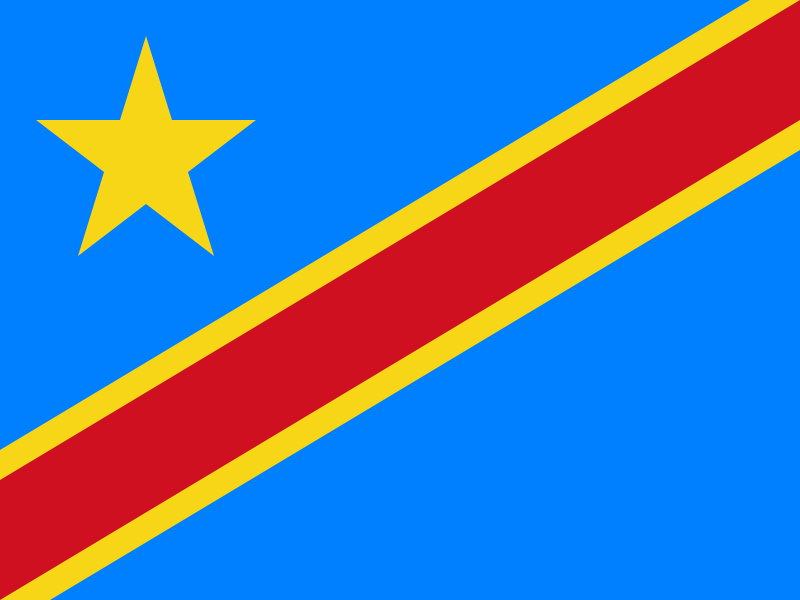
- Capital
- Kinshasa
- Population
- 112,832,000
- Region
- Africa · Middle Africa
Travel guide
Get in
thumb|375px|A map showing the visa requirements of Democratic Republic of the Congo thumb|Railway between [[Kinshasa and Matadi]]
Get around
thumb|400px|Map of ground & water transport. With an area covering and inadequately developed infrastructure, the DR Congo can be a very tough country to get around in.
See
thumb|Epulu River The Democratic Republic of the Congo, often called the "Heart of Africa" in terms of vastness, is the largest nation in sub-Saharan Africa and one of the most enigmatic countries on the continent. Much of the DRC is wild, but its attractions include a multitude of varied cultures and a beauty of tropical landscapes, which include rainforests scattered with waterways and captivating wildlife.
The "Academie des Beaux-Arts" is often considered a touristic site and is in itself and with its gallery a good place to meet the famous artists of this country. Big names like Alfred Liyolo, Lema Kusa oder Roger Botembe are teaching here as well as the only purely abstract working artist Henri Kalama Akulez, whose private studio is worth a visit.
Do
Congo is the centre of popular African music. Try visiting a local bar or disco, in Bandal or Matonge (both in Kinshasa), if possible with live soukouss music, and just hit the dance floor.
Eat
thumb|"Bread bike" Congo has one national dish: moambe. It's made of eight ingredients (moambe is the Lingala word for eight): palm nuts, chicken, fish, peanuts, rice, cassave leaves, bananas and hot pepper sauce.
Drink
The usual soft drinks (called sucré in Congo) such as Coke, Pepsi and Mirinda are available in most places and are safe to drink. Local drinks like Vitalo are amazing. Traditional drinks like ginger beer are also common.
The local beer is based on rice, and tastes quite good. It comes in 75 cl bottles. Primus, Skol, Castel are the most common brands. Tembo and Doppel are the local dark beers.
In rural areas, you may try the local palm wine, an alcoholic beverage from the sap of the palm tree. It is tapped from the tree, and begins fermenting immediately after collection. After two hours, fermentation yields an aromatic wine of up to 4% alcohol content, mildly intoxicating and sweet. The wine may be allowed to ferment longer, up to a day, to yield a stronger, more sour and acidic taste, which some people prefer.
~40 min read
Article
The Democratic Republic of the Congo (DRC), also known as the DR Congo, Congo-Kinshasa, or simply the Congo or less often Zaire, is a country in Central Africa. By land area, it is the second-largest country in Africa and the eleventh-largest in the world. With a population of around 124 million people, the Democratic Republic of the Congo is the fourth-most populous country in Africa and the most populous Francophone country in the world. French is the official and most widely spoken language, though there are over 200 indigenous languages, of which Lingala is the most widely spoken. The capital, largest city, and economic center is Kinshasa. The DRC is bordered by the Republic of the Congo, the Cabinda exclave of Angola, and the South Atlantic Ocean to the west; the Central African Republic and South Sudan to the north; Uganda, Rwanda, Burundi, and Tanzania (across Lake Tanganyika) to the east; and Zambia and Angola to the south. Centered on the Congo Basin, most of the country's terrain is covered by dense rainforests and is crossed by many rivers, while the east and southeast are mountainous.
The territory of the Congo was first inhabited by Central African foragers around 90,000 years ago and was settled in the Bantu expansion about 2,000 to 3,000 years ago. In the west, the Kingdom of Kongo ruled around the mouth of the Congo River from the 14th to the 19th century. In the center and east, the empires of Mwene Muji, Luba, and Lunda ruled between the 15th and 19th centuries. These kingdoms were broken up by Europeans during the colonization of the Congo Basin. King Leopold II of Belgium acquired rights to the Congo territory in 1885 and called it the Congo Free State. In 1908, Leopold ceded the territory after international pressure in response to widespread atrocities, and it became a Belgian colony. Congo achieved independence from Belgium in 1960 and was immediately confronted by secessionist movements, the assassination of Prime Minister Patrice Lumumba, and the seizure of power by Mobutu Sese Seko in 1965. Mobutu renamed the country Zaire in 1971 and imposed a personalist dictatorship.
Gallery (15)
On the map
2 mapped locations
Connections
Categories
1960 establishments in the Republic of the Congo (Léopoldville)Countries and territories where French is an official languageCountries in AfricaCountries in Central AfricaDemocratic Republic of the CongoLeast developed countriesMember states of the African UnionMember states of the Organisation internationale de la FrancophonieMember states of the United NationsRepublicsStates and territories established in 1960