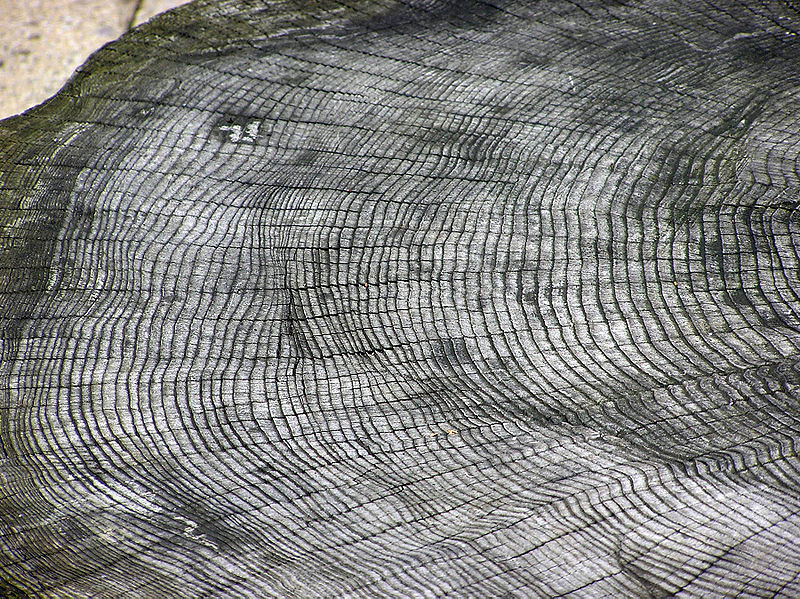
File:Tree.ring.arp.jpg · Wikimedia Commons · See Wikimedia Commons
dendrochronology
Sign in to saveAlso known as tree-ring dating, tree-ring analysis
thumb|The growth rings of a tree at Bristol Zoo, [[England. Each ring represents one year; the outside rings, near the bark, are the youngest]] thumb|A "tree cookie" cross-section of a Pseudotsuga menziesii var. menziesii|Coast Douglas-fir tree displayed in the [[Royal Ontario Museum. The tree was over 500 years old when it was cut down in British Columbia in the 1890s. The markings indicating historical events were added in the 1920s.]] Dendrochronology (or tree-ring dating) is the scientific method of dating tree rings (also called growth rings) to the exact year they were formed in a tree.
Dendrochronology is the scientific method of counting and analyzing a tree's growth rings to determine the exact year each ring formed. This technique matters because it allows scientists to date trees and wooden artifacts precisely, and to learn about historical climate and environmental conditions recorded in the ring patterns.
AI-generated from the Wikipedia summary — may contain errors.
Wikidata facts
- Subclass of
- dendrology
- Image
- 1937. Ponderosa pine stump section showing tree growth rings and fire scars from 1255-1930. Deming Creek. Bly, Oregon. (34049124174).jpg
Show 4 more facts
- Commons category
- Growth rings
- topic's main category
- Category:Dendrochronology
- uses
- growth ring
- on focus list of Wikimedia project
- WikiProject Climate change
via Wikidata · CC0
~23 min read
Encyclopedic overview
19 sectionsContents
- History
- Methods
- Growth rings
- Dendrochronological equation
- Sampling and dating
- Reference sequences
- Miyake events
- Frost rings
- Applications
- Radiocarbon dating calibration
- Climatology
- Art history
- Archaeology
- Measurement platforms, software, and data formats
- Continuous sequence
- Related chronologies
- See also
- References
- External links
thumb|The growth rings of a tree at Bristol Zoo, [[England. Each ring represents one year; the outside rings, near the bark, are the youngest]] thumb|A "tree cookie" cross-section of a Pseudotsuga menziesii var. menziesii|Coast Douglas-fir tree displayed in the [[Royal Ontario Museum. The tree was over 500 years old when it was cut down in British Columbia in the 1890s. The markings indicating historical events were added in the 1920s.]] Dendrochronology (or tree-ring dating) is the scientific method of dating tree rings (also called growth rings) to the exact year they were formed in a tree. As well as dating them, this can give data for dendroclimatology, the study of climate and atmospheric conditions during different periods in history from the wood of old trees. Dendrochronology derives from the Ancient Greek (), meaning "tree", (), meaning "time", and (), "the study of".
Dendrochronology is useful for determining the precise age of samples, especially those that are too recent for radiocarbon dating, which always produces a range rather than an exact date. However, for a precise date of the death of the tree a full sample to the edge is needed, which most trimmed timber will not provide. It also gives data on the timing of events and rates of change in the environment (most prominently climate) and also in wood found in archaeology or works of art and architecture, such as old panel paintings. It is also used as a check in radiocarbon dating to calibrate radiocarbon ages.
Excerpted from Wikipedia’s “dendrochronology” article, available under the CC BY-SA 4.0 licence.
Gallery (24)
Available in 61 languages
- Español
- Français
- Deutsch
- 中文
- 日本語
- Русский
- Português
- Italiano
- العربية
- हिन्दी
- Afrikaans
- Armenian
- Bahasa Indonesia
- Bangla
- Basque
- Belarusian
- Bosnian
- Breton
Show 42 more
- Bulgarian
- Catalan
- Chuvash
- Czech
- Danish
- Esperanto
- Estonian
- Finnish
- Galician
- Greek
- Haitian Creole
- Hebrew
- Hungarian
- Icelandic
- Irish
- Latin
- Limburgish
- Lithuanian
- Macedonian
- Malayalam
- Marathi
- Nederlands
- Norwegian
- Norwegian Nynorsk
- Polski
- Romanian
- Serbian
- simple
- Slovak
- Slovenian
- Sundanese
- Svenska
- Tiếng Việt
- Türkçe
- Ukrainian
- Urdu
- West Flemish
- Wu Chinese
- Yiddish
- فارسی
- ไทย
- 한국어
via Wikidata sitelinks · CC0