File:4951113771_b76622322c_bdracunculose.jpg · Wikimedia Commons · See Wikimedia Commons
dracunculiasis
Sign in to saveAlso known as dracontiasis, infection by Dracunculus medinensis, infection by Dracunculus medinensis (disorder), dracunculosis, Guinea worm infection, Medina worm disease, medinensis, Guinea worm disease
I don't have any context provided to base an overview of dracunculiasis on. Could you please share the context you'd like me to use? Once you provide it, I'll write a 2-sentence plain-language overview based only on that information.
AI-generated from the Wikipedia summary — may contain errors.
Key facts
- Medical condition (new).name
- Dracunculiasis
- Medical condition (new).image
- 4951113771 b76622322c bdracunculose.jpg
- Medical condition (new).alt
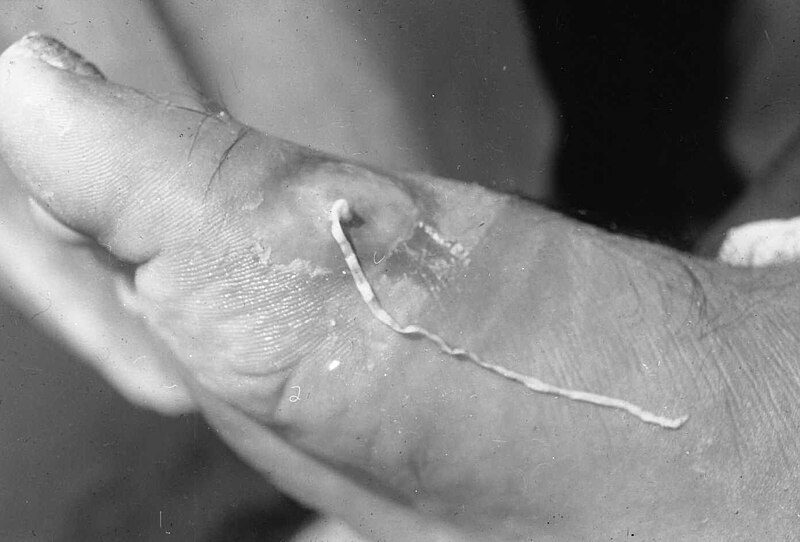
- A white worm emerging from a wound on a person's foot
- Medical condition (new).caption
- D. medinensis worm emerging from a wound on a person's foot
- Medical condition (new).field
- Infectious disease
- Medical condition (new).symptoms
- Painful blister that a long white worm crawls out of
- Medical condition (new).onset
- One year after exposure
- Medical condition (new).causes
- Ingesting Guinea worm–infected copepods, drinking contaminated water
- Medical condition (new).prevention
- Preventing those infected from putting the wound in drinking water, treating contaminated water
- Medical condition (new).treatment
- Slowly extracting worm, supportive care
- Medical condition (new).frequency
- 10–15 cases worldwide per year (2022–2025)
- Medical condition (new).deaths
- ~1% of cases
via Wikipedia infobox
Research
1,005 papers- Dracunculiasis: water-borne anthroponosis vs. food-borne zoonosis.ReviewJournal of helminthology · 2019Galán-Puchades MTDOI: 10.1017/S0022149X19000713
- Dracunculiasis-a case study for infection eradication.The Lancet. Infectious diseases · 2019The Lancet Infectious DiseasesDOI: 10.1016/S1473-3099(19)30488-8
- Dracunculus and dracunculiasis.ReviewAdvances in parasitology · 1971Muller RDOI: 10.1016/s0065-308x(08)60160-8
- Dracunculiasis Eradication: End-Stage Challenges.The American journal of tropical medicine and hygiene · 2022Hopkins DR, Weiss AJ, Torres-Velez FJ et al.DOI: 10.4269/ajtmh.22-0197
- Dracunculiasis (Guinea worm disease) eradication.ReviewAdvances in parasitology · 2006Ruiz-Tiben E, Hopkins DRDOI: 10.1016/S0065-308X(05)61007-X
- Dracunculiasis--the saddle is virtually ended.ReviewParasitology research · 2008Iriemenam NC, Oyibo WA, Fagbenro-Beyioku AFDOI: 10.1007/s00436-007-0828-9
- Dracunculiasis (guinea worm disease).ReviewCMAJ : Canadian Medical Association journal = journal de l'Association medicale canadienne · 2004Greenaway C
- Dracunculiasis eradication.ReviewBulletin de la Societe de pathologie exotique (1990) · 2006Karam M, Tayeh A
via PubMed
Wikidata facts
Show 10 more facts
- symptoms and signs
- fever
- health specialty
- tropical medicine
- disease transmission process
- water pollution
- Commons category
- Dracunculus medinensis
- NCI Thesaurus ID
- C84677
- drug or therapy used for treatment
- thiabendazole
- exact match
- www.orpha.net/ORDO/Orphanet_231
- has cause
- Dracunculus medinensis
- ICD-9-CM
- 125.7
- on focus list of Wikimedia project
- WikiProject Medicine
via Wikidata · CC0
~24 min read
Encyclopedic overview
14 sectionsContents
- Cause
- Signs and symptoms
- Diagnosis
- Prevention
- Treatment
- Outcomes
- Epidemiology
- History
- Eradication
- Non-human hosts
- Notes
- References
- Works cited
- External links
Dracunculiasis, also called Guinea-worm disease, is a parasitic infection by the Guinea worm (Dracunculus medinensis). A person becomes infected by drinking water contaminated with Guinea-worm larvae that reside inside copepods (a type of small crustacean). Stomach acid digests the copepod and releases the Guinea worm larva, which penetrates the digestive tract and escapes into the body. Around a year later, the adult female worm migrates to an exit site usually the lower leg and induces an intensely painful blister on the skin. Eventually, the blister bursts, creating a painful wound from which the worm gradually emerges over several weeks. The wound remains painful throughout the worm's emergence, disabling the affected person for the three to ten weeks it takes the worm to emerge. The female worm releases larvae when the host submerges the wound in water in attempts to relieve the pain, thus continuing the life cycle.
There is no medication to treat or prevent dracunculiasis. Instead, the mainstay of treatment is the careful wrapping of the emerging worm around a small stick or gauze to encourage and speed up its exit. Each day, a few more centimeters of the worm emerge, and the stick is turned to maintain gentle tension. Too much tension can break and kill the worm in the wound, causing severe pain and swelling. Dracunculiasis is a disease of extreme poverty, occurring in places with poor access to clean drinking water. Prevention efforts center on filtering drinking water to remove copepods as well as public education campaigns to discourage people from soaking affected limbs in sources of drinking water, as this action allows the worms to spread their larvae.
Excerpted from Wikipedia’s “dracunculiasis” article, available under the CC BY-SA 4.0 licence.