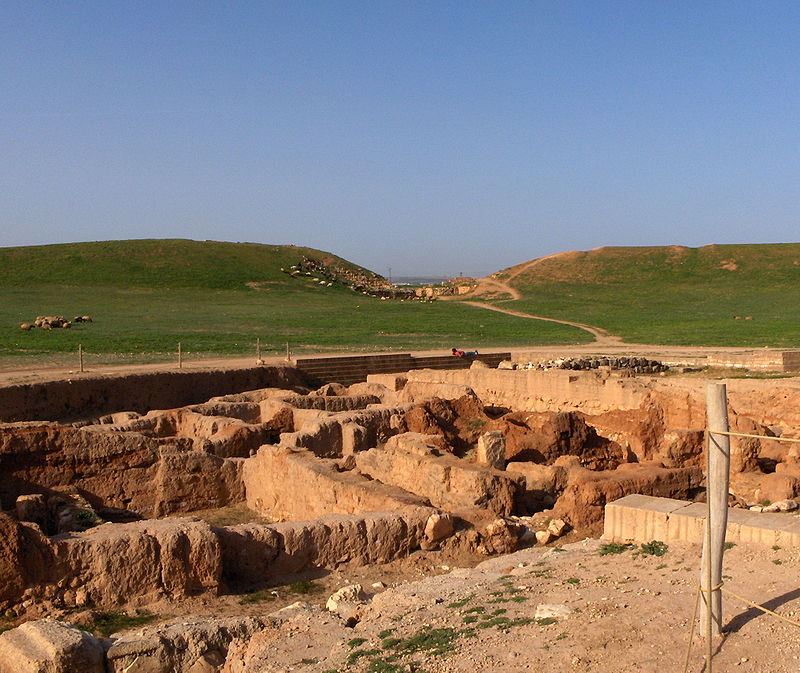
File:HPIM3078_1.JPG · Wikimedia Commons · See Wikimedia Commons
Ebla
Sign in to saveAlso known as Tell Mardikh
Ebla (Sumerian: eb₂-la, , modern: , Tell Mardikh) was one of the earliest kingdoms in Syria. Its remains constitute a tell located about southwest of Aleppo near the village of Mardikh. Ebla was an important center throughout the and in the first half of the Its discovery proved the Levant was a center of ancient, centralized civilization equal to Egypt and Mesopotamia and ruled out the view that the latter two were the only important centers in the Near East during the Early Bronze Age.
Ebla was an ancient Syrian kingdom located near present-day Aleppo whose archaeological remains have revealed it to be one of the earliest centers of civilization in the region. Its discovery challenged the long-held belief that only Egypt and Mesopotamia were significant powers in the ancient Near East, demonstrating that the Levant was equally important during the Early Bronze Age.
AI-generated from the Wikipedia summary — may contain errors.
Key facts
- Country.era
- Bronze Age
- Country.common_name
- Ebla
- Ancient site.name
- Ebla
- Ancient site.alternate_name
- Tell Mardikh
- Ancient site.image
- HPIM3078 1.JPG
- Ancient site.caption
- Ruins of the outer wall and the "Damascus Gate"
- Ancient site.map_type
- Syria
- Ancient site.relief
- yes
- Ancient site.map_size
- 200
- Ancient site.location
- Idlib Governorate, Syria
- Ancient site.type
- settlement
- Ancient site.built
- BC
- Ancient site.abandoned
- 7th century AD
- Ancient site.epochs
- Bronze Age
- Ancient site.cultures
- Kish civilization, Amorite
- Ancient site.excavations
- 1964–2011
- Ancient site.archaeologists
- Paolo Matthiae
- Ancient site.condition
- Ruined
via Wikipedia infobox
Wikidata facts
- Instance of
- historical period
- Country
- Syria
- Located in
- Idlib Governorate
- Image
- Ebla.jpg
Show 8 more facts
- Commons category
- Ebla
- topic's main category
- Category:Ebla
- inception
- 3000-00-00
- dissolved, abolished or demolished date
- 2240-01-01
- heritage designation
- Tentative World Heritage Site
- language used
- Canaanite
- different from
- Elbe
- on focus list of Wikimedia project
- Wikipedia:Vital articles/Level/4
via Wikidata · CC0
~41 min read
Encyclopedic overview
40 sectionsContents
- Etymology
- History
- Chalcolithic
- Early Bronze
- First kingdom
- Geography
- First destruction of Ebla
- Second kingdom
- Middle Bronze
- Third kingdom
- Middle Bronze I - Mardikh IIIA
- Middle Bronze II - Mardikh IIIB
- Late Bronze Age
- Iron Age & Later
- Site
- Layout
- Royal burials
- Hypogeum G4
- Western palace tombs
- Government
- Administration of the first kingdom
- Administrative divisions
- Chora
- People, language, and culture
- The first and second kingdoms
- The third kingdom
- Genetics
- Economy
- Religion
- Biblical connection theories
- Excavations
- Library
- Legacy
- Syrian civil war
- See also
- Notes
- References
- Bibliography
- Further reading
- External links
Ebla (Sumerian: eb₂-la, , modern: , Tell Mardikh) was one of the earliest kingdoms in Syria. Its remains constitute a tell located about southwest of Aleppo near the village of Mardikh. Ebla was an important center throughout the and in the first half of the Its discovery proved the Levant was a center of ancient, centralized civilization equal to Egypt and Mesopotamia and ruled out the view that the latter two were the only important centers in the Near East during the Early Bronze Age.
Starting as a small settlement in the Early Bronze Age ( BC), Ebla developed into a trading empire and later into an expansionist power that imposed its hegemony over much of northern and eastern Syria. Ebla was destroyed during the It was then rebuilt and was mentioned in the records of the Third Dynasty of Ur. The second Ebla was a continuation of the first, ruled by a new royal dynasty. It was destroyed at the end of the which paved the way for the Amorite tribes to settle in the city, forming the third Ebla. The third kingdom also flourished as a trade center; it became a subject and an ally of Yamhad (modern-day Aleppo) until its final destruction by the Hittite king in BC.
Excerpted from Wikipedia’s “Ebla” article, available under the CC BY-SA 4.0 licence.
Gallery (40)
On the map
3 mapped locations