
Syria
Sign in to saveAlso known as Syrian Arab Republic, Surya
OverviewAI-generated
Syria, officially the Syrian Arab Republic, is a country located in Western Asia. Its capital is Damascus. The nation operates as a unitary state with a presidential system and a provisional government. The People's Assembly of Syria serves as the legislative body, while the Supreme Constitutional Court of Syria is the highest judicial authority. Arabic is the official language. The native labels for the country include الجمهورية العربية السورية and سوريا.
The country has a population of approximately 23,865,423 to 25,620,000 people. It covers an area of 185,180 square kilometers. The Syrian pound is the currency used. Syria is a participant in the War of Attrition. It maintains diplomatic relations with Yemen, Saudi Arabia, Israel, and China. The country's inception date is recorded as March 8, 1920. The flag of Syria is represented by the Unicode character 🇸🇾.
Synthesized by Vinony from 67 facts across 9 sources: Wikidata, REST Countries, Open Meteo, Openweathermap, World Bank, OpenStreetMap, PubMed, Vinony graph, Geo. Generated from structured data (not the Wikipedia text) and checked against those facts — may still contain errors.
In the Vinony graph
Vinony catalogs Syria in its Countries collection (215 entries).
Vinony's link graph records 26,425 inbound references to Syria, and connects out to Babylonia, Neo-Assyrian Empire and history of Syria.
The entry is geolocated on the map in city, across 4 mapped points.
Vinony files it under 1946 establishments in Asia, Arab republics and Countries and territories where Arabic is an official language.
Weather now
cached 7h ago7-day forecast
via Open-Meteo
Country
- Capital
- Damascus
- Population
- 25,620,000
- Region
- Asia · Western Asia
- Demonym
- Syrian
- Currencies
- SYP (£)
- Languages
- Arabic
- Calling code
- +963
- Drives on
- Right
- Gini
- 37.5 (2003)
- FIFA code
- SYR
- TLD
- .sy, سوريا.
- Timezones
- UTC+02:00
- Borders
- IRQ, ISR, JOR, LBN, TUR
via REST Countries
Indicators · World Bank
- GDP
- $23.6B(2022)
- Population
- 24,672,760(2024)
- Life expectancy
- 72.6 yrs(2024)
- Unemployment
- 13.6 %(2025)
- Urban population
- 72.1 %(2024)
- Internet users
- 33.8 %(2018)
- Forest area
- 2.8 %(2023)
- Renewable energy
- 1.1 %(2021)
via World Bank Open Data · CC BY 4.0
Wikipedia views (30d)
171,376 totalvia Wikimedia Pageviews API
Key facts
- Country.conventional_long_name
- Syrian Arab Republic
- Country.common_name
- Syria
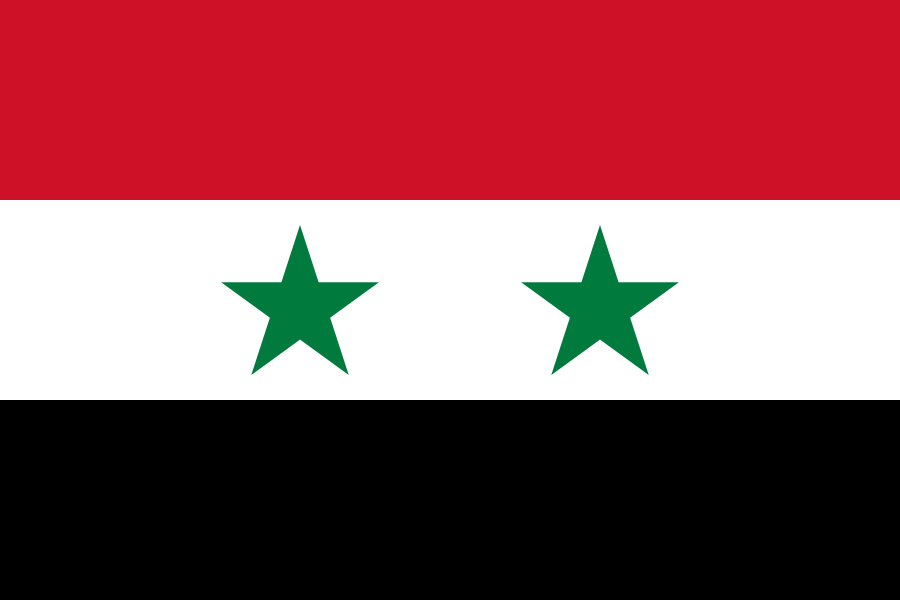
- Country.image_flag
- Flag of Syria (2025-).svg
- Country.flag_border
- yes
- Country.flag_type
- Flag
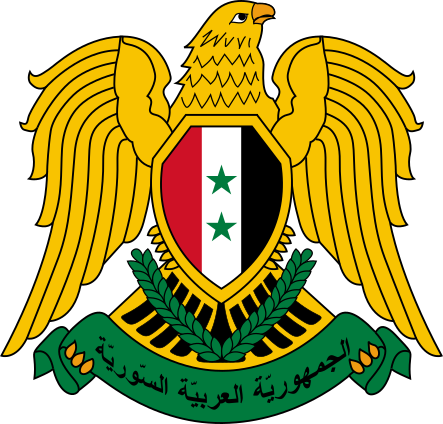
- Country.image_coat
- Emblem of Syria (2025–present).svg
- Country.symbol_width
- 100px
- Country.symbol_type
- Emblem
- Country.national_anthem
- "Ḥumāt ad-Diyār"Guardians of the Homeland (de jure)"Fī Sabīli al-Majd"In Pursuit of Glory (de facto)
- Country.capital
- Damascus
- Country.largest_city
- capital
- Country.official_languages
- Arabic
- Country.recognized_national_languages
- Kurdish
- Country.languages_type
- Spoken languages
- Country.ethnic_groups
- 80–90% Arabs9–10% Kurds1–10% others
- Country.ethnic_groups_year
- 2021
- Country.religion
- 94.17% Islam 79.19% Sunni 14.1% Shia 10–13% Alawites 3.84% Christianity 1.99% other
- Country.religion_year
- 2020
via Wikipedia infobox
Research
9,650 papers- Organ Donation in Syria.ReviewExperimental and clinical transplantation : official journal of the Middle East Society for Organ Transplantation · 2024Saeed BDOI: 10.6002/ect.BDCDSymp.L10
- Cancer and Syria in conflict: a systematic review.BMC cancer · 2024Basha L, Ahmed H, Hamze M et al.DOI: 10.1186/s12885-024-13256-9
- Lung Cancer in Syria.Journal of thoracic oncology : official publication of the International Association for the Study of Lung Cancer · 2024Saifo M, Alali M, Alhabeb H et al.DOI: 10.1016/j.jtho.2023.12.013
- Syria after the earthquake.Lancet (London, England) · 2023Skyle DDOI: 10.1016/S0140-6736(23)01784-1
- Organ Transplantation in Syria.ReviewTransplantation · 2020Saeed BDOI: 10.1097/TP.0000000000003121
- Sanctions on Syria.The Lancet. Global health · 2020Abbara A, Ekzayez A, Tarakji A et al.DOI: 10.1016/S2214-109X(20)30363-6
- Syria after the earthquakes: what researchers can do to help.Nature · 2023DOI: 10.1038/d41586-023-00571-7
- The Türkiye-Syria Earthquake: a response from the editors of the Turkish Journal of Pediatrics.The Turkish journal of pediatrics · 2023Düzova A, Akgül S, Utine GE et al.DOI: 10.24953/turkjped.2023.E001
via PubMed
Wikidata facts
- Part of
- West Asia
- Official name
- Suriye Arap Cumhuriyeti
- Demonym
- Suriyeli
- Participant in
- War of Attrition
- Country
- Syria
- Contains
- Hasakah Governorate
- Continent
- Asia
- Capital
- Damascus
- Official language
- Arabic
- Currency
- Syrian pound
- Population
- 23865423
- Area
- 185180
- Body of water
- Mediterranean Sea
- Form of government
- unitary state
- Legislature
- People's Assembly of Syria
- Anthem
- Humat ad-Diyar
- Shares border with
- Lebanon
- Highest point
- Mount Hermon
- Official website
- www.egov.sy
- Image
- Damascus, Syria, Panoramic view of Damascus.jpg
- Life expectancy
- 72
- Calling code
- +963
- Licence plate code
- SYR
- Mains voltage
- 220
Show 62 more facts
- Flag
- flag of Syria
- Coat of arms
- coat of arms of Syria
- topic's main Wikimedia portal
- Portal:Syria
- Unicode character
- 🇸🇾
- category of associated people
- Category:Syrian people
- geography of topic
- Geography of Syria
- native label
- الجمهورية العربية السورية
- diplomatic relation
- Morocco
- highest judicial authority
- Supreme Constitutional Court of Syria
- Commons gallery
- Syria - سوريا
- inception
- 1920-03-08
- trunk prefix
- 0
- history of topic
- history of Syria
- compulsory education (maximum age)
- 15
- mobile country code
- 417
- total fertility rate
- 2.95
- maritime identification digits
- 468
- compulsory education (minimum age)
- 6
- marriageable age
- 18
- topic's main category
- Category:Syria
- category for people buried here
- Category:Burials in Syria
- age of majority
- 18
- located in/on physical feature
- Levant
- category for people who died here
- Category:Deaths in Syria
- office held by head of state
- President of the Syrian Arab Republic
- Commons category
- Syria
- top-level Internet domain
- .sy
- category for people born here
- Category:Births in Syria
- number of out-of-school children
- 2416365
- driving side
- right
- lowest point
- Sea of Galilee
- central bank
- Central Bank of Syria
- language used
- Mlahsô
- GS1 country code
- 621
- culture
- culture of Syria
- BTI Status Index
- 1.54
- BTI Governance Index
- 1.21
- economy of topic
- economy of Syria
- demographics of topic
- demographics of Syria
- different from
- Syria
- madhhab
- Malikism
- Democracy Index
- 1.43
- hashtag
- syria
- Human Development Index
- 0.577
- P11012
- Bob Marley
- on focus list of Wikimedia project
- Wikipedia:Vital articles/Level/4
- Gini coefficient
- 37.5
- Inequality-adjusted Human Development Index
- 0.553
- water as percent of area
- 1.1
- P12749
- Manuel Montt
- executive body
- Government of Syria
- has cabinet
- Council of Ministers of Syria
- birth rate
- 20.531
- male population
- 11981578
- death rate
- 5.047
- rural population
- 9564966
- female population
- 11883845
- urban population
- 12560283
- territory claimed by
- France
- replaces
- Ba'athist Syria
- office held by head of government
- Prime Minister of Syria
Sources (15)
via Wikidata · CC0
Travel guide
Get in
thumb|450px|Visa policy of Syria. Countries in mint can receive visas on arrival. Gray countries require advanced permission; Israeli passport holders cannot enter.
See
thumb|Krak des Chevaliers
Ancient cities such as Damascus, Aleppo, Palmyra, Crac des Chevaliers and Bosra including Medieval souqs. In Hama there are the Al Aasi Water Wheels in a river (نواعير نهر العاصي). Al Hosn Castle in Homs. Qala'at Samaan (Basilica of St Simeon Stylites) about 30 km (19 mi) northwest of Aleppo and the oldest surviving Byzantine church, dating back to the 5th century. This church is popularly known as either Qalaat Semaan (Arabic: قلعة سمعان Qalʿat Simʿān), the 'Fortress of Simeon', or Deir Semaan (Arabic: دير سمعان Dayr Simʿān), the 'Monastery of Simeon' . Tartous with its Crusader-era Templar fortress The Yarmouk Valley Endless desert and countryside in much of the country Mountain ranges in the west of the country
Eat
thumb|Fatoush
Falafel, deep-fried chickpea patties, are available. Another popular vegetarian meal is Foul. Don't let the name put you off. It's pronounced "fool," and this fava bean paste – topped with cumin, paprika, and olive oil and served with flatbread, fresh mint, and onion – is tasty, satisfying, and filling.
You may also order a salad of Fatoush with your soup. Chopped tomatoes, onions, cucumbers, and herbs are mixed in a dressing and finished with a sprinkling of fried bread resembling croutons. Cheese may also be grated on top.
Syrians also have a well-honed sweet tooth, with its desserts being largely similar to that of Lebanon, Jordan and the Palestinians. Syria is particularly known for its local style of ice cream, with Damascus ice cream shop Bakdash having been continuously in business for over a century. Other Syrian desserts to try include baklava, a pastry made of filo dough, nuts and syrup, and knafeh, made of kataifi and cheese.
Drink
Fresh fruit juices are available from street stalls in most towns, such as mixed juice (usually banana, orange juice, and a few exotic fruits like pomegranate).
Beer is cheap. Syrian wine can be found, and Lebanese and French wines are also available in a higher price bracket.
Tea is served in a little glass without milk, sweetened with sugar. Add the sugar yourself, as the Syrians have a collective sweet tooth and will heap it in.
Sleep
A double room in a three-star hotel costs about US$50, US$80 for four stars, and can reach US$250 in a five-star hotel.
Stay safe
As of March 2026, travelers are advised to avoid majority-Kurdish areas in northern Syria, particularly around Kobane (Ayn al-Arab) in northeastern Aleppo Governorate and the Hasakah-Qamishli area. These areas remain politically sensitive, with periodic tensions between local Kurdish people and Syrian government institutions, including security forces.
Most of Suwayda Governorate, including its capital, is not under the effective control of the Syrian government but is instead held by local militias. Ongoing clashes between these groups and Syrian government forces occur regularly, creating a highly unstable security situation. Travelers should avoid the area entirely due to the risk of active conflict.
Travelers should avoid all large gatherings as they may turn violent.
You could find yourself in trouble if you engage in open criticism or appraisal of whatever opinions or political measure. Your best bet is to avoid political conversations altogether to avoid any possible problems. If you engage in political discussions with Syrians, be aware that they might face intense questioning by the secret police (mukhabarat) or whatever local equivalent if you are overheard. As a general rule, always assume that you are watched. This may change as the new government starts reforms of the system – for the better or for the worse.
Since begging is common in some parts of Syria, particularly outside tourist attractions, mosques, and churches, it has been known that beggars occasion…
Stay healthy
Healthcare in Syria is well below Western standards, and essential medication is not always available.
If you have a treatment, take it with you. Only expect to find some medicines in Syria. Ask for a "foreign" EU or US brand if you have to buy something from a pharmacy. You will have to pay a premium for that, but at least you will increase the chances of having actual medicine. According to certain local pharmacists, some products come from uncertain origins and are ineffective. Pharmacists often speak a little bit of English.
You can ask your hotel to call a doctor to visit your hotel room.
Of course, the best treatment is to stay healthy in the first place. When eating, pick busy restaurants.
Generally you can drink water from the tap. It should be safe, but ask the locals first. Tap water is free.
Respect
thumb|Old Damascus as of early 2011
Syria is a majority Muslim country with long-established Christian, Jewish and Yazidi minorities. However, the Jewish community is down to only a handful of individuals in Damascus, with the vast majority having immigrated to Israel. Historically, religious groups lived in harmony, and religion was primarily considered personal. It was inappropriate to ask someone about their faith unless you knew them well. However, this has changed since the start of the Syrian Civil War.
Travel guide from Wikivoyage (CC BY-SA 4.0)
~40 min read
Encyclopedic overview
56 sectionsContents
- History
- Ancient antiquity
- Classical antiquity
- Middle Ages
- Ottoman Syria
- French Mandate
- Independent Syrian Republic
- United Arab Republic
- Land reform
- Ba'athist Syria
- Involvement of Lebanese war
- Syrian revolution and civil war
- Rise and fall of Islamic State and factional escalation
- Rebel offensive and fall of the Ba'athist regime
- Post-Ba'athist and transitional period
- Geography
- Biodiversity
- Government and politics
- Post-Ba'athist Syria (2024–present)
- Ba'athist Syria (1963–2024)
- Administrative divisions
- Foreign relations
- Post-Ba'athist Syria
- Ba'athist Syria
- International disputes
- Military
- Human rights
- Economy
- Energy
- Agriculture
- Transport
- Internet and telecommunications
- Water supply and sanitation
- Drug industry
- Demographics
- Largest cities
- Ethnic groups
- Languages
- Religion
- Education
- Health
- Culture
- Literature
- Music
- Media
- Cuisine
- See also
- Notes
- References
- Sources
- Further reading
- External links
- Government
- History
- Tourism
- Maps
Syria, officially the Syrian Arab Republic (SAR), is a country in West Asia located in the Eastern Mediterranean and the Levant. It borders the Mediterranean Sea to the west, Turkey to the north and northwest, Iraq to the east and southeast, Jordan to the south, and Israel and Lebanon to the southwest. It is a republic under a provisional government and comprises 14 governorates. Damascus is the capital and largest city. With a population of 26 million across an area of 185,180 square kilometres (71,500 sq mi), it is the 56th-most populous and 87th-largest country.
The name "Syria" historically referred to the region of Syria, or known as Greater Syria and Syria-Palestine. The modern state encompasses the sites of several ancient kingdoms and empires, including the Eblan civilization. Damascus was the seat of the Umayyad Caliphate and a provincial capital under the Mamluk Sultanate. The modern Syrian state was established in the mid-20th century after centuries of Ottoman rule, as a French Mandate. The state represented the largest Arab state to emerge from the formerly Ottoman-ruled Syrian provinces. It gained de jure independence as a parliamentary republic in 1945 when the First Syrian Republic became a founding member of the United Nations, an act which legally ended the French Mandate. French troops withdrew in April 1946, granting the nation de facto independence. The post-independence period was tumultuous, with multiple coups and coup attempts between 1949 and 1971. In 1958, Syria entered a brief pan-Arab union with Egypt, which was terminated following a 1961 coup d'état. The 1963 coup d'état carried out by the military committee of the Ba'ath Party established a one-party state, which ran Syria under martial law from 1963 to 2011. Internal power-struggles within Ba'athist factions caused further coups in 1966 and 1970, the latter of which saw Hafez al-Assad come to power. Under Assad, Syria became a hereditary dictatorship. Assad died in 2000, and he was succeeded by his son, Bashar.
Excerpted from Wikipedia’s “Syria” article, available under the CC BY-SA 4.0 licence.
Gallery (39)
On the map
4 mapped locations
Available in 263 languages
- Español
- Français
- Deutsch
- 中文
- 日本語
- Русский
- Português
- Italiano
- العربية
- हिन्दी
- Abkhazian
- Achinese
- Adyghe
- Afrikaans
- Akan
- Albanian
- Albanian
- Amharic
Show 244 more
- ami
- Angika
- Aragonese
- Aramaic
- Armenian
- Arpitan
- Assamese
- Asturian
- Avaric
- Awadhi
- azb
- Azerbaijani
- Bahasa Indonesia
- Balinese
- Bambara
- Bangla
- Bashkir
- Basque
- bat_smg
- Bavarian
- be_x_old
- Belarusian
- Betawi
- Bhojpuri
- Bikol
- Bishnupriya
- Bislama
- Bosnian
- Breton
- Buginese
- Bulgarian
- Buriat
- Burmese
- Catalan
- cbk_zam
- cdo
- Cebuano
- Central Dusun
- Central Kurdish
- Chechen
- Church Slavic
- Chuvash
- Cornish
- Corsican
- Crimean Tatar
- Croatian
- Czech
- dag
- Danish
- Divehi
- dty
- Egyptian Arabic
- Esperanto
- Estonian
- Ewe
- Extremaduran
- Faroese
- Fiji Hindi
- Filipino
- Finnish
- fiu_vro
- Friulian
- Fula
- Gagauz
- Galician
- gcr
- Georgian
- Gilaki
- Goan Konkani
- Gothic
- Greek
- Guarani
- Gujarati
- Haitian Creole
- Hakka Chinese
- Hausa
- Hawaiian
- Hebrew
- Hungarian
- hyw
- Iban
- Icelandic
- Ido
- Iloko
- Inari Sami
- Interlingua
- Interlingue
- Irish
- Jamaican Creole English
- Javanese
- Kabardian
- Kabyle
- Kannada
- Kara-Kalpak
- Karachay-Balkar
- Kashmiri
- Kashubian
- Kazakh
- kbp
- kge
- Khmer
- Kikuyu
- Kinyarwanda
- Komi
- Kongo
- Kurdish
- Kyrgyz
- Ladino
- Lao
- Latin
- Latvian
- Lezghian
- Ligurian
- Limburgish
- Lingala
- Lingua Franca Nova
- Lithuanian
- lld
- Lojban
- Lombard
- Low German
- Lower Sorbian
- Luxembourgish
- Macedonian
- Madurese
- Maithili
- Malagasy
- Malay
- Malayalam
- Maltese
- Manipuri
- Manx
- Māori
- Marathi
- Mari
- Mazanderani
- Minangkabau
- Mingrelian
- Mirandese
- Moksha
- Mongolian
- Moroccan Arabic
- Navajo
- nds_nl
- Nederlands
- Nepali
- Newari
- Northern Frisian
- Northern Sami
- Norwegian
- Norwegian Nynorsk
- Novial
- Occitan
- Odia
- Old English
- olo
- Oromo
- Ossetic
- Pampanga
- Papiamento
- Pashto
- Picard
- Piedmontese
- Polski
- Pontic
- Punjabi
- Quechua
- Romanian
- Rusyn
- Samoan
- Sanskrit
- Santali
- Sardinian
- Scots
- Scottish Gaelic
- Serbian
- Serbian (Latin)
- Shan
- Shona
- Sicilian
- Silesian
- simple
- Sindhi
- Sinhala
- Slovak
- Slovenian
- Somali
- Sranan Tongo
- Standard Moroccan Tamazight
- Sundanese
- Svenska
- Swahili
- Swati
- syl
- szy
- Tajik
- Talysh
- Tamil
- Taroko
- Tatar
- tay
- tdd
- Telugu
- Tetum
- Tibetan
- Tiếng Việt
- Tigrinya
- Tok Pisin
- Toki Pona
- Tongan
- Tsonga
- Tumbuka
- Türkçe
- Turkmen
- Tyap
- Udmurt
- Ukrainian
- Upper Sorbian
- Urdu
- Uyghur
- Uzbek
- Venetian
- Veps
- Volapük
- Walloon
- Waray
- Welsh
- West Flemish
- Western Frisian
- Western Panjabi
- Wolof
- Wu Chinese
- Yakut
- Yiddish
- Yoruba
- Zaza
- Zeelandic
- zh_classical
- zh_min_nan
- zh_yue
- Zhuang
- فارسی
- ไทย
- 한국어
via Wikidata sitelinks · CC0