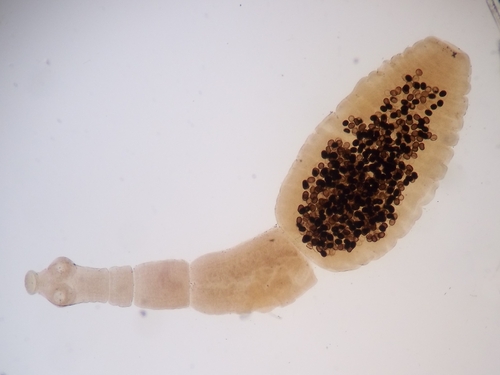
(c) Ganímedes, some rights reserved (CC BY-SA) · cc-by-sa
Echinococcus granulosus
Sign in to savespecies of worm
Species
Hydatid Worm
SPECIES
- KingdomAnimalia
- PhylumPlatyhelminthes
- ClassCestoda
- OrderCyclophyllidea
- FamilyTaeniidae
単包条虫 Echinococcus granulosus 単包条虫の頭節 分類 界 : 動物界 Animalia 門 : 扁形動物門 Platyhelminthes 綱 : 条虫綱 Cestoda 亜綱 : 真性条虫亜綱 Eucestoda 目 : 円葉目 Cyclophyllidea 科 : テニア科 Taeniidae 属 : エキノコックス属 Echinococcus 種 : 単包条虫 E. granulosus 学名 Echinococcus granulosus (Batsch, 1786) Rudolphi, 1801[1] 和名 単包条虫 エキノコックス属の生活環 単包条虫(たんほうじょうちゅう、学名:Echinococcus granulosus)とは、円葉目テニア科エキノコックス属に属する条虫の1種。体長2-9mmで3-4個の片節より構成される。頭節には4個の吸盤と額嘴を有する。成熟片節には1組の生殖器官が存在する。中間宿主はヒツジ、ウシ、ウマ、ラクダ、カンガルー、ワラビー、サル、ヒトなど、終宿主はイヌ、オオカミ、ジャッカル、ディンゴなど。生活環は外界に排出された虫卵を中間宿主が摂取しその体内で六鉤幼虫へと発育する。六鉤幼虫は血行性あるいはリンパ行性に肝臓や肺に移動し包虫囊に発育する。終宿主への移行は中間宿主の捕食により起こり、その小腸で成虫へと発育する。 形態 虫卵は直径約35μmで、六鉤幼虫が中に入っている。虫卵の形態は単包条虫の物も多包条虫の物も類似しており、両種の虫卵の区別は困難である。 成虫は約7週間で体長2.5mm-9.0mmに成熟し、終宿主の腸内に虫卵を放出し始める。終宿主に大きな病害を与えることはない。 生活環(ライフサイクル) 終宿主(=イヌ、オオカミ、ジャッカル、コヨーテ、ハイエナ、ディンゴ、キツネ、タヌキといったイヌ科の肉食獣) → 終宿主の糞便中に虫卵が排出され、周囲の地面や水や植物等を汚染する。 → 虫卵が粉塵、飲水、食物などとともに中間宿主に経口摂取される。 → 中間宿主(=ヒツジ、ウシ、ウマ、ブタ、ヤギ、ウサギ、トナカイといった草食獣やヒト) → 宿主の十二指腸・小腸上部で孵化。 → 終宿主が単包虫を含む中間宿主の臓器を食べる。 ヒトへの感染経路 病態 虫卵から放出された六鉤幼虫が腸壁に侵入し、血流もしくはリンパ流にのって諸臓器(肝、肺、脳など)に運ばれ幼虫期である単包虫を形成する。単包虫は様々な大きさの球形の限局性嚢胞性病変を形成する。嚢胞は漿液性の包虫液で満たされており、その中に多数の原頭節が生じる。 脚注[編集] ^ 日本寄生虫学会用語委員会 「暫定新寄生虫和名表」 2008年5月22日 Archived 2011年4月14日, at the Wayback Machine. 参考文献[編集] 今井壯一ほ
via GBIF
Museum specimens
- Specimen records
- 256
- With media
- 53
- Family
- Taeniidae
- Collections
- MSB, USNM
- Recorded in
- United States, Canada
Research
5,828 papers- Echinococcus granulosus sensu lato and Echinococcus multilocularis: A review.Research in veterinary science · 2021
- Echinococcus Granulosus, a Parasite Producing Hydatid Cyst: A Review.Archives of Razi Institute · 2025
- Echinococcus granulosus sensu lato genotypes infecting humans--review of current knowledge.International journal for parasitology · 2014
- Genetic diversity of Echinococcus granulosus sensu lato in China: Epidemiological studies and systematic review.Transboundary and emerging diseases · 2022
- Cystic echinococcosis (Echinococcus granulosus sensu lato infection) in Tunisia, a One Health perspective for a future control programme.Parasite (Paris, France) · 2024
via PubMed
Wikidata facts
- Instance of
- taxon
- Parent taxon
- Echinococcus
- Image
- Echinococcus granulosus scolex.jpg
Show 5 more facts
- taxon rank
- species
- taxon name
- Echinococcus granulosus
- Commons category
- Echinococcus granulosus
- taxon common name
- 単包条虫
- short name
- E. granulosus
via Wikidata · CC0
~9 min read
Encyclopedic overview
Echinococcus granulosus, also called the hydatid worm or dog tapeworm, is a cyclophyllid cestode that dwells in the small intestine of canids as an adult, but which has important intermediate hosts such as livestock and humans, where it causes cystic echinococcosis, also known as hydatid disease. The adult tapeworm ranges in length from 3 mm to 6 mm and has three proglottids ("segments") when intact—an immature proglottid, mature proglottid and a gravid proglottid. The average number of eggs per gravid proglottid is 823. Like all cyclophyllideans, E. granulosus has four suckers on its scolex ("head"), and E. granulosus also has a rostellum with hooks. Several strains of E. granulosus have been identified, and all but two are noted to be infective in humans.
The lifecycle of E. granulosus involves dogs and wild carnivores as a definitive host for the adult tapeworm. Definitive hosts are where parasites reach maturity and reproduce. Wild or domesticated ungulates, such as sheep, serve as an intermediate host. Transitions between life stages occur in intermediate hosts. The larval stage results in the formation of echinococcal cysts in intermediate hosts. Echinococcal cysts are slow growing, but can cause clinical symptoms in humans and be life-threatening. Cysts may not initially cause symptoms, in some cases for many years. Symptoms developed depend on location of the cyst, but most occur in the liver, lungs, or both.
Excerpted from Wikipedia’s “Echinococcus granulosus” article, available under the CC BY-SA 4.0 licence.