Skip to content
Edwin Abbott Abbott

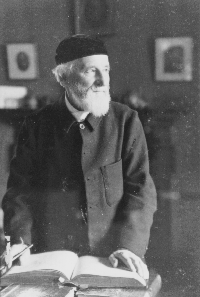
File:Abbott_older-medium.gif · Wikimedia Commons · See Wikimedia Commons

EntityQ531606· pop 39· linked from 90 articles

Edwin Abbott Abbott

Sign in to save

Also known as Edwin Abbott, Edwin A. Abbott, Abbott

British theologian and author (1838-1926)

Person · Open Library

Born
20 December 1838
Died
12 October 1926
Works
77

Top works

  • Flatlandia
  • Mishoryah
  • Flatland
  • Flatland : a Romance of Many Dimensions
  • Flatland (an Edwin Abbot Classic)

via Open Library + Wikidata

Music · MusicBrainz

Type
Person
Gender
Male
Active from
1838
Active to
1926

via MusicBrainz · CC0

Listeners · Last.fm

Listeners
125
Total plays
1,145

Tags

Audiobookliteratureflatlandlibrivoxruth golding

Edwin Abbott Abbott (20 December 1838 – 12 October 1926), English schoolmaster and theologian, is best known as the author of the mathematical satire and religious allegory Flatland (1884). Edwin Abbott Abbott was the eldest son of Edwin Abbott (1808–1882), headmaster of the Philological School, Marylebone, and his wife, Jane Abbott (1806–1882). His parents were first cousins. He was educated at the City of London School and at St John's College <a href="https://www.last.fm/music/Edwin+Abbott+Ab

via Last.fm · Edwin Abbott Abbott

Quotes

  • Never shall we apprehend the nature of true divinity nor the true divineness of Jesus of Nazareth, the Carpenter's Son, till we learn to moralize our theology, training ourselves to lay less stress on "Almighty" — an epithet characteristic of the silver age of Hebrew literature and of our Anglican Prayer Book, but never once used as an epithet of God by Him who knew Him as He is. By way of compensation, we must lay far more stress on "Wise" and "Good."
  • It was in old days, with our learned men, an interesting and oft-investigated question, "What is the origin of light?" and the solution of it has been repeatedly attempted, with no other result than to crowd our lunatic asylums with the would-be solvers. Hence, after fruitless attempts to suppress such investigations indirectly by making them liable to a heavy tax, the Legislature, in comparatively recent times, absolutely prohibited them.
  • If our highly pointed Triangles of the Soldier class are formidable, it may be readily inferred that far more formidable are our Women. For if a Soldier is a wedge, a Woman is a needle; being, so to speak, ALL point, at least at the two extremities. Add to this the power of making herself practically invisible at will, and you will perceive that a Female, in Flatland, is a creature by no means to be trifled with.
  • Though we cannot SEE angles, we can INFER them, and this with great precision. Our sense of touch, stimulated by necessity, and developed by long training, enables us to distinguish angles far more accurately than your sense of sight, when unaided by a rule or measure of angles.
  • Expediency therefore concurs with Nature in stamping the seal of its approval upon Regularity of conformation.
  • It is high time that I should pass from these brief and discursive notes about things in Flatland to the central event of this book, my initiation into the mysteries of Space. THAT is my subject; all that has gone before is merely preface.

via Wikiquote · CC BY-SA

Key facts

Born
( 1838-12-20 ) 20 December 1838, Marylebone , London, England
Died
12 October 1926 (1926-10-12) (aged 87), Hampstead , London, England
Education
City of London School , St John's College, Cambridge
Occupations
Teacher, author
Known for
Flatland
Father
Edwin Abbott

via Wikipedia infobox

Wikidata facts

Image
Edwin Abbott Abbott.jpg
Show 5 more facts
Commons category
Edwin Abbott Abbott
date of birth
1838-12-20
date of death
1926-10-12
name in native language
Edwin Abbott Abbott
pseudonym
A. Square
Sources (2)

via Wikidata · CC0

~7 min read

Article

Edwin Abbott Abbott (20 December 1838 – 12 October 1926) was an English schoolmaster, theologian, and Anglican priest, best known as the author of the novella Flatland (1884).

Early life and education

Gallery (2)

Connections

Categories