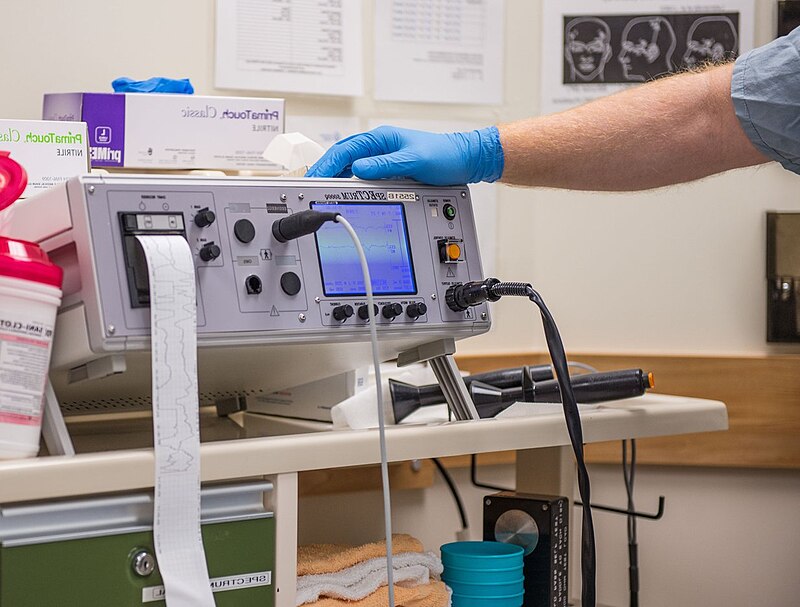
File:MECTA_spECTrum_ECT.jpg · Wikimedia Commons · See Wikimedia Commons
electroconvulsive therapy
Sign in to saveAlso known as ECT, electroshock therapy, electric shock therapy
medical procedure
Key facts
- Other names
- Electroshock therapy (historical)
- Icd 10 pcs
- GZB
- Mesh
- D004565
- Ops 301 code
- 8-630
- Medlineplus
- 007474
via Wikipedia infobox
Research
18,600 papers- Electroconvulsive Therapy.The New England journal of medicine · 2022
- Electroconvulsive therapy.Journal of biomedical engineering · 1989
- Electroconvulsive therapy.Canadian journal of psychiatry. Revue canadienne de psychiatrie · 1992
- Electroconvulsive Therapy in Geriatric Psychiatry: A Selective Review.Clinics in geriatric medicine · 2020
- Use of Electroconvulsive Therapy in Autism.The Psychiatric clinics of North America · 2021
via PubMed
Wikidata facts
- Instance of
- treatment of mental disorders
- Subclass of
- convulsive therapy
- Developer
- Ugo Cerletti
- Image
- NTM Eg Asyl ECT apparatus IMG 0977.JPG
Show 3 more facts
- Commons category
- Electroconvulsive therapy
- ICD-9-CM
- 94.27
- topic's main category
- Category:Electroconvulsive therapy
via Wikidata · CC0
~40 min read
Encyclopedic overview
Electroconvulsive therapy (ECT) is a psychiatric treatment that causes a generalized seizure by passing electrical current through the brain. ECT is often used as an intervention for mental disorders when other treatments are inadequate. Conditions responsive to ECT include major depressive disorder, mania, and catatonia.
ECT evolved from early seizure-inducing treatments and 18th–19th century electrical experiments into a formal procedure in the 1930s, later becoming widely used in the 1940s–50s. It then declined in use due to safety concerns and negative public perception. With the introduction of anesthesia, muscle relaxants, and improved techniques, it became safer and more regulated, leading to its modern use as an effective treatment for severe, treatment-resistant psychiatric conditions.
Excerpted from Wikipedia’s “electroconvulsive therapy” article, available under the CC BY-SA 4.0 licence.