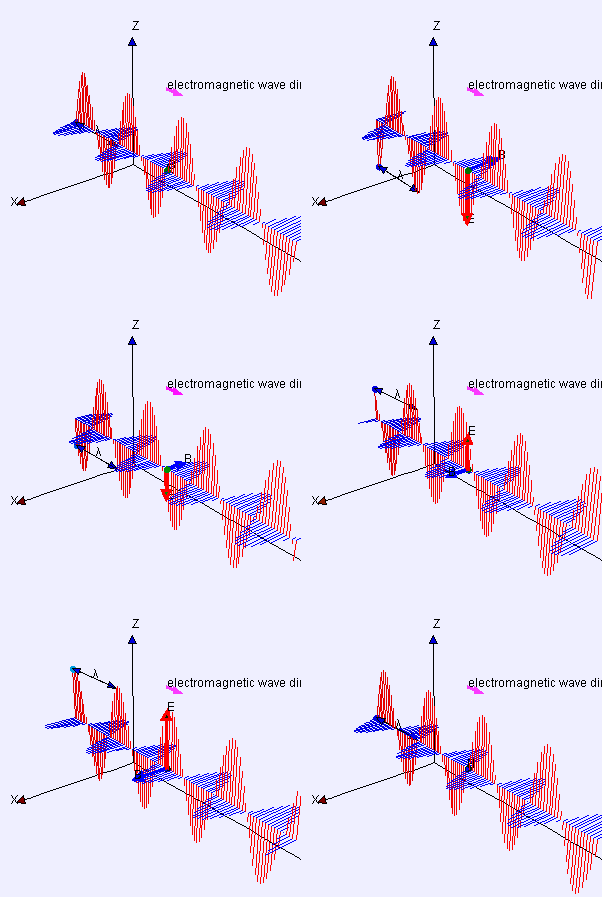
File:Electromagneticwave3D.gif · Wikimedia Commons · See Wikimedia Commons
electromagnetic radiation
Sign in to saveAlso known as EMR, EM radiation
form of energy emitted and absorbed by particles which are charged which shows wave-like behavior as it travels through space
Electromagnetic radiation is a form of energy that comes from charged particles and travels through space in waves. It matters because it's a fundamental way that energy moves through the universe and interacts with charged particles around us.
AI-generated from the Wikipedia summary — may contain errors.
Research
397,372 papers- Effects of Radiofrequency Electromagnetic Radiation on Neurotransmitters in the Brain.ReviewFrontiers in public health · 2021Hu C, Zuo H, Li YDOI: 10.3389/fpubh.2021.691880
- Radiofrequency electromagnetic radiation from Wi-fi and its effects on human health, in particular children and adolescents. Review.ReviewRoczniki Panstwowego Zakladu Higieny · 2020Magiera A, Solecka JDOI: 10.32394/rpzh.2020.0125
- Electromagnetic radiation: a new charming actor in hematopoiesis?ReviewExpert review of hematology · 2021Darvishi M, Mashati P, Kandala S et al.DOI: 10.1080/17474086.2020.1826301
- Electromagnetic radiation as an emerging driver factor for the decline of insects.ReviewThe Science of the total environment · 2021Balmori ADOI: 10.1016/j.scitotenv.2020.144913
- Radiofrequency electromagnetic radiation-induced behavioral changes and their possible basis.ReviewEnvironmental science and pollution research international · 2019Narayanan SN, Jetti R, Kesari KK et al.DOI: 10.1007/s11356-019-06278-5
- Electromagnetic radiation and biophoton emission in neuronal communication and neurodegenerative diseases.ReviewProgress in biophysics and molecular biology · 2025Erboz A, Kesekler E, Gentili PL et al.DOI: 10.1016/j.pbiomolbio.2024.12.004
- Relationship between radiofrequency-electromagnetic radiation from cellular phones and brain tumor: meta-analyses using various proxies for RF-EMR exposure-outcome assessment.Environmental health : a global access science source · 2024Moon J, Kwon J, Mun YDOI: 10.1186/s12940-024-01117-8
- Interactions of Melanin with Electromagnetic Radiation: From Fundamentals to Applications.ReviewChemical reviews · 2024Xie W, Dhinojwala A, Gianneschi NC et al.DOI: 10.1021/acs.chemrev.3c00858
via PubMed
Wikidata facts
- Subclass of
- radiation
- Part of
- electromagnetism
- Has part
- photon
- Image
- RGB Laser Pointer.jpg
- Said to be same as
- electromagnetic wave
Show 8 more facts
- described by source
- Encyclopædia Britannica 11th edition
- topic's main category
- Category:Electromagnetic radiation
- Commons category
- Electromagnetic radiation
- on focus list of Wikimedia project
- Wikipedia:Vital articles/Level/4
- time of discovery or invention
- 1886-11-13
- discoverer or inventor
- Heinrich Hertz
- different from
- mechanical wave
- exact match
- purl.obolibrary.org/obo/ENVO_01001026
via Wikidata · CC0
~40 min read
Encyclopedic overview
A linearly polarized electromagnetic wave going in the z-axis, with E denoting the electric field and perpendicular B denoting magnetic field
In physics, electromagnetic radiation (EMR) or an electromagnetic wave (EMW) is a self-propagating wave of the electromagnetic field that carries momentum and radiant energy through space. It encompasses a broad spectrum, classified by frequency (inversely proportional to wavelength), ranging from radio waves, microwaves, infrared, visible light, ultraviolet, X-rays, to gamma rays. All forms of EMR travel at the speed of light in a vacuum and exhibit wave–particle duality, behaving both as waves and as discrete particles called photons.
Excerpted from Wikipedia’s “electromagnetic radiation” article, available under the CC BY-SA 4.0 licence.
Gallery (10)
Available in 121 languages
- Español
- Français
- Deutsch
- 中文
- 日本語
- Русский
- Português
- Italiano
- العربية
- हिन्दी
- Afrikaans
- Albanian
- Amharic
- Aragonese
- Armenian
- Assamese
- Asturian
- azb
Show 102 more
- Azerbaijani
- Bahasa Indonesia
- Balinese
- Bangla
- Bashkir
- Basque
- be_x_old
- Belarusian
- Bhojpuri
- Bosnian
- Bulgarian
- Burmese
- Catalan
- Central Kurdish
- Chuvash
- Croatian
- Czech
- Danish
- Egyptian Arabic
- Esperanto
- Estonian
- Fiji Hindi
- Filipino
- Finnish
- fiu_vro
- Galician
- gcr
- Georgian
- Greek
- Haitian Creole
- Hebrew
- Hungarian
- Icelandic
- Ido
- Igbo
- Inari Sami
- Interlingua
- Interlingue
- Irish
- Jamaican Creole English
- Javanese
- Kannada
- Kazakh
- Kyrgyz
- Latin
- Latvian
- Limburgish
- Lithuanian
- Low German
- Macedonian
- Malagasy
- Malay
- Malayalam
- Mirandese
- Mongolian
- Nederlands
- Nepali
- Newari
- Nigerian Pidgin
- Northern Frisian
- Norwegian
- Norwegian Nynorsk
- Occitan
- Oromo
- Pashto
- Piedmontese
- Polski
- Punjabi
- rki
- Romanian
- Rusyn
- Saterland Frisian
- Scots
- Serbian
- Serbian (Latin)
- simple
- Sindhi
- Slovak
- Slovenian
- Sundanese
- Svenska
- Swahili
- Tamil
- Tiếng Việt
- Türkçe
- Tuvinian
- Ukrainian
- Urdu
- Uyghur
- Uzbek
- Veps
- Waray
- Welsh
- Western Panjabi
- Wu Chinese
- Yiddish
- zh_min_nan
- zh_yue
- Zulu
- فارسی
- ไทย
- 한국어
via Wikidata sitelinks · CC0