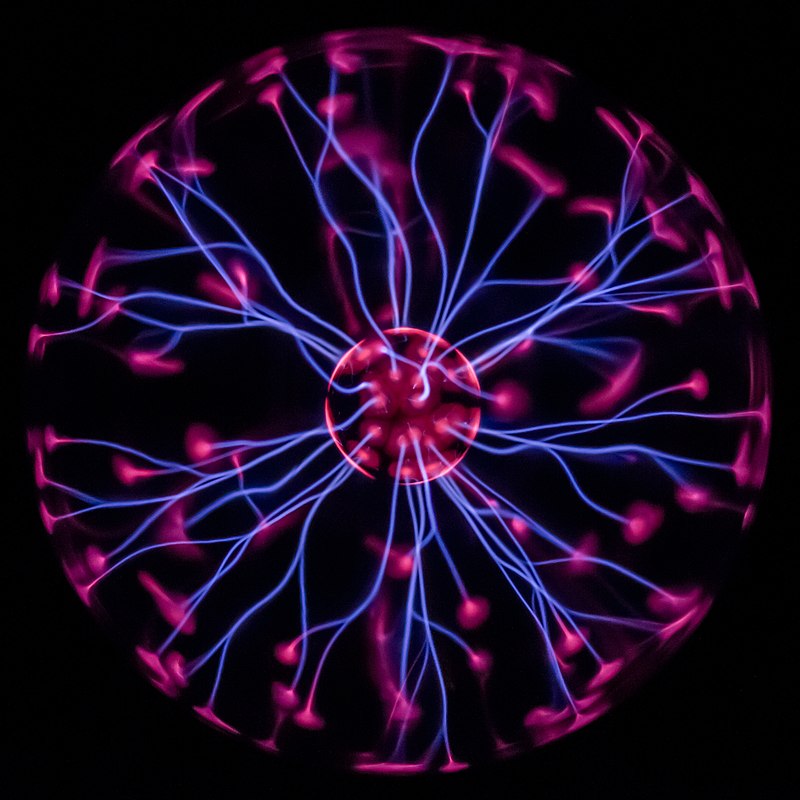
File:Plasma_globe_60th.jpg · Wikimedia Commons · See Wikimedia Commons
electromagnetism
Sign in to saveAlso known as electromagnetic, study of electromagnetism, physics of electromagnetism, electromagnetic physics
thumb|300x300px|Electromagnetic interactions are responsible for the glowing filaments in this plasma globe.
Electromagnetism is the science of how electricity and magnetism work together as a unified force. It matters because electromagnetic interactions power many everyday technologies and natural phenomena, from the glowing lights in a plasma globe to the devices we use daily.
AI-generated from the Wikipedia summary — may contain errors.
Wikidata facts
- Instance of
- branch of physics
- Subclass of
- physical phenomenon
- Part of
- physics
- Image
- Ferrofluid poles.jpg
Show 7 more facts
- different from
- electromagnetic interaction
- topic has template
- Template:Electromagnetism
- Commons category
- Electromagnetism
- topic's main category
- Category:Electromagnetism
- described by source
- Encyclopædia Britannica 11th edition
- Stack Exchange tag
- physics.stackexchange.com/tags/electromagnetism
- history of topic
- timeline of electromagnetism and classical optics
Sources (3)
via Wikidata · CC0
~18 min read
Encyclopedic overview
15 sectionsContents
- History
- Ancient world
- 19th century
- A fundamental force
- Classical electrodynamics
- Extension to nonlinear phenomena
- Quantities and units
- Applications
- See also
- References
- Further reading
- Web sources
- Textbooks
- General coverage
- External links
thumb|300x300px|Electromagnetic interactions are responsible for the glowing filaments in this plasma globe.
In physics, electromagnetism is an interaction that occurs between particles with electric charge via electromagnetic fields. The electromagnetic force is one of the four fundamental forces of nature. It is the dominant force in the interactions of atoms and molecules. Electromagnetism can be thought of as a combination of electrostatics and magnetism, which are distinct but closely intertwined phenomena. Electromagnetic forces occur between any two charged particles. Electric forces cause an attraction between particles with opposite charges and repulsion between particles with the same charge, while magnetism is an interaction that occurs between charged particles in relative motion. These two forces are described in terms of electromagnetic fields. Macroscopic charged objects are described in terms of Coulomb's law for electricity and Ampère's force law for magnetism; the Lorentz force describes microscopic charged particles.
Excerpted from Wikipedia’s “electromagnetism” article, available under the CC BY-SA 4.0 licence.
Gallery (10)
Available in 108 languages
- Español
- Français
- Deutsch
- 中文
- 日本語
- Русский
- Português
- العربية
- हिन्दी
- Afrikaans
- Albanian
- Angika
- Aragonese
- Armenian
- Assamese
- Asturian
- azb
- Bahasa Indonesia
Show 89 more
- Bangla
- Basque
- Betawi
- Bhojpuri
- Bosnian
- Bulgarian
- Buriat
- Burmese
- Catalan
- Central Kurdish
- Croatian
- Czech
- Danish
- Egyptian Arabic
- Esperanto
- Estonian
- Fiji Hindi
- Filipino
- Finnish
- Galician
- gcr
- Georgian
- Gorontalo
- Haitian Creole
- Hebrew
- Hungarian
- Icelandic
- Ido
- Igbo
- Interlingua
- Irish
- Jamaican Creole English
- Kannada
- Kara-Kalpak
- Khmer
- Kyrgyz
- Latin
- Latvian
- Limburgish
- Luxembourgish
- Macedonian
- Malay
- Malayalam
- Marathi
- Mingrelian
- Mongolian
- Nederlands
- Newari
- Norwegian
- Norwegian Nynorsk
- Occitan
- Odia
- Oromo
- Polski
- Punjabi
- Quechua
- Romanian
- Rusyn
- Serbian
- Serbian (Latin)
- Sicilian
- simple
- Sindhi
- Sinhala
- Slovak
- Slovenian
- Sundanese
- Svenska
- Tachelhit
- Tamil
- Tatar
- Tibetan
- Tiếng Việt
- Türkçe
- Ukrainian
- Urdu
- Uzbek
- Waray
- Welsh
- Western Frisian
- Western Panjabi
- Wolof
- Wu Chinese
- zh_min_nan
- zh_yue
- Zulu
- فارسی
- ไทย
- 한국어
via Wikidata sitelinks · CC0