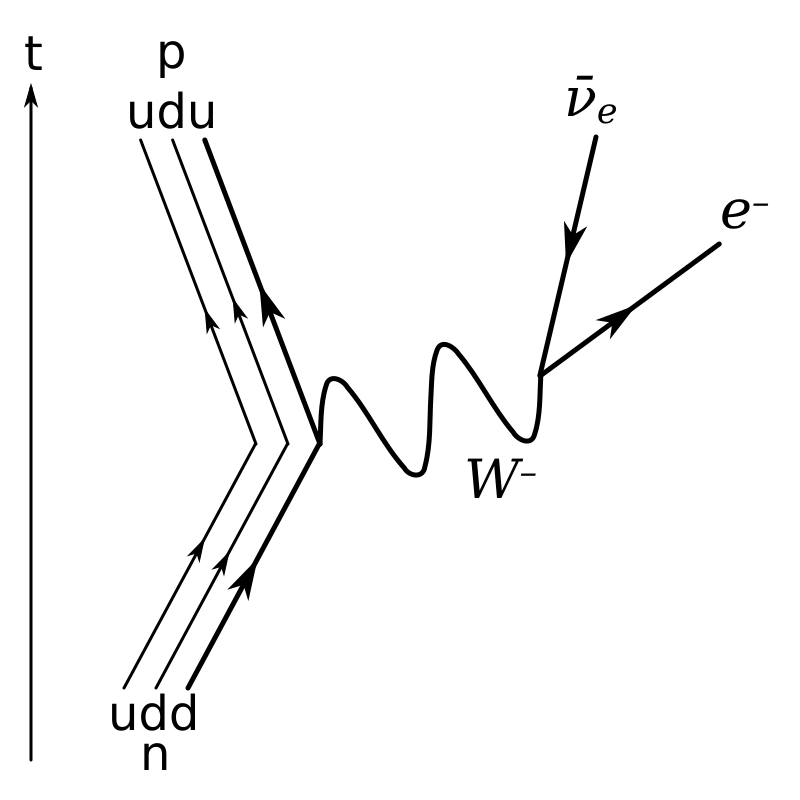
File:Beta_Negative_Decay.svg · Wikimedia Commons · See Wikimedia Commons
lepton
Sign in to saveIn particle physics, a lepton is an elementary particle of half-integer spin (spin ) that does not undergo strong interactions. Two main classes of leptons exist: charged leptons (also known as the electron-like leptons or muons), including the electron, muon, and tauon, and neutral leptons, better known as neutrinos. Charged leptons can combine with other particles to form various composite particles such as atoms and positronium, while neutrinos rarely interact with anything, and are consequently rarely observed. The best known of all leptons is the electron.
A lepton is a tiny fundamental particle that doesn't experience the strong force holding atomic nuclei together; the most familiar example is the electron, which helps form atoms, while other leptons like neutrinos barely interact with anything and are nearly impossible to detect. Leptons matter because they're building blocks of ordinary matter and help physicists understand the basic structure of the universe.
AI-generated from the Wikipedia summary — may contain errors.
Key facts
- Particle.name
- Lepton
- Particle.image
- 200px
- Particle.caption
- Leptons are involved in several processes such as beta decay.
- Particle.num_types
- 6 (electron, electron neutrino, muon, muon neutrino, tau, tau neutrino)
- Particle.composition
- Elementary particle
- Particle.statistics
- Fermionic
- Particle.generation
- 1st, 2nd, 3rd
- Particle.interaction
- Electromagnetism, gravitation, weak
- Particle.antiparticle
- Antilepton ()
- Particle.baryon_number
- 0
- Particle.electric_charge
- +1 e, 0 e, −1 e
- Particle.color_charge
- No
- Particle.spin
- ħ
via Wikipedia infobox
Wikidata facts
- Subclass of
- fermion
- Image
- Lepton-interaction-vertex-pvW.svg
Show 9 more facts
- different from
- Lepton
- antiparticle
- antilepton
- has superpartner
- slepton
- interaction
- gravity
- Commons category
- Leptons
- topic's main category
- Category:Leptons
- has characteristic
- baryon number
- spin quantum number
- 0.5
- on focus list of Wikimedia project
- Wikipedia:Vital articles/Level/4
Sources (6)
via Wikidata · CC0
~22 min read
Encyclopedic overview
15 sectionsContents
- Etymology
- History
- Properties
- Spin and chirality
- Electromagnetic interaction
- Weak interaction
- Mass
- Lepton flavor quantum numbers
- Universality
- Table of leptons
- See also
- Notes
- References
- Bibliography
- External links
In particle physics, a lepton is an elementary particle of half-integer spin (spin ) that does not undergo strong interactions. Two main classes of leptons exist: charged leptons (also known as the electron-like leptons or muons), including the electron, muon, and tauon, and neutral leptons, better known as neutrinos. Charged leptons can combine with other particles to form various composite particles such as atoms and positronium, while neutrinos rarely interact with anything, and are consequently rarely observed. The best known of all leptons is the electron.
There are six types of leptons, known as flavours, grouped in three generations. The first-generation leptons, also called electronic leptons, comprise the electron () and the electron neutrino (); the second are the muonic leptons, comprising the muon () and the muon neutrino (); and the third are the tauonic leptons, comprising the tau () and the tau neutrino (). Electrons have the least mass of all the charged leptons. The heavier muons and taus will rapidly change into electrons and neutrinos through a process of particle decay: the transformation from a higher mass state to a lower mass state. Thus electrons are stable and the most common charged lepton in the universe, whereas muons and taus can only be produced in high-energy collisions (such as those involving cosmic rays and those carried out in particle accelerators).
Excerpted from Wikipedia’s “lepton” article, available under the CC BY-SA 4.0 licence.
Gallery (24)
Available in 83 languages
- Español
- Français
- Deutsch
- 中文
- 日本語
- Русский
- Português
- Italiano
- العربية
- हिन्दी
- Afrikaans
- Armenian
- Asturian
- azb
- Azerbaijani
- Bahasa Indonesia
- Basque
- Belarusian
Show 64 more
- Bosnian
- Bulgarian
- Burmese
- Catalan
- Croatian
- Czech
- Danish
- Esperanto
- Estonian
- Filipino
- Finnish
- Galician
- Georgian
- Greek
- Hebrew
- Hungarian
- Icelandic
- Ido
- Interlingua
- Irish
- Kannada
- Kara-Kalpak
- Kazakh
- Kyrgyz
- Latin
- Latvian
- Limburgish
- Lithuanian
- Low German
- Luxembourgish
- Malay
- Malayalam
- Mongolian
- Moroccan Arabic
- Nederlands
- Norwegian
- Norwegian Nynorsk
- Occitan
- Polski
- Punjabi
- rki
- Romanian
- Serbian
- Serbian (Latin)
- simple
- Slovak
- Slovenian
- Svenska
- Tamil
- Tatar
- Tiếng Việt
- Türkçe
- Ukrainian
- Urdu
- Uzbek
- Waray
- Welsh
- Western Panjabi
- Wolof
- Wu Chinese
- zh_yue
- فارسی
- ไทย
- 한국어
via Wikidata sitelinks · CC0