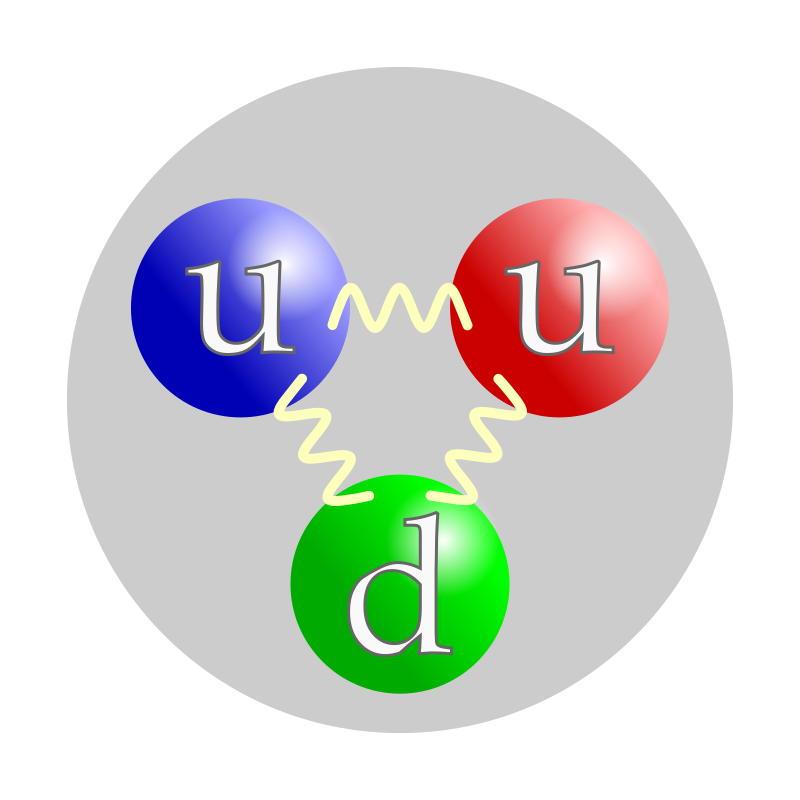
File:Quark_structure_proton.svg · Wikimedia Commons · See Wikimedia Commons
subatomic particle
Sign in to saveAlso known as particle (subatomic), sub-atomic particle, subatomic quantum particle, atomic constituent, particle of subatomic scale
particle smaller than an atom
A subatomic particle is a tiny piece of matter that is smaller than an atom and makes up the building blocks of everything around us. Understanding these particles helps scientists explain how atoms work and how the universe behaves at the most fundamental level.
AI-generated from the Wikipedia summary — may contain errors.
Wikidata facts
- Part of
- atom
- Image
- Atom.svg
Show 6 more facts
- Commons category
- Subatomic particles
- topic's main category
- Category:Subatomic particles
- interaction
- gravity
- studied by
- particle physics
- on focus list of Wikimedia project
- Wikipedia:Vital articles/Level/4
- topic has template
- Template:Subatomic particle
via Wikidata · CC0
~14 min read
Encyclopedic overview
A composite particle proton is made of two up quarks and one down quark, which are elementary particles.
In physics, a subatomic particle is a particle smaller than an atom. According to the Standard Model of particle physics, a subatomic particle can be a composite particle or an elementary particle. A composite particle, such as a proton or a neutron, is composed of other particles while an elementary particle, such as an electron, is not composed of other particles. Particle physics and nuclear physics study these particles and how they interact. Most force-carrying particles such as photons or gluons are called bosons and, although they have quanta of energy, do not have rest mass or discrete diameters (other than pure energy wavelength) and are unlike the former particles that have rest mass and cannot overlap or combine, which are called fermions. The W and Z bosons, however, are an exception to this rule and have relatively large rest masses at approximately 80 GeV/c and 90 GeV/c respectively.
Excerpted from Wikipedia’s “subatomic particle” article, available under the CC BY-SA 4.0 licence.
Gallery (3)
Available in 89 languages
- Español
- Français
- Deutsch
- 中文
- 日本語
- Русский
- Português
- Italiano
- العربية
- हिन्दी
- Afrikaans
- Armenian
- Asturian
- azb
- Azerbaijani
- Bahasa Indonesia
- Bangla
- Basque
Show 70 more
- Belarusian
- Bhojpuri
- blk
- Bosnian
- Bulgarian
- Burmese
- Catalan
- cdo
- Central Kurdish
- Croatian
- Czech
- Danish
- Esperanto
- Estonian
- Finnish
- fiu_vro
- Galician
- gcr
- Georgian
- Greek
- Haitian Creole
- Hebrew
- Hungarian
- Ido
- Interlingua
- Irish
- Jamaican Creole English
- Kannada
- Kurdish
- Latin
- Latvian
- Limburgish
- Lithuanian
- Macedonian
- Malay
- Malayalam
- Manx
- Mongolian
- Moroccan Arabic
- Nederlands
- Norwegian
- Norwegian Nynorsk
- Novial
- Oromo
- Polski
- Punjabi
- Romanian
- Serbian
- Serbian (Latin)
- simple
- Sinhala
- Slovak
- Slovenian
- Sundanese
- Svenska
- Swahili
- Tamil
- Tiếng Việt
- Türkçe
- Ukrainian
- Urdu
- Uzbek
- Welsh
- Wu Chinese
- Xhosa
- zh_yue
- Zulu
- فارسی
- ไทย
- 한국어
via Wikidata sitelinks · CC0