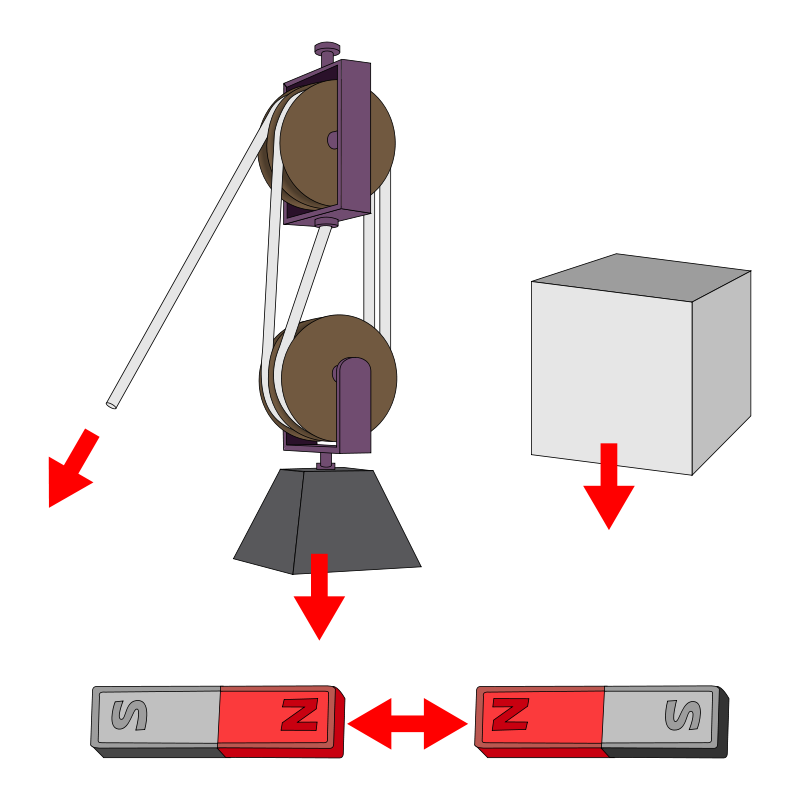
File:Force_examples.svg · Wikimedia Commons · See Wikimedia Commons
force
Sign in to saveAlso known as mass times acceleration
In physics, a force is an action that can cause an object to change its velocity or its shape, or to resist other forces, or to cause changes of pressure in a fluid. In mechanics, force makes ideas like 'pushing' or 'pulling' mathematically precise. Because the magnitude and direction of a force are both important, force is a vector quantity (force vector). The SI unit of force is the newton (N), and force is often represented by the symbol .
A force is a push or pull that can change how fast or in what direction an object is moving, change its shape, or affect fluids and other forces. Because both how strong a force is and which direction it points matter, scientists use vectors to represent forces mathematically, measuring them in units called newtons.
AI-generated from the Wikipedia summary — may contain errors.
Key facts
- Physical quantity.name
- Force
- Physical quantity.image
- 200px
- Physical quantity.caption
- Forces can be described as a push or pull on an object. They can be due to phenomena such as gravity, magnetism, or anything that might cause a mass to accelerate.
- Physical quantity.unit
- newton (N)
- Physical quantity.otherunits
- dyne, pound-force, poundal, kip, kilopond
- Physical quantity.symbols
- \vec F, ,
- Physical quantity.baseunits
- kg·m·s−2
- Physical quantity.dimension
- wikidata
via Wikipedia infobox
Wikidata facts
- Subclass of
- physical quantity
- Part of
- interaction
- Image
- Force examples.svg
- Said to be same as
- strength
Show 10 more facts
- Commons category
- Forces (physics)
- topic's main category
- Category:Force
- described by source
- Granat Encyclopedic Dictionary
- on focus list of Wikimedia project
- Wikipedia:Vital articles/Level/4
- quantity symbol (string)
- F
- has cause
- fundamental interaction
- Stack Exchange tag
- physics.stackexchange.com/tags/forces
- has characteristic
- point
- has effect
- interaction
- maintained by WikiProject
- WikiProject Mathematics
Sources (3)
via Wikidata · CC0
~59 min read
Encyclopedic overview
40 sectionsContents
- Development of the concept
- Pre-Newtonian concepts
- Newtonian mechanics
- First law
- Second law
- Third law
- Defining "force"
- Combining forces
- Equilibrium
- Static <span class="anchor" id="Static equilibrium"></span>
- Dynamic <span class="anchor" id="Dynamical equilibrium"></span><span class="anchor" id="Dynamic equilibrium"></span>
- Examples of forces in classical mechanics <span class="anchor" id="Non-fundamental forces"></span>
- Gravitational force or Gravity
- Electromagnetic
- Normal
- Friction
- Tension
- Spring
- Centripetal
- Continuum mechanics
- Fictitious
- Concepts derived from force
- Rotation and torque
- Yank
- Kinematic integrals
- Potential energy
- Conservation
- Units
- Revisions of the force concept
- Special theory of relativity
- Quantum mechanics
- Quantum field theory
- Fundamental interactions
- Gravitational
- Electromagnetic
- Strong nuclear
- Weak nuclear
- See also
- References
- External links
In physics, a force is an action that can cause an object to change its velocity or its shape, or to resist other forces, or to cause changes of pressure in a fluid. In mechanics, force makes ideas like 'pushing' or 'pulling' mathematically precise. Because the magnitude and direction of a force are both important, force is a vector quantity (force vector). The SI unit of force is the newton (N), and force is often represented by the symbol .
Force plays an important role in classical mechanics. The concept of force is central to all three of Newton's laws of motion. Types of forces often encountered in classical mechanics include elastic, frictional, contact or "normal" forces, and gravitational. The rotational version of force is torque, which produces changes in the rotational speed of an object. In an extended body, each part applies forces on the adjacent parts; the distribution of such forces through the body is the internal mechanical stress. In the case of multiple forces, if the net force on an extended body is zero the body is in equilibrium.
Excerpted from Wikipedia’s “force” article, available under the CC BY-SA 4.0 licence.
Gallery (38)
Available in 157 languages
- Español
- Français
- Deutsch
- 中文
- 日本語
- Русский
- Português
- Italiano
- العربية
- हिन्दी
- Afrikaans
- Albanian
- Albanian
- Amharic
- Aragonese
- Armenian
- Assamese
- Asturian
Show 138 more
- azb
- Azerbaijani
- Bahasa Indonesia
- Bangla
- Bashkir
- Basque
- bat_smg
- Bavarian
- be_x_old
- Belarusian
- Bhojpuri
- Bikol
- blk
- Bosnian
- Bulgarian
- Buriat
- Burmese
- Catalan
- Cebuano
- Central Kurdish
- Chuvash
- Croatian
- Czech
- Danish
- Egyptian Arabic
- Esperanto
- Estonian
- Extremaduran
- Fiji Hindi
- Filipino
- Finnish
- Galician
- Gan Chinese
- Ganda
- gcr
- Georgian
- Greek
- Guarani
- Gujarati
- Haitian Creole
- Hakka Chinese
- Hebrew
- Hungarian
- hyw
- Icelandic
- Ido
- Inari Sami
- Interlingua
- Interlingue
- Irish
- Jamaican Creole English
- Javanese
- Kabyle
- Kannada
- Kara-Kalpak
- Kashmiri
- Kazakh
- kbp
- Khmer
- Kurdish
- Latin
- Latvian
- Limburgish
- Lingua Franca Nova
- Lithuanian
- Lombard
- Low German
- Macedonian
- Malagasy
- Malay
- Malayalam
- Manx
- Marathi
- Mazanderani
- Moksha
- Mongolian
- Nederlands
- Nepali
- Newari
- Northern Frisian
- Norwegian
- Norwegian Nynorsk
- Occitan
- Odia
- Oromo
- Piedmontese
- Polski
- Punjabi
- Quechua
- rki
- Romanian
- Rusyn
- Sanskrit
- Sardinian
- Scots
- Serbian
- Serbian (Latin)
- Shona
- Sicilian
- simple
- Sindhi
- Sinhala
- Slovak
- Slovenian
- Somali
- Sundanese
- Svenska
- Swahili
- Tajik
- Tamil
- Tatar
- Telugu
- Tiếng Việt
- Toki Pona
- Türkçe
- Turkmen
- Tuvinian
- Ukrainian
- Urdu
- Uzbek
- Venetian
- Veps
- Waray
- Welsh
- Western Frisian
- Western Panjabi
- Wu Chinese
- Xhosa
- Yakut
- Yiddish
- Yoruba
- zh_classical
- zh_min_nan
- zh_yue
- Zulu
- فارسی
- ไทย
- 한국어
via Wikidata sitelinks · CC0