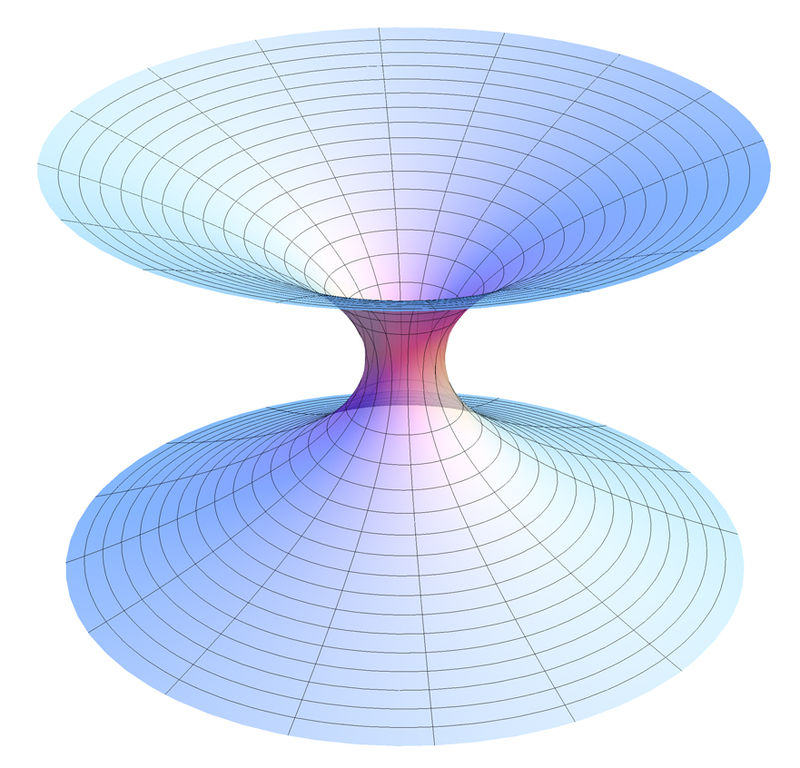
File:LorentzianWormhole.jpg · Wikimedia Commons · See Wikimedia Commons
theoretical physics
Sign in to savebranch of physics concerned with formulating theory rather than performing experiments
Theoretical physics is the branch of physics focused on developing mathematical theories and ideas to explain how the universe works, rather than conducting experiments to test them directly. It matters because these theories provide the framework that helps scientists understand fundamental phenomena and predict how nature behaves.
AI-generated from the Wikipedia summary — may contain errors.
Wikidata facts
- Image
- École de Physique des Houches (Les Houches Physics School) main lecture hall 1972.jpg
Show 2 more facts
- Commons category
- Theoretical physics
- Stack Exchange tag
- hsm.stackexchange.com/tags/theoretical-physics
Sources (3)
via Wikidata · CC0
~19 min read
Article
Visual representation of a Schwarzschild wormhole. Wormholes have never been observed, but they are predicted by mathematical models in general relativity.
Theoretical physics is a branch of physics that uses mathematical models and abstractions of physical objects and systems to explain and predict natural phenomena. It is, in the broadest sense, the attempt to say why things happen the way they do, not merely to record that they do. This is in contrast to experimental physics, which tests and refines those explanations through direct measurement and observation. In practice, the two feed each other constantly: a theoretical prediction suggests an experiment, and an unexpected experimental result sends theorists back to the drawing board.
Gallery (7)
Available in 82 languages
- Español
- Français
- Deutsch
- 中文
- 日本語
- Русский
- Português
- Italiano
- العربية
- हिन्दी
- Afrikaans
- Albanian
- Armenian
- Asturian
- Azerbaijani
- Bahasa Indonesia
- Bangla
- Basque
Show 63 more
- be_x_old
- Belarusian
- Bhojpuri
- Bosnian
- Breton
- Bulgarian
- Catalan
- Central Kurdish
- Chuvash
- Croatian
- Czech
- Danish
- Esperanto
- Estonian
- Filipino
- Finnish
- Galician
- Greek
- Hebrew
- Hungarian
- Ido
- Interlingua
- Kazakh
- Kurdish
- Latin
- Latvian
- Lithuanian
- Macedonian
- Malay
- map_bms
- Mingrelian
- mnw
- Mongolian
- Nederlands
- Norwegian
- Norwegian Nynorsk
- Pashto
- Polski
- Punjabi
- Romanian
- Scots
- Serbian
- Serbian (Latin)
- Slovak
- Slovenian
- Sundanese
- Svenska
- Tamil
- Tatar
- Telugu
- Tiếng Việt
- Türkçe
- Ukrainian
- Urdu
- Waray
- Western Frisian
- Western Panjabi
- Wu Chinese
- Zaza
- zh_yue
- فارسی
- ไทย
- 한국어
via Wikidata sitelinks · CC0