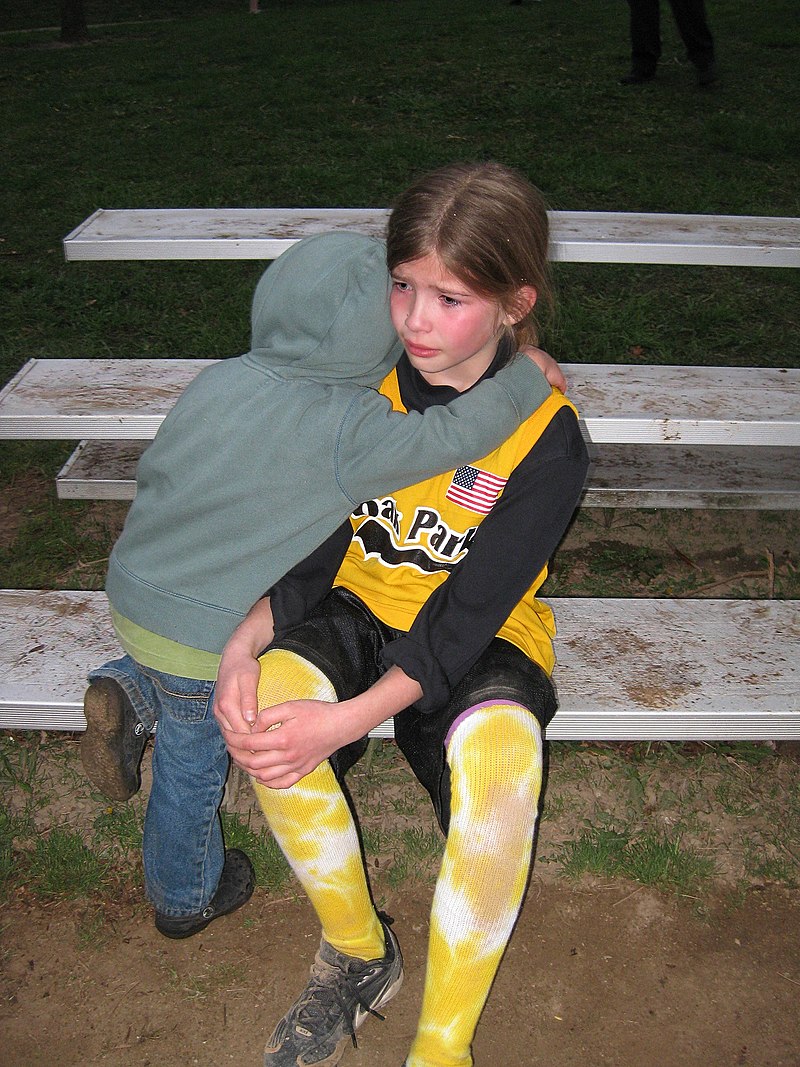
File:There's_no_crying_in_baseball!_(4549295140)_2.jpg · Wikimedia Commons · See Wikimedia Commons
empathy
Sign in to saveAlso known as empathic
alt=A small child hugs an older, injured child|thumb|Hugging is a common display of empathy
OverviewAI-generated
Empathy is a subject documented across various digital platforms and academic databases. It has a dedicated category on the Wikimedia Commons site and is tagged within the psychology section of Stack Exchange. The term appears in a specific article titled "Empaths: 7 signs you might be an empath, and what that means," which is described at a URL on the Stylist website.
In academic research, the query for empathy yields a count of 41,309 results on PubMed. The subject is referenced by 1,787 other encyclopedia articles. A source property identified as P973 is associated with the subject, and a related text contains 7,886 characters.
Synthesized by Vinony from 10 facts across 4 sources: Wikidata, Firecrawl, PubMed, Vinony graph. Generated from structured data (not the Wikipedia text) and checked against those facts — may still contain errors.
Research
41,309 papers- Empathy.Psychotherapy (Chicago, Ill.) · 2011Elliott R, Bohart AC, Watson JC et al.DOI: 10.1037/a0022187
- Empathy is not in our genes.ReviewNeuroscience and biobehavioral reviews · 2018Heyes CDOI: 10.1016/j.neubiorev.2018.11.001
- Compassion Fatigue: Understanding Empathy.ReviewThe Veterinary clinics of North America. Small animal practice · 2021Harrison KDOI: 10.1016/j.cvsm.2021.04.020
- Empathy in Medicine: What It Is, and How Much We Really Need It.ReviewThe American journal of medicine · 2020Decety JDOI: 10.1016/j.amjmed.2019.12.012
- The complex relation between morality and empathy.Trends in cognitive sciences · 2014Decety J, Cowell JMDOI: 10.1016/j.tics.2014.04.008
- Empathy in Nursing Students: A Scoping Review.Journal of holistic nursing : official journal of the American Holistic Nurses' Association · 2024Juniarta, Eka NGA, Ferawati Sitanggang YDOI: 10.1177/08980101231163966
- Development and validation of the Basic Empathy Scale.Journal of adolescence · 2006Jolliffe D, Farrington DPDOI: 10.1016/j.adolescence.2005.08.010
- Empathy, sympathy, and emotion regulation: A meta-analytic review.Psychological bulletin · 2024Yavuz HM, Colasante T, Galarneau E et al.DOI: 10.1037/bul0000426
via PubMed
Described at

Empaths: 7 signs you might be an empath, and what that means
Do you find it hard to switch off from the emotions of those around you, and often adopt them as if they’re your own? You could be an empath.
stylist.co.uk →Most people experience varying degrees of empathy – aka, the ability to share and understand the emotions of the people around you – but for empaths, this skill is on a whole other level. Not only are they highly attuned to the emotions and energy of the people around them, but they also have a tendency to absorb other people’s feelings – something which can lead to feelings of overwhelm and burnout if not properly managed. However, while empaths are often described by those around them as ‘sensitive’, an empath is not the same as a highly sensitive person (HSP) . Because being affected by other people’s emotions is just one of the many signs of a highly sensitive person, it’s believed that most empaths are HSPs, but not all HSPs are empaths. So, how can you tell whether you’re an empath? On top of feeling particularly in tune with other people’s emotions, here are seven key signs that you might be an empath. One of the key traits often associated with empaths is a strong sense of intuition or ‘knowing’. For example, they might know not to trust someone before they show their true colours, or feel confident diving into a situation because they just ‘know’ they can trust the people involved. This is usually because empaths are able to read others pretty well. Because empaths are able to connect with the emotions of others no matter how well they know them, being in a crowded place with lots of people (and therefore emotions) can feel particularly overwhelming. People often come to empaths with their problems because they know they’ll be able to listen and understand what they’re going through. However, this can become a problem if empaths constantly find themselves being bombarded by other people’s experiences – especially if they struggle not to ‘adopt’ other people’s emotions as their own. Empaths often struggle with conflict because the emotions involved are so intense, and can often leave them feeling overwhelmed and riddled with guilt. As such, they tend to avoid it at all costs – and can struggle to get what they want out of a resolution if forced to engage. Because empaths tend to find being around lots of people overwhelming, spending time in nature away from the emotions of others can provide a much-needed break and chance to relax. An empath’s ability to tune into the subtle emotional cues of those around them often makes them brilliant lie detectors. This can be a gift and a curse – while being able to know who not to trust is helpful, knowing that someone they love or admire is lying to them can bring about additional stress .
Excerpt from a page describing this subject · 7,886 chars · not written by Vinony
Wikidata facts
- Instance of
- philosophical concept
- Subclass of
- social skill
- Image
- There's no crying in baseball! (4549295140) 2.jpg
Show 6 more facts
- facet of
- aesthetics
- Commons category
- Empathy
- different from
- compassion
- described at URL
- www.stylist.co.uk/health/mental-health/empath-signs/637158?utm_source=pocket-newtab-global-en-GB
- topic's main category
- Category:Empathy
- Stack Exchange tag
- psychology.stackexchange.com/tags/empathy
Sources (7)
via Wikidata · CC0
~69 min read
Encyclopedic overview
47 sectionsContents
- Definitions
- Distinctions between empathy and related concepts
- Classification <span class="anchor" id="Affective and cognitive"></span>
- Empathic anger
- Empathic distress
- Measurement
- Self-report measures
- Development
- Ontogenetic development
- Individual differences
- Sex differences
- Environmental influences
- Biological basis
- Genetics
- Neuroscientific basis of empathy
- Evolution across species
- Evolution of cooperation
- Impairment
- Autism and controversy
- Psychopathy
- Other conditions
- Effects
- Benefits of empathizing
- Empathy and power
- Empathy and violence
- Influence on helping behavior
- Conflict Resolution
- Selective empathy
- Gullibility
- Manipulative use
- Compassion fatigue
- Empathic accuracy
- Therapeutic interventions
- Disciplinary approaches
- Philosophy
- Ethics
- Phenomenology
- History
- Psychotherapy
- Business and management
- In educational contexts
- In intercultural contexts
- In fiction
- See also
- References
- Further reading
- External links
alt=A small child hugs an older, injured child|thumb|Hugging is a common display of empathy
Empathy is generally described as the ability to perceive another person's perspective, to understand, feel, and possibly share and respond to their experience. However, there are other (sometimes conflicting) definitions of empathy that include but are not limited to social, cognitive, and emotional processes primarily concerned with understanding others. Empathy is often considered to be a broad term, and can be divided into more specific concepts and categories, such as cognitive empathy, emotional (or affective) empathy, somatic empathy, and spiritual empathy.
Excerpted from Wikipedia’s “empathy” article, available under the CC BY-SA 4.0 licence.
Gallery (6)
Available in 69 languages
- Español
- Français
- Deutsch
- 中文
- 日本語
- Русский
- Português
- Italiano
- العربية
- हिन्दी
- Albanian
- Armenian
- Asturian
- Azerbaijani
- Bahasa Indonesia
- Balinese
- Bangla
- Bashkir
Show 50 more
- Basque
- Belarusian
- Bosnian
- Bulgarian
- Catalan
- Croatian
- Czech
- Danish
- Esperanto
- Estonian
- Finnish
- Galician
- Georgian
- Greek
- Hebrew
- Hungarian
- Kannada
- Kara-Kalpak
- Kazakh
- Kurdish
- Latin
- Latvian
- Lithuanian
- Macedonian
- Malay
- Malayalam
- Nederlands
- Norwegian
- Norwegian Nynorsk
- Occitan
- Polski
- Romanian
- Scots
- Serbian
- Serbian (Latin)
- simple
- Slovak
- Slovenian
- Sundanese
- Svenska
- Tiếng Việt
- Türkçe
- Turkmen
- Ukrainian
- Wu Chinese
- zh_min_nan
- zh_yue
- فارسی
- ไทย
- 한국어
via Wikidata sitelinks · CC0