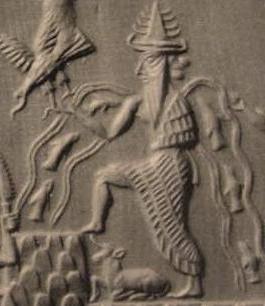
File:Enki(Ea).jpg · Wikimedia Commons · See Wikimedia Commons
Enki
Sign in to saveAlso known as En‐ki
Enki (Sumerian: dEN-KI), also known as Ea (Akkadian: dE₂-A), was the Mesopotamian god of wisdom, crafts, fresh subterranean waters, magic, and incantations. He was believed to rule the Abzû. In Mesopotamian astronomy, he was associated with the stars of the southern band of the sky. Enki's wife was Damgalnuna, and their children included Nanshe, Asalluhi, Marduk and Enbilulu. His sukkal (attendant deity) was Isimud. Servants of the god included lahmu, kulullû, and the Seven Sages.
Enki was an important god in ancient Mesopotamian religion, credited with wisdom, crafts, magic, and control over fresh water underground. He mattered to Mesopotamian peoples because they believed he governed essential knowledge and natural resources, and they associated him with specific stars and celestial regions.
AI-generated from the Wikipedia summary — may contain errors.
Key facts
- Deity.type
- Mesopotamian
- Deity.name
- Enki
- Deity.image
- Enki(Ea).jpg
- Deity.caption
- Detail of Enki from the Adda Seal, an ancient Akkadian cylinder seal dating to circa 2,300 BCE
- Deity.deity_of
- God of subterranean fresh waters, wisdom, crafts, magic and incantations
- Deity.symbol
- ram-headed staff, goat-fish, turtle, ibex
- Deity.children
- several, including Nanshe, Asalluhi, Marduk and Enbilulu
- Deity.equivalent1
- Kothar-wa-Khasis
- Deity.equivalent1_type
- Ugaritic
- Deity.equivalent3
- Eyan
- Deity.equivalent4
- Napirisha
- Deity.equivalent2_type
- Egyptian
- Deity.equivalent3_type
- Hurrian
- Deity.equivalent4_type
- Elamite
- Deity.abode
- Abzu
- Deity.other_names
- Ea, Nudimmud, Nagbu, Niššīku
- Deity.cult_center
- Eridu, Malgium, Babylon
- Deity.number
- 40
via Wikipedia infobox
Wikidata facts
- Instance of
- water deity
- Part of
- Inanna and Enki
- Gender
- male
- Spouse
- Ninhursag
- Child
- Gibil
- Sibling
- Enlil
- Religion
- Ancient Mesopotamian religion
- Image
- Copia de Enki.jpg
- Said to be same as
- Ogmios
Show 4 more facts
- Commons category
- Enki
- worshipped by
- Mesopotamian mythology
- described by source
- Encyclopædia Britannica 11th edition
- domain of saint or deity
- Eridu
Sources (2)
via Wikidata · CC0
~97 min read
Encyclopedic overview
58 sectionsContents
- Names
- Enki
- Ea
- Alternative names and epithets
- Nudimmud
- Nagbu
- Niššīku
- DIŠ
- Other names and epithets
- Character and attributes
- Symbols and iconography
- Relations with other deities
- Parents
- Siblings
- Consort
- Children
- Court
- Enki/Ea and foreign deities
- Worship
- Third millennium BCE
- Second millennium BCE
- First millennium BCE
- Anatolian reception
- Mythology
- Creation myths
- Enki and the world order
- Enki and Ninhursag
- Enki and Ninmah
- Enūma Eliš
- Disputation between the bird and the fish
- The First Brick
- Story of the flood
- Atra-ḫasīs
- The Eridu Genesis
- ''Epic of Gilgamesh''
- The Babyloniaca
- Inanna myths
- Inanna and Enki
- Inanna's descent into the Underworld
- The Agushaya hymn
- Inanna and Shukaletuda
- Miscellaneous myths
- Enki's journey to Nippur
- Enmerkar and the Lord of Aratta
- Myth of Anzû
- Ninurta and the turtle
- Nergal and Ereshkigal
- Adapa and the South Wind
- Gilgamesh, Enkidu and the Netherworld
- The Death of Gilgamesh
- Others
- Hurrian myths
- See also
- References
- Notes
- Citations
- Bibliography
- External links
Enki (Sumerian: dEN-KI), also known as Ea (Akkadian: dE₂-A), was the Mesopotamian god of wisdom, crafts, fresh subterranean waters, magic, and incantations. He was believed to rule the Abzû. In Mesopotamian astronomy, he was associated with the stars of the southern band of the sky. Enki's wife was Damgalnuna, and their children included Nanshe, Asalluhi, Marduk and Enbilulu. His sukkal (attendant deity) was Isimud. Servants of the god included lahmu, kulullû, and the Seven Sages.
Enki was first worshipped in Sumer. The earliest sources associate him with the city of Eridu, which was his main cult center, and regarded as his home. His temple there was the E-Abzû. He was already a major deity at the time of the earliest written sources, and the influence of his cult spread outside of Southern Mesopotamia early on. It is uncertain when Enki was fully assimilated to Ea, a god whose name is of unknown, but possibly semitic origin. They were already syncretized with each other in parts of Babylonia in the second half of the third millennium BCE.
Excerpted from Wikipedia’s “Enki” article, available under the CC BY-SA 4.0 licence.