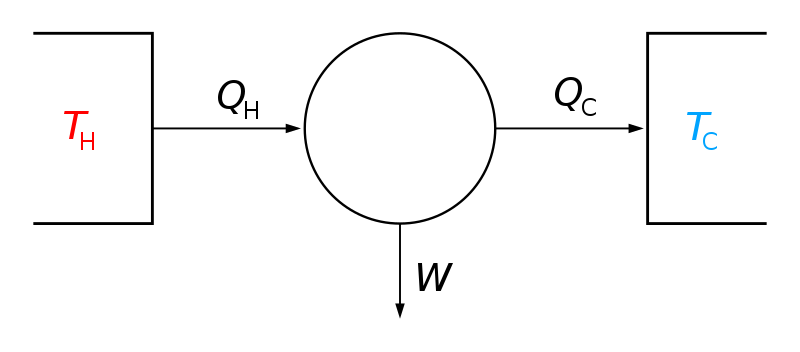
File:Carnot_heat_engine_2.svg · Wikimedia Commons · See Wikimedia Commons
enthalpy
Sign in to saveEnthalpy () is the sum of a thermodynamic system's internal energy and the product of its pressure and volume. It is a state function in thermodynamics used in many measurements in chemical, biological, and physical systems at a constant external pressure, which is conveniently provided by Earth's ambient atmosphere. The pressure–volume term expresses the work W that was done against constant external pressure P_\text{ext} to establish the system's physical dimensions from V_\text{system, initial}=0 to some final volume V_\text{system, final} (as W=P_\text{ext}\Delta V), i.e. to make room for
Enthalpy is a measurement that combines a system's internal energy with the energy needed to make room for it at a given pressure and volume. Scientists use enthalpy to track energy changes in chemical, biological, and physical systems, especially when they occur at the constant atmospheric pressure of Earth's surface.
AI-generated from the Wikipedia summary — may contain errors.
Key facts
- Physical quantity.name
- Enthalpy
- Physical quantity.unit
- joule
- Physical quantity.symbols
- H
- Physical quantity.baseunits
- kg⋅m2⋅s−2
via Wikipedia infobox
Wikidata facts
- Subclass of
- energy
Show 7 more facts
- topic's main category
- Category:Enthalpy
- Commons category
- Enthalpy
- different from
- entropy
- studied by
- thermodynamics
- maintained by WikiProject
- WikiProject Mathematics
- invariant under
- isenthalpic process
- on focus list of Wikimedia project
- Wikipedia:Vital articles/Level/4
via Wikidata · CC0
~29 min read
Encyclopedic overview
24 sectionsContents
- Definition
- Other expressions
- Characteristic functions and natural state variables
- Physical interpretation
- Relationship to heat
- Applications
- Heat of reaction
- Specific enthalpy
- Enthalpy changes
- Chemical properties
- Physical properties
- Open systems
- Diagrams
- Some basic applications
- Throttling
- Example 1
- Example 2
- Compressors
- History and etymology
- Notes
- See also
- References
- Bibliography
- External links
Enthalpy () is the sum of a thermodynamic system's internal energy and the product of its pressure and volume. It is a state function in thermodynamics used in many measurements in chemical, biological, and physical systems at a constant external pressure, which is conveniently provided by Earth's ambient atmosphere. The pressure–volume term expresses the work W that was done against constant external pressure P_\text{ext} to establish the system's physical dimensions from V_\text{system, initial}=0 to some final volume V_\text{system, final} (as W=P_\text{ext}\Delta V), i.e. to make room for it by displacing its surroundings. The pressure-volume term is very small for solids and liquids at common conditions, and fairly small for gases. Therefore, enthalpy is a stand-in for energy in chemical systems; bond, lattice, solvation, and other chemical "energies" are actually enthalpy differences. As a state function, enthalpy depends only on the final configuration of internal energy, pressure, and volume, not on the path taken to achieve it.
In the International System of Units (SI), the unit of measurement for enthalpy is the joule. Other historical conventional units still in use include the calorie and the British thermal unit (BTU).
Excerpted from Wikipedia’s “enthalpy” article, available under the CC BY-SA 4.0 licence.
Gallery (13)
Available in 71 languages
- Español
- Français
- Deutsch
- 中文
- 日本語
- Русский
- Português
- Italiano
- العربية
- हिन्दी
- Afrikaans
- Armenian
- Asturian
- Azerbaijani
- Bahasa Indonesia
- Bangla
- Basque
- be_x_old
Show 52 more
- Belarusian
- Bikol
- Bosnian
- Bulgarian
- Burmese
- Catalan
- Central Kurdish
- Croatian
- Czech
- Danish
- Esperanto
- Estonian
- Finnish
- Galician
- Greek
- Haitian Creole
- Hebrew
- Hungarian
- Irish
- Kazakh
- Latvian
- Lithuanian
- Macedonian
- Malay
- Malayalam
- Mongolian
- Nederlands
- Norwegian
- Norwegian Nynorsk
- Polski
- rki
- Romanian
- Santali
- Serbian
- Serbian (Latin)
- simple
- Slovak
- Slovenian
- Svenska
- Tamil
- Tiếng Việt
- Türkçe
- Ukrainian
- Uzbek
- Venetian
- Wu Chinese
- zh_classical
- zh_min_nan
- zh_yue
- فارسی
- ไทย
- 한국어
via Wikidata sitelinks · CC0