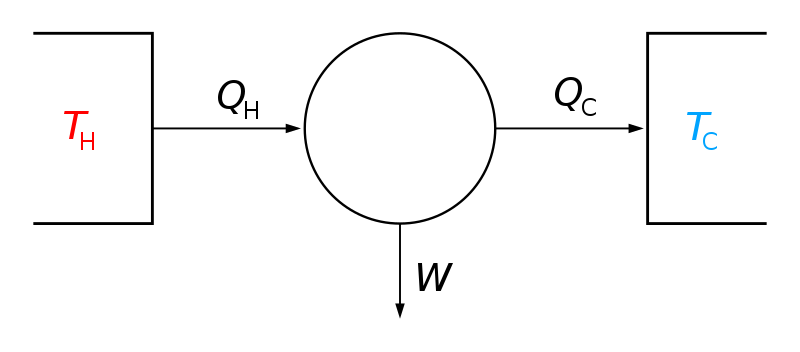
File:Carnot_heat_engine_2.svg · Wikimedia Commons · See Wikimedia Commons
entropy
Sign in to saveAlso known as thermodynamic entropy
Entropy is a scientific concept, most commonly associated with states of disorder, randomness, or uncertainty. The term and the concept are used in diverse fields, from classical thermodynamics, where it was first recognized, to the microscopic description of nature in statistical physics, and to the principles of information theory. It has found far-ranging applications in chemistry and physics, in biological systems and their relation to life, in cosmology, economics, and information systems including the transmission of information in telecommunication.
Entropy is a measure of disorder, randomness, or uncertainty that appears throughout nature and science, from the behavior of heat and molecules to the organization of information. It matters because understanding entropy helps explain fundamental processes in physics, chemistry, biology, economics, and technology—essentially how systems change and evolve across virtually all scientific disciplines.
AI-generated from the Wikipedia summary — may contain errors.
Key facts
- Physical quantity.name
- Entropy
- Physical quantity.unit
- joules per kelvin (J⋅K−1)
- Physical quantity.symbols
- S
- Physical quantity.baseunits
- kg⋅m2⋅s−2⋅K−1
via Wikipedia infobox
Research
71,730 papers- Entropy for the Complexity of Physiological Signal Dynamics.ReviewAdvances in experimental medicine and biology · 2017Zhang XDDOI: 10.1007/978-981-10-6041-0_3
- Enthalpy-entropy compensation: the role of solvation.ReviewEuropean biophysics journal : EBJ · 2017Dragan AI, Read CM, Crane-Robinson CDOI: 10.1007/s00249-016-1182-6
- Entropy and Human Aging.Aging cell · 2025Cummings SR, Hong N, Cohen AADOI: 10.1111/acel.70292
- Portable Models for Entropy Effects on Kinetic Selectivity.ReviewJournal of the American Chemical Society · 2022Tantillo DJDOI: 10.1021/jacs.2c04683
- The Molecular Origin of Enthalpy/Entropy Compensation in Biomolecular Recognition.ReviewAnnual review of biophysics · 2018Fox JM, Zhao M, Fink MJ et al.DOI: 10.1146/annurev-biophys-070816-033743
- Entropy and Enzyme Catalysis.Accounts of chemical research · 2017Åqvist J, Kazemi M, Isaksen GV et al.DOI: 10.1021/acs.accounts.6b00321
- RETRACTED: Entropy-based financial asset pricing: Evidence from Pakistan.PloS one · 2022Wang S, Khan SA, Munir M et al.DOI: 10.1371/journal.pone.0278236
- Entropy-based reliable non-invasive detection of coronary microvascular dysfunction using machine learning algorithm.Mathematical biosciences and engineering : MBE · 2023Zhao X, Gong Y, Xu L et al.DOI: 10.3934/mbe.2023582
via PubMed
Wikidata facts
Show 10 more facts
- Commons category
- Entropy
- topic's main category
- Category:Entropy
- opposite of
- negentropy
- studied by
- thermodynamics
- different from
- enthalpy
- Stack Exchange tag
- quantumcomputing.stackexchange.com/tags/entropy
- on focus list of Wikimedia project
- Wikipedia:Vital articles/Level/4
- maintained by WikiProject
- WikiProject Mathematics
- invariant under
- isentropic process
- has effect
- data loss
via Wikidata · CC0
~60 min read
Encyclopedic overview
39 sectionsContents
- History
- Etymology
- Definitions and descriptions
- State variables and functions of state
- Reversible process
- Carnot cycle
- Classical thermodynamics
- Statistical mechanics
- Entropy of a system
- Equivalence of definitions
- Second law of thermodynamics
- Applications
- The fundamental thermodynamic relation
- Entropy in chemical thermodynamics
- World's technological capacity to store and communicate entropic information
- Entropy balance equation for open systems
- Entropy change formulas for simple processes
- Isothermal expansion or compression of an ideal gas
- Cooling and heating
- Phase transitions
- Approaches to understanding entropy
- Standard textbook definitions
- Order and disorder
- Energy dispersal
- Relating entropy to energy ''usefulness''
- Entropy and adiabatic accessibility
- Entropy in quantum mechanics
- Information theory
- Measurement
- Interdisciplinary applications
- Philosophy and theoretical physics
- Biology
- Cosmology
- Economics
- See also
- Notes
- References
- Further reading
- External links
Entropy is a scientific concept, most commonly associated with states of disorder, randomness, or uncertainty. The term and the concept are used in diverse fields, from classical thermodynamics, where it was first recognized, to the microscopic description of nature in statistical physics, and to the principles of information theory. It has found far-ranging applications in chemistry and physics, in biological systems and their relation to life, in cosmology, economics, and information systems including the transmission of information in telecommunication.
Entropy is central to the second law of thermodynamics, which states that the entropy of an isolated system left to spontaneous evolution cannot decrease with time. As a result, isolated systems evolve toward thermodynamic equilibrium, where the entropy is highest. "High" entropy means that energy is more disordered or dispersed, while "low" entropy means that energy is more ordered or concentrated. A consequence of the second law of thermodynamics is that certain processes are irreversible.
Excerpted from Wikipedia’s “entropy” article, available under the CC BY-SA 4.0 licence.
Gallery (19)
Available in 91 languages
- Español
- Français
- Deutsch
- 中文
- 日本語
- Русский
- Português
- Italiano
- العربية
- हिन्दी
- Afrikaans
- Albanian
- Amharic
- Armenian
- Asturian
- Azerbaijani
- Bahasa Indonesia
- Bangla
Show 72 more
- Basque
- Bavarian
- be_x_old
- Belarusian
- Bikol
- Bosnian
- Breton
- Bulgarian
- Burmese
- Catalan
- Central Kurdish
- Chuvash
- Croatian
- Czech
- Danish
- Esperanto
- Estonian
- Finnish
- Galician
- Georgian
- Gorontalo
- Greek
- Haitian Creole
- Hebrew
- Hungarian
- Interlingua
- Irish
- Kannada
- Kazakh
- Kurdish
- Kyrgyz
- Latin
- Latvian
- Lithuanian
- Lombard
- Macedonian
- Malayalam
- Manx
- Mongolian
- Moroccan Arabic
- Nederlands
- Norwegian
- Norwegian Nynorsk
- Occitan
- Oromo
- Pashto
- Polski
- Punjabi
- Romanian
- Sardinian
- Serbian
- Serbian (Latin)
- Sicilian
- simple
- Slovak
- Slovenian
- Svenska
- Tamil
- Telugu
- Tiếng Việt
- Türkçe
- Ukrainian
- Urdu
- Uzbek
- Wu Chinese
- Yiddish
- zh_classical
- zh_min_nan
- zh_yue
- فارسی
- ไทย
- 한국어
via Wikidata sitelinks · CC0