File:Holbein-erasmus.jpg · Wikimedia Commons · See Wikimedia Commons
Erasmus
Sign in to saveAlso known as Erasmus of Rotterdam, Desiderius Erasmus, Desiderius Erasmus Roterodamus, Erasmus Von Rotterdam Erasmus, Desiderius Erasmus of Rotterdam, Erasmus von Rotterdam, Erasmus Rotterdam
Desiderius Erasmus Roterodamus ( ; ; 28 October c. 1466 – 12 July 1536), commonly known in English as Erasmus of Rotterdam or simply Erasmus, was a Dutch humanist, Christian theologian, and pioneering philologist and educationalist. He was, through his writings and translations, one of the most influential scholars of the Northern Renaissance and a major figure of Western culture.
OverviewAI-generated
Desiderius Erasmus Roterodamus was a translator, philosopher, theologian, and essayist born in Rotterdam in 1466 or 1469. He worked in Rotterdam and Basel and was educated at the University of Paris, Queens' College, the University of Cambridge, and the University of Turin. Erasmus held the academic degree of Doctor of Divinity and was employed by the Old University of Leuven. He was a citizen of the Seventeen Provinces and wrote in Latin, Dutch, Greek, and Biblical Hebrew.
His notable works include *In Praise of Folly*, *A handbook on manners for children*, *Adagia*, and *Familiar Colloquies*. His field of work encompassed Christian philosophy and Renaissance humanism, and he was influenced by Epicureanism, Cicero, and Giovanni Pico della Mirandola. Erasmus studied under Alexander Hegius von Heek, Jan Standonck, John Colet, and George Hermonymus. He died of dysentery in Basel on July 12, 1536, and is buried at Basel Minster.
Synthesized by Vinony from 33 facts across 4 sources: Wikidata, TMDb, VIAF, Europeana Sparql. Generated from structured data (not the Wikipedia text) and checked against those facts — may still contain errors.
Authority record · VIAF
- Lifespan
- 1469–1536
- Nationality
- NL, CH, NLD, XX
- Role / Field
- Theologians, Humanists, Authors, Priests, Philosophers, Teologia
- Language
- lat, nld, dut
- Gender
- Male
Recorded by 48 libraries
via VIAF · OCLC
Key facts
- Scholar.honorific_prefix
- The Reverend Father, later Doctor ('), Imperial Councillor (')
- Scholar.name
- Desiderius Erasmus
- Scholar.era
- Northern Renaissance
- Scholar.image
- Holbein-erasmus.jpg
- Scholar.caption
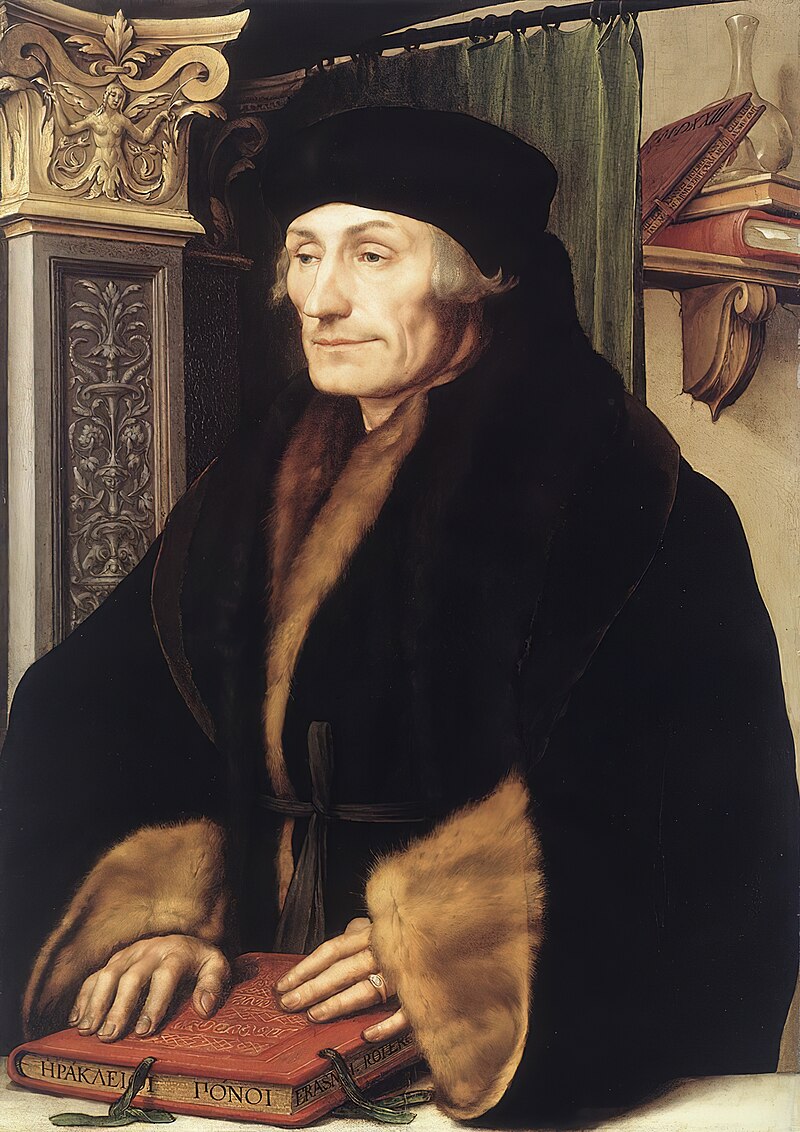
- Erasmus, in a 1523 portrait by Hans Holbein the Younger
- Scholar.other_names
- Desiderius Erasmus Roterodamus
- Scholar.birth_place
- Rotterdam or Gouda, Burgundian Netherlands, Holy Roman Empire
- Scholar.known_for
- New Testament translations and exegesis, satire, pacificism, letters, author and editor
- Scholar.death_place
- Basel, Old Swiss Confederacy
- Scholar.main_interests
- Bonae litterae Philology Pastoral theology Patristics Catholic theology Political philosophy Philosophy of education Criticism of Protestantism
- Scholar.notable_works
- The Praise of Folly Handbook of a Christian Knight On Civility in Children Julius Excluded The Education of a Christian Prince Novum Instrumentum omne On Free Will
- Scholar.notable_ideas
- Philosophia Christi Biblical ad fontes Erasmian pronunciation Critique of just war theory accommodation Lectio difficilior potior
- Scholar.influences
- Gospels Jerome Origen Lorenzo Valla John Colet Jean Vitrier John Fisher Aldus Manutius Cicero Socrates Augustine of Hippo Thomas Aquinas
- Scholar.influenced
- Thomas More Martin Luther Philip Melanchthon Huldrych Zwingli Johannes Oecolampadius William Tyndale John Calvin Wolfgang Capito Damião de Góis François Rabelais Miguel de Cervantes William Shakespeare Ignatius of Loyola Francis De Sales John Henry Newman Henri de Lubac
- Scholar.awards
- Counsellor to Charles V. (hon.)
- Clergy.child
- yes
- Clergy.religion
- Christianity
- Clergy.church
- Catholic Church
via Wikipedia infobox
Wikidata facts
- Instance of
- human
- Gender
- male
- Citizenship
- Seventeen Provinces
- Place of birth
- Rotterdam
- Place of death
- Basel
- Occupation
- pedagogue
- Educated at
- College of Sorbonne
- Employer
- Old University of Leuven
- Languages spoken
- Biblical Hebrew
- Religion
- Catholic Church
- Academic degree
- Doctor of Divinity
- Doctoral advisor
- Alexander Hegius von Heek
- Student of
- George Hermonymus
- Doctoral student
- Jacob Milich
- Field of work
- renaissance humanism
- Movement
- Renaissance philosophy
- Image
- Holbein-erasmus.jpg
- Work location
- Basel
- Residence
- Erasmus House
- Religious order
- Canons Regular of Saint Augustine
Show 17 more facts
- topic's main category
- Category:Desiderius Erasmus
- place of burial
- Basel Minster
- Commons category
- Desiderius Erasmus
- date of birth
- 1469-10-28
- date of death
- 1536-07-12
- cause of death
- dysentery
- name in native language
- Desiderius Erasmus Roterodamus
- manner of death
- natural causes
- Commons Creator page
- Desiderius Erasmus
- influenced by
- Giovanni Pico della Mirandola
- has works in the collection
- National Gallery of Art
- writing language
- Latin
- on focus list of Wikimedia project
- Wikipedia:Vital articles/Level/4
- time period
- Renaissance
- significant person
- Jakob Wimpfeling
- P12749
- Bovernier
- P13311
- Ludorf
Sources (10)
via Wikidata · CC0
Works in European collections
36 objects attributed to Erasmus, held across European museums, libraries & archives · via Europeana
Adagiorum opus Des. Erasmi Roterodami per eundem exquisitiore quam antehac unquam cura recognitu ..
De copia verborum et rerum libri duo
Untitled
Untitled
Untitled
Untitled
Untitled
Untitled
Untitled
Untitled
Untitled
Untitled
Untitled
Untitled
Untitled
Untitled
Untitled
Untitled
Untitled
Untitled
Untitled
Untitled
Untitled
Untitled
Untitled
Untitled
Untitled
Untitled
Untitled
Untitled
Untitled
Untitled
Untitled
Untitled
Untitled
Untitled
~113 min read
Encyclopedic overview
74 sectionsContents
- Works
- New Testament editions
- Notable writings
- Life and career
- Early life
- Vows, ordination and canonry experience
- Disengagement
- Travels
- Paris
- First visit to England (1499–1500)
- France and Brabant
- Second visit to England (1505–1506)
- Italy
- Third visit to England (1510–1515)
- Flanders and Brabant
- Basel (1521–1529)
- Freiburg (1529–1535)
- Fates of friends
- Death in Basel
- Thought and views
- Manner of thinking
- Manner of expression
- Irony
- Copiousness
- Pacifism
- War
- Intra-Christian religious toleration<span class="anchor" id="Religious toleration"></span>
- Heresy and sedition
- Outsiders
- Turks
- Jews
- Slaves
- Politics
- Religious reform
- Personal Reform
- Proper attitude to sacraments
- Catholic reform
- Institutional reforms
- Anti-fraternalism
- Protestant reform
- Increasing disagreement with Luther
- Dispute on free will
- "False evangelicals"
- Other
- Philosophy
- Classical
- Anti-scholasticism
- {{lang|la|Philosophia Christi}}
- Theology
- Accommodation
- Inverbation
- Scopus christi
- Mystical theology
- Theological writings
- Legacy and evaluations
- Personal
- Health
- Clothing
- Signet ring and personal motto
- {{anchor|Representations}}Visual representations
- In literature and media
- Name used
- Exhumation
- Notes
- References
- Further reading
- Biographies
- Topics
- Non-English
- Primary sources
- External links
- Non-English
- Media
- Video
Desiderius Erasmus Roterodamus ( ; ; 28 October c. 1466 – 12 July 1536), commonly known in English as Erasmus of Rotterdam or simply Erasmus, was a Dutch humanist, Christian theologian, and pioneering philologist and educationalist. He was, through his writings and translations, one of the most influential scholars of the Northern Renaissance and a major figure of Western culture.
Erasmus was an important figure in Renaissance classical scholarship who wrote in a spontaneous, copious and correct but natural Latin style. As a Catholic priest developing humanist techniques for working on texts, he prepared pioneering new Latin and Greek scholarly editions of the New Testament and of the Church Fathers, with annotations and commentary that were immediately and vitally influential in both the Protestant Reformation and the Catholic Reformation. He also wrote On Free Will, The Praise of Folly, The Complaint of Peace, Handbook of a Christian Knight, On Civility in Children, Copia: Foundations of the Abundant Style and many other academic, popular and pedagogical works.
Excerpted from Wikipedia’s “Erasmus” article, available under the CC BY-SA 4.0 licence.
Gallery (52)
Available in 103 languages
- Español
- Français
- Deutsch
- 中文
- 日本語
- Русский
- Português
- Italiano
- العربية
- हिन्दी
- Afrikaans
- Albanian
- Albanian
- Aragonese
- Armenian
- Asturian
- Aymara
- Azerbaijani
Show 84 more
- Bahasa Indonesia
- Basque
- be_x_old
- Belarusian
- Bislama
- Bosnian
- Bulgarian
- Burmese
- Catalan
- Central Kurdish
- Corsican
- Croatian
- Czech
- Danish
- Egyptian Arabic
- Esperanto
- Estonian
- Filipino
- Finnish
- Galician
- Georgian
- Greek
- Hebrew
- Hungarian
- Icelandic
- Ido
- Interlingua
- Irish
- Kazakh
- Kurdish
- Kyrgyz
- Latin
- Latvian
- Limburgish
- Lingua Franca Nova
- Lithuanian
- Luxembourgish
- Macedonian
- Malagasy
- Malay
- Malayalam
- Nederlands
- Northern Frisian
- Norwegian
- Norwegian Nynorsk
- nrm
- Occitan
- Pashto
- Pennsylvania German
- Picard
- Piedmontese
- Polski
- Quechua
- Romanian
- Sardinian
- Saterland Frisian
- Scots
- Scottish Gaelic
- Serbian
- Serbian (Latin)
- Sicilian
- simple
- Slovak
- Slovenian
- Somali
- Svenska
- Swahili
- szy
- Tamil
- Tiếng Việt
- Türkçe
- Ukrainian
- Urdu
- Uzbek
- Waray
- Welsh
- Western Frisian
- Wu Chinese
- Zaza
- Zeelandic
- zh_yue
- فارسی
- ไทย
- 한국어
via Wikidata sitelinks · CC0