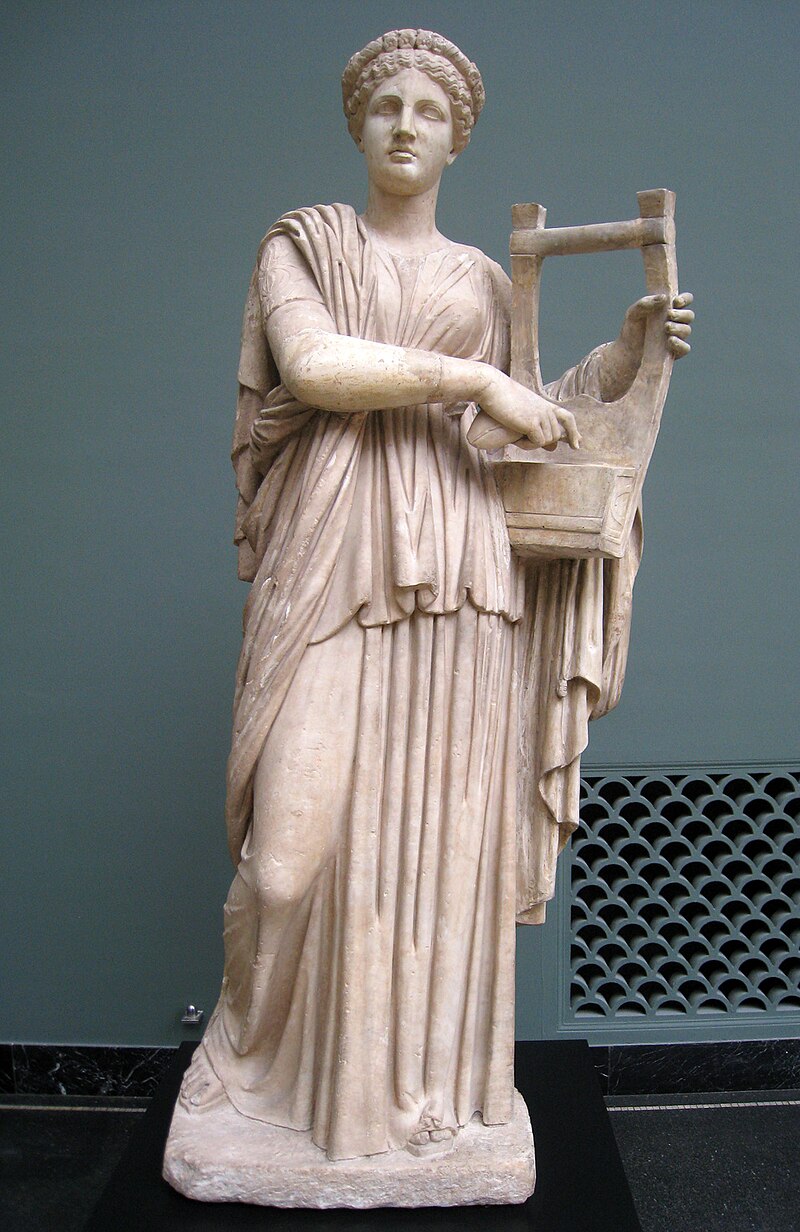
File:Erato_monte_calvo.jpg · Wikimedia Commons · See Wikimedia Commons
Erato
Sign in to savethumb|right|Erato on an antique fresco from Pompeii In Greek mythology, Erato (; ) is one of the Muses, associated with erotic lyric poetry. The name would mean "desired" or "lovely", if derived from the same root as Eros, as Apollonius of Rhodes playfully suggested in the invocation to Erato that begins Book III of his Argonautica.
Erato is one of the nine Muses in Greek mythology, traditionally associated with erotic lyric poetry. Her name likely derives from the same root as "Eros" and means "desired" or "lovely," reflecting her connection to romantic and sensual themes in ancient literature.
AI-generated from the Wikipedia summary — may contain errors.
Key facts
- Deity.type
- Greek
- Deity.name
- Erato
- Deity.image
- Erato monte calvo.jpg
- Deity.caption
- Roman statue of Erato (2nd century AD), playing the kithara or lyre
- Deity.god_of
- Goddess of erotic and lyrical poetry
- Deity.symbols
- Lyre, kithara
- Deity.member_of
- the Muses
- Deity.abode
- Mount Olympus
- Deity.parents
- Zeus and Mnemosyne
- Deity.siblings
- Euterpe, Polyhymnia, Urania, Clio, Calliope, Thalia, Terpsichore, Melpomene and several paternal half-siblings
- Deity.consort
- Malus (Μάλος)
- Deity.children
- Cleophema
via Wikipedia infobox
Wikidata facts
- Part of
- Muse
- Gender
- female
- Father
- Zeus
- Mother
- Mnemosyne
- Sibling
- Thalia
- Field of work
- lyric poetry
- Image
- Erató Kroměříž.jpg
Show 4 more facts
- Commons category
- Erato
- name in native language
- Ερατώ
- worshipped by
- Ancient Greek religion
- different from
- Erato
Sources (3)
via Wikidata · CC0
~5 min read
Encyclopedic overview
8 sectionsContents
- Function
- Family
- Development
- See also
- Notes
- References
- Further reading
- External links
thumb|right|Erato on an antique fresco from Pompeii In Greek mythology, Erato (; ) is one of the Muses, associated with erotic lyric poetry. The name would mean "desired" or "lovely", if derived from the same root as Eros, as Apollonius of Rhodes playfully suggested in the invocation to Erato that begins Book III of his Argonautica.
== Function == Erato is the Muse of lyric poetry, particularly erotic poetry, and mimic imitation. In the Orphic hymn to the Muses, it is Erato who charms the sight. Since the Renaissance she has mostly been shown with a wreath of myrtle and roses, holding a lyre, or a small kithara, a musical instrument often associated with Apollo. In Simon Vouet's representations, two turtle-doves are eating seeds at her feet. She is sometimes depicted holding a golden arrow, symbolizing "eros", the feeling she inspires in everybody; at times she is accompanied by Eros, holding a torch.
Excerpted from Wikipedia’s “Erato” article, available under the CC BY-SA 4.0 licence.