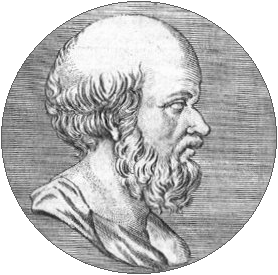
File:Portrait_of_Eratosthenes.png · Wikimedia Commons · See Wikimedia Commons
Eratosthenes
Sign in to saveAlso known as Eratosthenes of Cyrene, Eρατοσθένης
Eratosthenes of Cyrene ( ; ; – ) was an Ancient Greek polymath: a philosopher, scholar, mathematician, geographer, poet, astronomer, and music theorist. Eratosthenes eventually became the chief librarian at the Library of Alexandria. His work was the precursor to the modern discipline of geography, and he introduced some of its terminology, coining the terms geography and geographer.
OverviewAI-generated
Eratosthenes (Ἐρατοσθένης) was a male mathematician, astronomer, poet, and librarian of the Hellenistic period. Born in Cyrene around 276 BCE, he spoke and wrote in Ancient Greek. He studied under Ariston of Chios, Zeno of Citium, Arcesilaus, and Callimachus. His fields of work included geometry, number theory, and geography. He was employed by the Library of Alexandria and taught Ptolemy IV Philopator.
His notable work is the sieve of Eratosthenes. He died in Alexandria around 194 BCE. His name in his native language is Ἐρατοσθένης ὁ Κυρηναῖος. He is described in sources such as the Brockhaus and Efron Encyclopedic Dictionary and the Encyclopædia Britannica 11th edition. Other works attributed to him include Eratosthenis Geographicorum fragmenta and Eratosthenis Catasterismi.
Synthesized by Vinony from 26 facts across 4 sources: Wikidata, Open Library, Last.fm, Europeana Sparql. Generated from structured data (not the Wikipedia text) and checked against those facts — may still contain errors.
In the Vinony graph
Vinony's link graph records 698 inbound references to Eratosthenes, and connects out to arithmetic, Library of Alexandria and Elements.
It is catalogued under topics including 190s BC deaths, 270s BC births and 276 BC births.
Vinony links it to 102 Wikipedia language editions.
Person · Open Library
- Born
- c. 276 BC
- Died
- c. 194 BC
- Works
- 21
Top works
- Eratosthenis Geographicorum fragmenta
- Eratosthenes Batavus De terræ ambitus vera quantitate
- Eratosthenis Catasterismi
- Mythographi graeci ...
- Mythographi graeci
via Open Library + Wikidata
Listeners · Last.fm
- Listeners
- 14
- Total plays
- 251
Tags
Similar artists
<a href="https://www.last.fm/music/Eratosthenes">Read more on Last.fm</a>
Key facts
- Person.name
- Eratosthenes
- Person.image
- Portrait of Eratosthenes.png
- Person.image_upright
- 0.9
- Person.caption
- Eratosthenes
- Person.birth_date
- 276 BC
- Person.birth_place
- Cyrene (in modern Libya)
- Person.death_date
- 194 BC (around age 82)
- Person.death_place
- Alexandria
via Wikipedia infobox
Wikidata facts
- Instance of
- human
- Gender
- male
- Place of birth
- Apollonia
- Place of death
- Alexandria
- Occupation
- philosopher
- Employer
- Library of Alexandria
- Languages spoken
- Ancient Greek
- Field of work
- geography
- Image
- Eratosthenes.jpg
Show 13 more facts
- Commons category
- Eratosthenes
- date of birth
- 0276-00-00
- date of death
- 0196-00-00
- student
- Ptolemy IV Philopator
- described by source
- Pauly–Wissowa
- time period
- Hellenistic period
- name in native language
- Ἐρατοσθένης ὁ Κυρηναῖος
- writing language
- Ancient Greek
- Commons Creator page
- Eratosthenes
- on focus list of Wikimedia project
- Wikipedia:Vital articles/Level/4
- maintained by WikiProject
- WikiProject Mathematics
- birth name
- Ἐρατοσθένης
- significant place
- Cyrene
Sources (3)
via Wikidata · CC0
Works in European collections
10 objects attributed to Eratosthenes, held across European museums, libraries & archives · via Europeana

Eratosthenis Geographicorvm Fragmenta

Eratosthenis Geographicorvm Fragmenta

Eratosthenis Catasterismi :Cum Interpretatione Latina Et Commentario

Eratosthenis Carminvm Reliqviae

Eratosthenis Catasterismi : cum interpretatione Latina et commentario

Vranologion Sive Systema Variorvm Avthorvm, Qvi De Sphæra, Ac Sideribvs, Eorvmqve Motibvs Graecè commentati sunt. Sunt autem horum libri. Gemini, Achillis Tatij Isagoge ad Arati Phænomena. Hipparchi libri tres, ad Aratum. Ptolemæi de apparentiis. Theodori Gazæ de Mensibus. Maximi Isaaci Argyri duplex, S. Andreæ Cretensis Computi. Omnia vel Graecè ac Latinè nunc primùm edita, vel antè non edita. Cura & studio Dionysii Petavii Aurelianensis è Societate Iesv. ... Accesserunt Variarum dissertationum libri octo, ad authores illos intelligendos imprimis vtiles, eodem authore

Aratou Soleos Phainomena ... Et Germanici Caesaris Phaenomena. Les Phénomenes, D' Aratus De Soles, Et De Germanicus Cèsar ... Avec Les Scholies De Théon, Les Catastérismes D'Ératosthène Et La Sphére De Leontius, ... Traduits ... Par M. L'Abbé Halma
Untitled

Untitled
Untitled
~31 min read
Encyclopedic overview
17 sectionsContents
- Life
- Contributions
- Astronomy
- Measurement of Earth's circumference{{anchor|Earth's circumference|Arc measurement}}
- Sun measurements
- Obliquity of the ecliptic
- Geography
- Mathematics, music theory and metaphysics
- Works
- Athenian period
- Alexandrian period
- Additional works
- See also
- Notes
- References
- Further reading
- External links
Eratosthenes of Cyrene ( ; ; – ) was an Ancient Greek polymath: a philosopher, scholar, mathematician, geographer, poet, astronomer, and music theorist. Eratosthenes eventually became the chief librarian at the Library of Alexandria. His work was the precursor to the modern discipline of geography, and he introduced some of its terminology, coining the terms geography and geographer.
He is best remembered as the first known person to calculate the Earth's circumference. He was also the first to calculate Earth's axial tilt, which similarly proved to have remarkable accuracy. He created the first global projection of the world incorporating parallels and meridians based on the geographic knowledge of his era. Eratosthenes was the founder of scientific chronology; he used Egyptian and Persian records to estimate the dates of the main events of the Trojan War, dating the sack of Troy to 1184 BC. In number theory, he introduced the sieve of Eratosthenes, an efficient method of identifying prime numbers and composite numbers.
Excerpted from Wikipedia’s “Eratosthenes” article, available under the CC BY-SA 4.0 licence.
Gallery (16)
Available in 102 languages
- Español
- Français
- Deutsch
- 中文
- 日本語
- Русский
- Português
- Italiano
- العربية
- हिन्दी
- Afrikaans
- Albanian
- Albanian
- Armenian
- Asturian
- Awadhi
- Azerbaijani
- Bahasa Indonesia
Show 83 more
- Bangla
- Basque
- Belarusian
- Bhojpuri
- Bosnian
- Breton
- Bulgarian
- Burmese
- Catalan
- Central Kurdish
- Croatian
- Czech
- Danish
- Divehi
- Egyptian Arabic
- Esperanto
- Estonian
- Filipino
- Finnish
- fiu_vro
- Galician
- Georgian
- Greek
- Hebrew
- Hungarian
- Icelandic
- Ido
- Irish
- Kannada
- Kazakh
- Khmer
- Kyrgyz
- Latin
- Latvian
- Ligurian
- Lithuanian
- Macedonian
- Malagasy
- Malay
- Malayalam
- Marathi
- Mazanderani
- Mingrelian
- Nederlands
- Norwegian
- Norwegian Nynorsk
- Occitan
- Pampanga
- Piedmontese
- Polski
- Romanian
- rsk
- Rusyn
- Scots
- Serbian
- Serbian (Latin)
- Sicilian
- simple
- Sindhi
- Sinhala
- Slovak
- Slovenian
- Svenska
- Swahili
- Talysh
- Tamil
- Tatar
- Telugu
- Tibetan
- Tiếng Việt
- Türkçe
- Ukrainian
- Urdu
- Uzbek
- Waray
- Welsh
- West Flemish
- Western Panjabi
- Wu Chinese
- zh_yue
- فارسی
- ไทย
- 한국어
via Wikidata sitelinks · CC0